
Donatello, born in Florence, most likely in …
Years: 1413 - 1413
Donatello, born in Florence, most likely in the year 1386, as the son of Niccolò di Betto Bardi, a member of the Florentine Wool Combers Guild, and had been educated in the house of the Martelli family.
He had apparently received his early artistic training in a goldsmith's workshop, then worked briefly in the studio of Lorenzo Ghiberti.
While undertaking study and excavations with Filippo Brunelleschi in Rome (1404–1407), work that had gained the two men the reputation of treasure seekers, Donatello had made a living by working at goldsmiths' shops.
Their Roman sojourn will prove decisive for the entire development of Italian art in the fifteenth century, for it was during this period that Brunelleschi had undertaken his measurements of the Pantheon dome and of other Roman buildings.
Brunelleschi's buildings and Donatello's sculptures are both considered supreme expressions of the spirit of this era in architecture and sculpture, and they will exercise a potent influence upon the artists of the age.
In Florence, Donatello had assisted Ghiberti with the statues of prophets for the north door of the Florence Baptistery, for which he had received payment in November 1406 and early 1408.
He had in 1409–1411, executed the colossal seated figure of Saint John the Evangelist (which until 1588 will occupy a niche of the old cathedral façade, and is now placed in the Museo dell'Opera del Duomo).
This work marks a decisive step forward from late Gothic Mannerism in the search for naturalism and the rendering of human feelings.
The face, the shoulders and the bust are still idealized, while the hands and the fold of cloth over the legs are more realistic.
Donatello has worked from 1411 to 1413 on a marble statue of St. Mark for the guild church of Orsanmichele, adapting the drapery to the body's movement to produce a figure of tremendous organic vitality and unity, and in the process rediscovering contrapposto.
Donatello now seeks to portray his figures as individual personalities rather than as types.
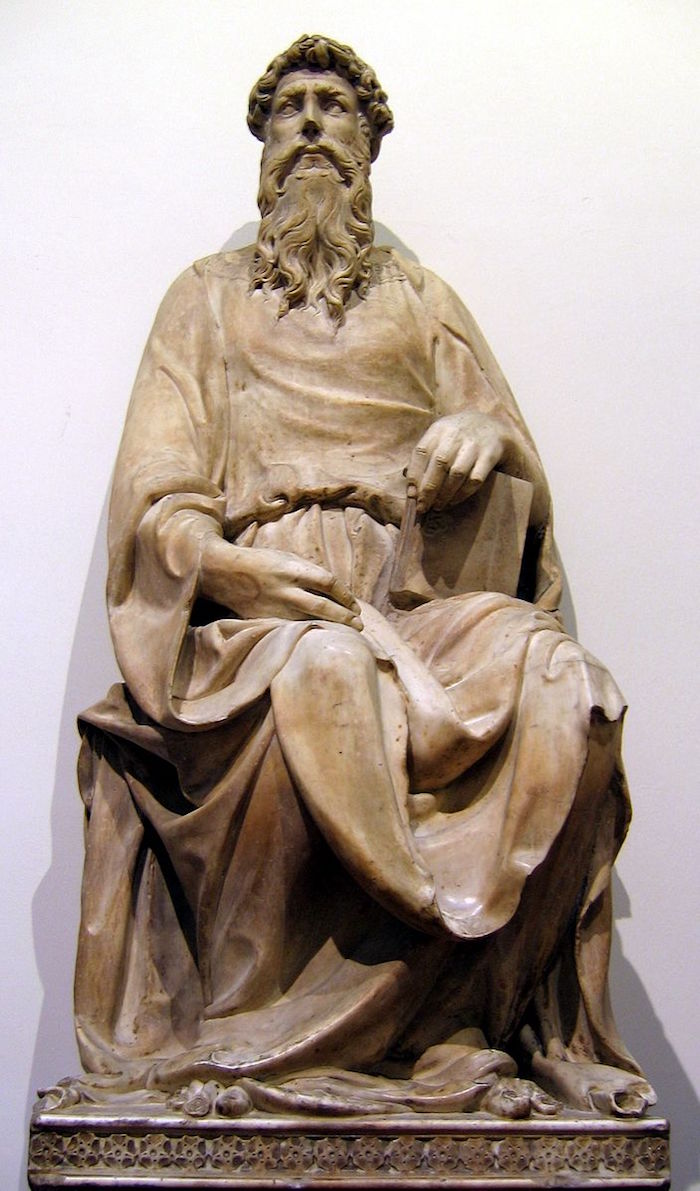
Donatello: Saint John the Evangelist (1409–1411) (Photo taken march 2005 by Richardfabi)
Locations
People
Groups
Topics
Subjects
Regions
Subregions
Related Events
Showing 10 events out of 42362 total
Years: 1413 - 1413
Donatello: Saint John the Evangelist (1409–1411) (Photo taken march 2005 by Richardfabi)
Locations
People
Groups
Topics
Subjects
Regions
Subregions