
Domitian acquits himself of the task of …
Years: 86 - 86
Domitian acquits himself of the task of censor dutifully, and with care.
He renews the Lex Iulia de Adulteriis Coercendis, under which adultery is punishable by exile.
From the list of jurors he strikes an equestrian who had divorced his wife and taken her back, while an ex-quaestor is expelled from the Senate for acting and dancing.
Domitian also heavily prosecutes corruption among public officials, removing jurors if they accepted bribes and rescinding legislation when a conflict of interest is suspected.
He ensures that libelous writings, especially those directed against himself, are punishable by exile or death.
Actors are likewise regarded with suspicion, as their performances provide an opportunity for satire at the expense of the government.
Consequently, he forbids mimes from appearing on stage in public.
In order to appease the people of Rome, an estimated one hundred and thirty-five million sestertii will be spent on donatives, or congiaria, throughout Domitian's reign.
The Emperor also revives the practice of public banquets, which had been reduced to a simple distribution of food under Nero, while he invests large sums on entertainment and games.
In 86, he founds the Capitoline Games, a quadrennial contest comprising athletic displays, chariot racing, and competitions for oratory, music and acting.
Domitian himself supports the travel of competitors from all corners of the Empire to Rome and distributes the prizes.
Innovations are also introduced into the regular gladiatorial games such as naval contests, nighttime battles, and female and dwarf gladiator fights.
Lastly, he adds two new factions to the chariot races, Gold and Purple, to race against the existing White, Red, Green and Blue factions.
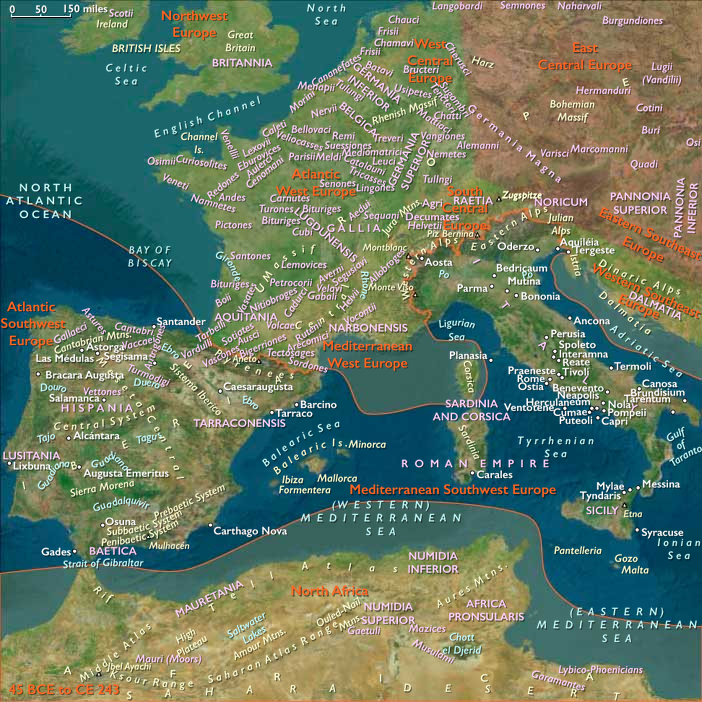
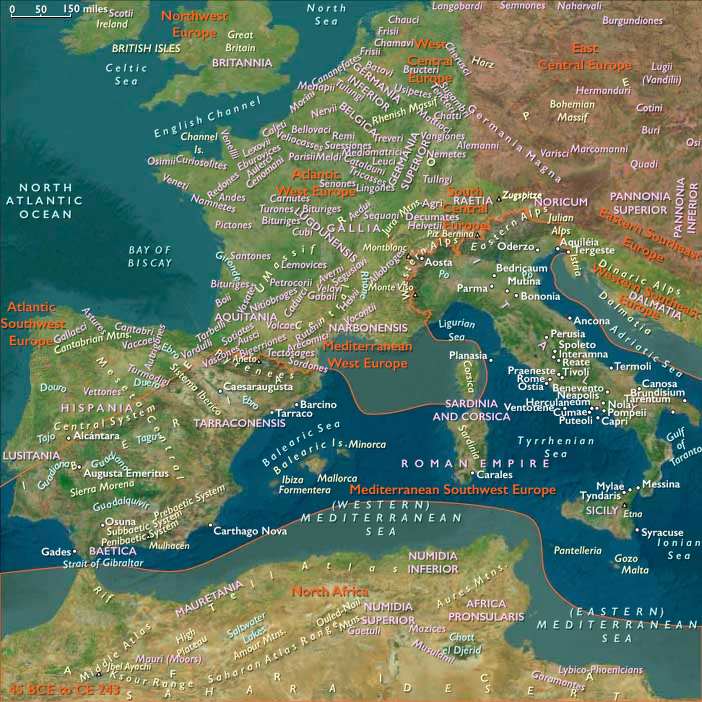
The most significant threat the Roman Empire faces during the reign of Domitian arises from the northern provinces of Illyricum, where the Suebi, the Sarmatians and the Dacians continuously harass Roman settlements along the Danube river.
Of these, the Sarmatians and the Dacians pose the most formidable threat.
In approximately 85 or 86 the Dacians, led by Diurpaneus (the later king Decebalus), cross the Danube into the province of Moesia, wreaking havoc and killing the Moesian governor Oppius Sabinus.
Domitian quickly launches a counteroffensive, personally traveling to the region accompanied by a large force commanded by his praetorian prefect Cornelius Fuscus.
Locations
People
Groups
- Sarmatians
- Dacia, Kingdom of
- Suebi (Germanic tribe)
- Chariot racing factions, Roman
- Italy, Roman
- Roman Empire (Rome): Flavian dynasty
Topics
Commodoties
Subjects
- Commerce
- Watercraft
- Environment
- Labor and Service
- Conflict
- Games and Sports
- Faith
- Government
- Custom and Law
- Technology
Regions
Subregions
Related Events
Filter results
Showing 10 events out of 1604 total
he Renaming of Lutetia to Paris (360 CE)
In 360 CE, Lutetia, the Roman city on the Île de la Cité, was officially renamed Paris, adopting the name of the Gallic Parisii tribe that had once inhabited the region.
1. The Origins of the Name "Paris"
- The Parisii were a Gallic tribe that had settled along the Seine River before the Roman conquest of Gaul in the 1st century BCE.
- While the Romans named their city Lutetia, the local population continued to use "Parisii" as an ethnic and regional identifier.
- The term "Parisiacus" had already been used for centuries as an adjective, referring to things related to the Parisii or Lutetia.
2. Julian and the Renaming of the City
- The renaming of Lutetia to Paris occurred during the reign of Julian, who was serving as Caesar in Gaul at the time.
- Julian had used Lutetia as his winter quarters in 357 CE, after securing a major victory over the Alamanni at the Battle of Strasbourg.
- By 360 CE, he had been proclaimed Augustus by his troops while in Lutetia, further elevating the city’s status.
3. The Significance of the Name Change
- The name change from Lutetia to Paris reflected the enduring influence of Gallic heritage in the region.
- It marked a shift from the older Roman designation to one more closely tied to local identity.
- This renaming foreshadowed the later importance of Paris as a medieval and modern capital, becoming the heart of the Frankish and later French kingdoms.
4. Conclusion: The Birth of Paris as a Lasting Identity
- The transition from Lutetia to Paris in 360 CE signaled the city's growing regional prominence.
- Although still a Roman city, Paris retained its Gallic roots, a blend of Roman and indigenous traditions that would shape its future identity.
- Over time, Paris would rise to become one of the most significant cities in European history, a transformation that began with its renaming in the late Roman period.
Julian's Acclamation as Augustus and the Imminent Civil War (360–361 CE)
By 360 CE, Julian had proven himself to be an extraordinarily successful military leader, having defeated and expelled both the Alemanni and the Franks, restoring Roman control over the Rhine frontier. His victories had made him immensely popular with his legions, but they also aroused the jealousy of Constantius II, the reigning Augustus of the Eastern Roman Empire.
Constantius, who had always been suspicious of Julian’s growing influence, deliberately kept him short on funds and placed him under secret surveillance.
1. Constantius’ Attempt to Weaken Julian (Late 360 CE)
- In late 360 CE, while Julian was wintering at Lutetia (modern Paris), Constantius demanded a large number of his best troops, ostensibly to be sent for service in the East against the Persians.
- In reality, this move was designed to weaken Julian’s power in Gaul, ensuring that he could not challenge Constantius’ authority.
Julian, dutifully prepared his men to depart, but his troops, loyal to their general and unwilling to leave Gaul unprotected, mutinied.
2. Julian is Acclaimed as Augustus (Early 361 CE)
- Julian’s army, refusing to leave Gaul, declared him Augustus in early 361 CE.
- Despite his initial reluctance, Julian realized that the act was irreversible—he was now in open rebellionagainst Constantius.
- The news infuriated Constantius, who immediately rejected any negotiation or accommodation, treating Julian as a usurper.
3. Julian Prepares for War Against Constantius
- Recognizing that civil war was now inevitable, Julian decided to act first, preparing to march eastward and confront Constantius before he could strike first.
- His legions in Gaul were loyal, and he sought to rally additional forces to his cause.
- His brilliant military record and charismatic leadership ensured that many Roman officers and officials secretly sympathized with him.
4. The Path to Civil War
- As Julian mobilized his forces, Constantius began preparing for a campaign against him.
- However, fate intervened: before any battle took place, Constantius suddenly fell ill and died in late 361 CE.
- On his deathbed, Constantius unexpectedly named Julian as his successor, abruptly ending the conflict before it could begin.
5. Conclusion: Julian’s Ascendancy
- Julian’s proclamation as Augustus in 361 CE marked a turning point in Roman history, as he became sole ruler of the empire.
- His rise to power demonstrated the importance of military loyalty, as his legions had been the key factor in his rebellion.
- Julian’s reign (361–363 CE) would soon become famous for:
- His attempts to revive paganism in a now predominantly Christian empire.
- His campaign against the Sassanid Persians, which would ultimately lead to his untimely death in 363 CE.
Though Julian had been forced into rebellion, his ascension ultimately proved bloodless, as the death of Constantius II removed his only rival. Now, the empire would witness one of its most unique rulers—a philosopher-emperor who would seek to reverse Constantine’s Christianization of Rome and return it to pagan traditions.
Valentinian I’s Response to the Alemanni Invasion (365 CE): The Defense of Gaul
In 365 CE, the Alemanni, having once again crossed the frozen Rhine in large numbers, launched a major incursion into Roman Gaul. On January 2, 365, they defeated Valentinian I’s generals, delivering a serious blow to Roman forces in the region.
Despite this setback, Emperor Valentinian I (r. 364–375 CE) demonstrated tireless energy and strategic focus, initiating a massive effort to fortify and defend the empire’s northern borders.
1. Fortifying the Rhine Frontier
- Valentinian personally took charge of military operations, recognizing the urgent threat posed by the Alemanni.
- He ordered new defensive fortifications along the Rhine, reinforcing existing garrisons and constructing new military bases.
- His strategy emphasized securing key crossings to prevent further barbarian incursions into Gaul.
2. Establishing Command in Lutetia (Paris) by October 365 CE
-
By October 365 CE, Valentinian set up his imperial residence in Lutetia (modern Paris), making it the center of his military operations.
-
From Lutetia, he coordinated:
- Defensive strategies against further Alemanni invasions.
- Counteroffensives to reclaim lost territory.
- The reorganization of Roman forces in Gaul, ensuring better preparedness for future conflicts.
-
Lutetia’s strategic location made it an ideal command center, providing access to both northern and eastern frontiers.
3. Significance of Valentinian’s Defense Efforts
- Valentinian’s leadership stabilized the Rhine frontier, preventing the Alemanni from gaining a permanent foothold in Gaul.
- His military reforms strengthened the Roman border defenses, setting the stage for future Roman counterattacks.
- His personal involvement in military affairs enhanced his reputation as a capable and resolute emperor.
4. Conclusion: A Strong Emperor Against the Barbarian Threat
- Despite the initial defeat of Roman forces in early 365, Valentinian acted swiftly and effectively to secure Gaul.
- His presence in Lutetia as a wartime headquarters marked an important moment in the city’s history, reinforcing its role as a key Roman stronghold.
- His campaigns against the Alemanni would continue in the following years, leading to a decisive Roman victory in 368 CE, securing the Rhine frontier for a time.
Through determination and strategic foresight, Valentinian proved to be one of the last great defenders of the Western Roman Empire, successfully holding back the barbarian tide for another generation.
...Saint Genevieve of Paris is later credited with saving her city through her fervent prayers and leadership. She is said to have inspired the people of Paris to resist, while urging them to remain steadfast in their faith. Though it is unclear whether Attila’s forces actually reached Paris, the legend of Genevieve would later cement her status as the patron saint of the city.
Clovis I: Supreme Ruler of the Franks and the Consolidation of Gaul (507–511 CE)
By the end of his reign, Clovis I has transformed the Franks from a loose tribal confederation into the dominant power in Gaul, controlling nearly all of the former Roman province. His victories over the Romans, Alemanni, and Visigoths, combined with ruthless political consolidation, secure his position as the first king of all the Franks.
Territorial Expansion and the Unification of Gaul
- Conquest of Belgica Secunda – Following his defeat of Syagrius in 486 CE, Clovis annexes the last Roman-held territories in northern Gaul, including Soissons and surrounding cities.
- Victory over the Visigoths (507 CE) – Clovis' triumph at Vouillé eliminates Visigothic power in Gaul, adding Poitou, Saintonge, and Aquitaine to his kingdom, extending Frankish rule to the Pyrenees.
- Final Territories to be Conquered – By 511 CE, Clovis controls all of Gaul except Burgundy, Provence, and Septimania, marking the beginning of Frankish hegemony.
The Elimination of Rival Frankish Chiefs
With his external enemies defeated, Clovis turns against internal rivals, consolidating his rule by eliminating competing Frankish warlords.
- Many Frankish sub-kings (reguli), including his former ally Ragnachar of Cambrai, are executed or assassinated.
- By ruthlessly eliminating rivals, Clovis centralizes power under his Merovingian dynasty, ensuring that his sons inherit an undivided Frankish kingdom.
The Role of Christianity in Clovis’ Rule
- Clovis' Catholic conversion (496 CE), influenced by his wife Clotilde, brings him closer to the powerful Christian clergy in Gaul.
- The Gallo-Roman bishops, wielding significant authority over their communities, become key political alliesin stabilizing the new Frankish kingdom.
- Clovis patronizes Christian missionaries, expanding Frankish influence into the eastern Germanic frontierand spreading Catholic Christianity among the Franks.
Codification of Salic Law (Lex Salica)
- While Salic Law is based on ancient Frankish customs, its written codification occurs between 507 and 511 CE, likely at Clovis' direction.
- The Lex Salica establishes legal traditions such as compensatory fines (wergeld) instead of corporal punishment, inheritance laws, and rules governing property rights.
- The law will later be cited in medieval succession disputes, particularly in the Hundred Years' War.
The Fleur-de-Lis and the Divine Legitimacy of the Frankish Kings
- A legend emerges that Clovis receives a fleur-de-lis ("lily flower") from heaven, reinforcing the idea that his authority comes directly from God.
- The heraldic device, with three petals joined by a bar, later becomes the symbol of the French monarchy.
- Many versions of the legend connect the fleur-de-lis with Clovis’ Christian conversion, emphasizing divine approval of the Merovingian dynasty.
Legacy of Clovis I
By the time of Clovis’ death in 511 CE, he has:
- United the Franks under a single ruler, eliminating rival kings.
- Conquered most of Gaul, replacing both Roman and Visigothic rule.
- Established Christianity as the faith of the Franks, aligning with the Catholic Church.
- Created the foundation of Frankish law, codified in the Lex Salica.
His conquests and political consolidation lay the groundwork for the rise of the Frankish Kingdom, which will later evolve into medieval France and the Holy Roman Empire.
Clovis I: Christianization, Consolidation, and Recognition by the Eastern Empire (507–511 CE)
By the end of his reign, Clovis I completes the unification of the Franks, establishes a Christian Frankish state, and earns imperial recognition from the Eastern Roman Empire, securing his place as the most powerful ruler in Western Europe.
1. Making Chalcedonian Christianity the Official Religion
- Following his baptism in 496 CE, Clovis formally establishes Catholic (Chalcedonian) Christianity as the official faith of his kingdom.
- This solidifies his alliance with the Gallo-Roman bishops, giving him strong political backing in former Roman territories.
- His conversion sets the Franks apart from other Germanic kingdoms, such as the Visigoths, Burgundians, and Ostrogoths, which still followed Arian Christianity.
2. Paris Becomes the Frankish Capital
- Clovis moves his royal residence from Soissons to Paris (Lutetia), recognizing its strategic central location on the Seine River.
- This decision marks the beginning of Paris’ rise as the political and cultural center of France.
3. Founding the Abbey of Saints Peter and Paul
- Clovis commissions the construction of an abbey on the south bank of the Seine, dedicated to Saints Peter and Paul.
- The abbey later becomes known as the Abbey of Saint Genevieve, named after the patron saint of Paris, who had led the city's resistance against Attila the Hun.
- This abbey serves as the burial site for Clovis and his wife, Queen Clotilde.
4. Recognition by the Eastern Roman Empire
- After his victory at Vouillé (507 CE), the Eastern Roman Emperor Anastasius I acknowledges Clovis’ growing power.
- Gregory of Tours records that Anastasius grants Clovis the title of consul, though Clovis’ name does not appear in official Roman consular lists.
- This suggests that Clovis was granted a suffect consulship, an honorary title marking him as a protector of the Roman people in Gaul.
- This imperial recognition further legitimizes Clovis’ rule, allowing him to present himself as the heir to Roman authority in the West.
5. Eliminating the Other Frankish “Reguli” (Sub-Kings)
To centralize power and prevent internal threats, Clovis ruthlessly eliminates rival Frankish leaders, consolidating his rule over all Frankish tribes. Gregory of Tours records several assassinations:
- Sigobert the Lame (a Ripuarian Frankish king) is murdered, and his son Chlodoric the Parricide is later killed by Clovis’ agents.
- Chararic, another Salian Frankish king who had previously refused to aid Clovis in battle, is executed.
- Ragnachar of Cambrai, his brother Ricchar, and their sibling Rignomer of Le Mans are eliminated, removing the last major rivals to Clovis’ dominance.
6. Clovis’ Final Triumph: The Sole King of the Franks
By the time of his death in 511 CE, Clovis has:
- Unified all Frankish tribes under a single rule, creating a centralized Frankish kingdom.
- Established Paris as the political capital of his expanding realm.
- Positioned himself as the protector of Catholic Christianity in Western Europe.
- Earned recognition from the Eastern Roman Empire, reinforcing his legitimacy.
- Secured the long-term stability of his dynasty, setting the stage for the Merovingian kingship.
The Legacy of Clovis I
Clovis’ reign transforms the Franks from a loose collection of tribes into the dominant power in post-Roman Gaul. His policies lay the foundation for the Frankish kingdom, which will evolve into medieval France and the Holy Roman Empire. His conversion to Catholic Christianity, his strategic alliances with the clergy, and his ruthless political consolidation ensure that his descendants will rule for centuries, shaping the course of Western European history.
The Death of Clovis I and the Division of the Frankish Kingdom (511 CE)
On November 27, 511 CE, Clovis I, the first king of all the Franks, dies at the age of forty-five in Paris, the capital he had established. His death marks the end of his personal rule, but the Merovingian Dynasty continues through his four sons.
Burial in the Abbey of St. Genevieve
- Clovis is buried in the Abbey of St. Genevieve, which he had founded on the south bank of the Seine.
- This symbolic resting place reinforces his legacy as a Christian king, intertwining Frankish monarchy with the Church.
The Partition of the Frankish Kingdom
As was customary among Germanic kings, Clovis' realm is divided among his sons, rather than passing to a single ruler. The Frankish Kingdom is split into four parts, with each son ruling from a different capital:
- Childebert I – Rules from Paris
Frankish Church Councils and the Strengthening of Catholic Rule
As Chalcedonian Christianity becomes the official faith of the Frankish Kingdom, the Franks hold a series of national church councils to reinforce Catholic orthodoxy and consolidate royal power. These councils, heavily influenced by the Frankish monarchy and episcopate, impose restrictions on Jews, regulate Christian behavior, and establish Paris as a religious and political center.
1. Anti-Jewish Policies in the Frankish Church Councils
The Frankish church councils, convened under the Merovingians, enact laws that:
- Ban Jewish judges – Preventing Jews from holding legal authority over Christians.
- Prohibit Jews from administrative positions – Excluding Jews from public office to limit their influence in governance.
- Strongly discourage Christian-Jewish intermarriage – Enforcing separation between the Christian and Jewish communities.
- Excommunicate those who consume food offered to idols – Strengthening Catholic doctrine against pagan and Jewish sacrificial practices.
These policies reflect the growing power of the Catholic Church within Frankish society and align with broader anti-Jewish measures seen in the Byzantine Empire.
2. The Foundation of St. Vincent Monastery (St-Germain-des-Prés)
- The Monastery of St. Vincent, later renamed St-Germain-des-Prés, is established just outside the gates of Paris.
- It is built to house a sacred relic—the tunic of St. Vincent, which had been plundered from the Visigoths in Spain after Clovis' victory at Vouillé (507 CE).
- The monastery becomes a major religious institution, associated with the Frankish royal family.
3. The Rise of Paris as the Frankish Capital
- Under Clovis I, Paris is chosen as the primary royal residence of the Merovingian dynasty.
- The foundation of the St. Vincent monastery further solidifies Paris’ religious and political significance.
- Over time, Paris emerges as the heart of the Frankish realms, serving as a center for governance, Christian authority, and cultural life.
Conclusion: The Merovingian Theocratic State
The Frankish national church councils, combined with the growth of religious institutions in Paris, reflect the increasing fusion of Church and state under the Merovingians. This period marks:
- The strengthening of Catholic authority, defining the religious identity of the Franks.
- The exclusion of Jews from political life, reinforcing Catholic dominance.
- The development of Paris into a Frankish royal and religious center, setting the foundation for its eventual role as the capital of France.
These events help establish the Merovingians as the foremost Catholic rulers in Western Europe, a position their Carolingian successors will later build upon.
Childebert I and the Foundation of St-Germain-des-Prés (c. 542 CE)
After returning from his expedition against the Visigoths in Spain, Childebert I, King of Paris, brings back one of the most sacred relics of the early medieval Frankish Church—the tunic of St. Vincent, a highly venerated martyr of the Hispanic Church.
1. The Spanish Campaign and the Acquisition of the Relic
- Childebert I, in alliance with his brother Chlothar I, launches a Frankish incursion into Visigothic Spain.
- After successfully besieging Zaragoza, they plunder the city’s Christian treasures, including the tunic of St. Vincent, a famous Spanish martyr from the early fourth century.
- Childebert brings the relic back to Paris, reinforcing his status as a pious Christian ruler and patron of the Catholic Church.
2. The Founding of the Monastery of St. Vincent (St-Germain-des-Prés)
- In honor of St. Vincent’s tunic, Childebert commissions a grand monastery at the gates of Paris.
- Originally named the Monastery of St. Vincent, it is later renamed St-Germain-des-Prés, after Saint Germain, Bishop of Paris.
- The monastery becomes one of the most significant religious institutions in medieval France, serving as:
- A royal burial site.
- A center of learning and monastic culture.
- A powerful symbol of Frankish Christian rule.
3. The Significance of the Relic and Monastic Foundation
- The acquisition of St. Vincent’s tunic and the monastery’s construction further solidify Paris as a major religious center in the Frankish kingdom.
- This act strengthens Frankish ties with the Catholic Church, reinforcing Childebert’s legitimacy as a Christian ruler.
- The monastery of St-Germain-des-Prés will later play a crucial role in the intellectual and monastic revival of medieval Europe.
Conclusion: A Lasting Religious Legacy
Through his expedition to Spain and the establishment of the Monastery of St. Vincent, Childebert elevates Paris as a religious and political capital. The monastery of St-Germain-des-Prés will remain an enduring symbol of Frankish piety, royal patronage, and monastic scholarship, influencing the spiritual and cultural landscape of medieval France for centuries to come.
3. Fredegund’s Swift Seizure of Power
- Immediately after Chilperic’s death, Fredegund seizes his treasury, securing the royal wealth for herself and her son.
- She flees to Paris, where she convinces the Neustrian nobles to recognize her infant son, Chlothar II, as king.
- Acting as regent, she ensures that Neustria remains politically intact, continuing her rivalries with Guntram of Burgundy and Brunhilda of Austrasia.
4. The Continuation of the Civil Wars
- Fredegund continues her war against Brunhilda, the widow of Sigebert I, keeping alive the decades-long feud between Austrasia and Neustria.
- She also must contend with Guntram, who, as the last surviving son of Clovis I, attempts to act as a mediatorin the Frankish realm.
- Despite the instability, Fredegund maintains her grip on power, using political cunning and assassination to eliminate rivals.
5. The Legacy of Chilperic’s Death and Fredegund’s Regency
- Chilperic’s violent death marks the end of a brutal reign, but his assassination does not bring stability—instead, it prolongs the bloody Merovingian civil wars.
- Fredegund emerges as the dominant figure in Neustria, ruling until her death in 597 CE, after which her son, Chlothar II, will consolidate power.
- Her rivalry with Brunhilda shapes the next three decades of Frankish history, defining one of the most treacherous and vengeful political feuds of the Merovingian period.
Conclusion: The Widow Who Ruled
With Chilperic’s assassination in 584 CE, Fredegund swiftly consolidates power, ensuring that her infant son remains king. Her ability to outmaneuver rivals, command loyalty, and use political violence makes her one of the most formidable figures of the Merovingian age. However, the Merovingian civil wars rage on, fueled by the unrelenting feud between Fredegund and Brunhilda, ensuring that the Frankish kingdom remains engulfed in bloodshed for years to come.
Years: 86 - 86
Locations
People
Groups
- Sarmatians
- Dacia, Kingdom of
- Suebi (Germanic tribe)
- Chariot racing factions, Roman
- Italy, Roman
- Roman Empire (Rome): Flavian dynasty
Topics
Commodoties
Subjects
- Commerce
- Watercraft
- Environment
- Labor and Service
- Conflict
- Games and Sports
- Faith
- Government
- Custom and Law
- Technology
