
Dominance in Mesopotamia begins to pass around …
Years: 2349BCE - 2206BCE
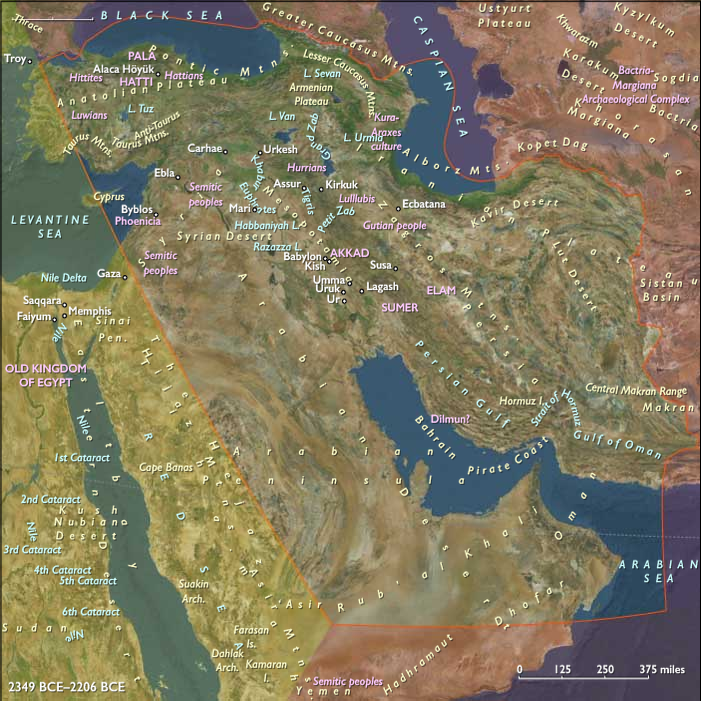
Dominance in Mesopotamia begins to pass around 2400 BCE from the Sumerians in the lower valley to the more northerly Akkadians, a Semitic people who have begun to dominate central Mesopotamia and possibly the northern region.
Akkadian influence soon extends west into Syria and east as far as Susa in present Iran.
Other Semitic-speaking population centers grow in Syria-Palestine, southern Arabia, and various smaller centers along the Arabian littoral.
Sumerian references to the Mar.tu ("tent dwellers"—considered to be Amorite) country west of the Euphrates date from even earlier than Sargon, at least to the reign of Enshakushanna of Uruk in the twenty-sixth century.
Caucasian-speaking groups dominate Asia Minor and most of the Iranian plateau.
The Ebla tablets are a collection of as many as eighteen hundred complete clay tablets, forty-seven hundred fragments and many thousand minor chips found in the palace archives of the ancient city of Ebla, Syria.
The tablets, which were found in situ on collapsed shelves, retained many of their contemporary clay tags to help reference them.
They all date to the period between about 2500 BCE and the destruction of the city in around 2250 BCE.
They are the oldest and the largest collection of tablets yet found from the ancient Middle East.
Two languages appeared in the writing on the tablets: Sumerian, and a previously unknown language that used the Sumerian cuneiform script (Sumerian logograms or "Sumerograms") as a phonetic representation of the locally spoken Ebla language.
The latter script was initially identified as proto-Canaanite by professor Giovanni Pettinato, who first deciphered the tablets, because it predated the Semitic languages of Canaan, like Ugaritic and Hebrew.
Pettinato later retracted the designation and decided to call it simply "Eblaite,” the name by which it is known today.
The only tablets at Ebla that were written exclusively in Sumerian are lexical lists, probably for use in training scribes.
The archives contain thousands of copybooks, lists for learning relevant jargon, and scratch pads for students, demonstrating that Ebla was a major educational center specializing in the training of scribes.
The purely phonetic use of Sumerian logograms marks a momentous advance in the history of writing.
Sumerian scribes developed a clumsy system that employed a mixed use of logograms and phonetic signs.
Drawing from the existing systems, the scribes at Ebla employed a reduced number of signs entirely phonetically, both the earliest example of transcription (rendering sounds in a system invented for another language) and a major simplifying step towards "reader friendliness" that would enable a wider spread of literacy in palace, temple and merchant contexts.
The tablets provide a wealth of information on Syria and Canaan in the Early Bronze Age, and include the first known references to the "Canaanites,” "Ugarit,” and "Lebanon.” The contents of the tablets reveal that Ebla was a major trade center.
One focus was economic records, inventories recording Ebla's commercial and political relations with other Levantine cities and logs of the city's import and export activities.
For example, they reveal that Ebla produced a range of beers, including one that appears to be named "Ebla,” for the city.
Ebla was also responsible for the development of a sophisticated trade network system between city-states in northern Syria.
This system grouped the region into a commercial community, which is clearly evidenced in the texts.
There are king lists for the city of Ebla, royal ordinances, edicts, treaties.
There are gazetteers listing place names, including a version of a standardized place-name list that has also been found at Abu Salabikh (possibly ancient Eresh) where it was datable to around 2600 BCE.
The literary texts include hymns and rituals, epics, and proverbs.
The Eblaite tablets from the Igrish-Khalam dynasty administration, written in Sumerian cuneiform script, record commercial treaties; bilingual vocabularies; lists of birds, fish, and stones; ritual and mythological texts; diplomatic letters; military dispatches; and lists of personal and place names.
The Eblaite texts name Ebla as the center of a commercial empire that radiates north to Anatolia, west to Cyprus, south to Canaan and Egypt, east to Persia, and southeast to Mesopotamia.
Locations
Groups
Topics
Commodoties
Subjects
- Commerce
- Language
- Writing
- Environment
- Government
- Scholarship
- Custom and Law
- Mythology
- Anthropology
- Archaeology
- Linguistics
- Economics
Regions
Subregions
Years: 2349BCE - 2206BCE
Locations
Groups
Topics
Commodoties
Subjects
- Commerce
- Language
- Writing
- Environment
- Government
- Scholarship
- Custom and Law
- Mythology
- Anthropology
- Archaeology
- Linguistics
- Economics
Regions
Subregions