
Djer may have pushed Egypt’s boundaries farther …
Years: 3009BCE - 2998BCE
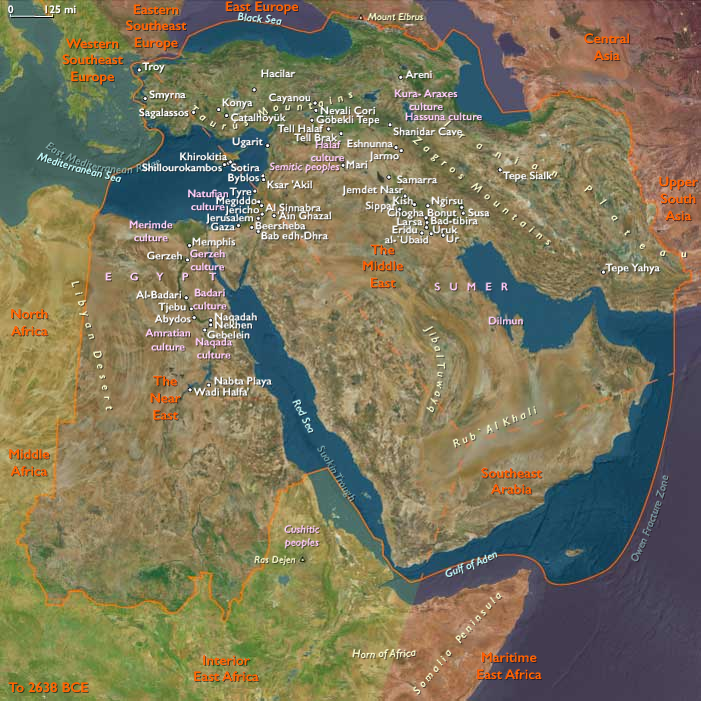
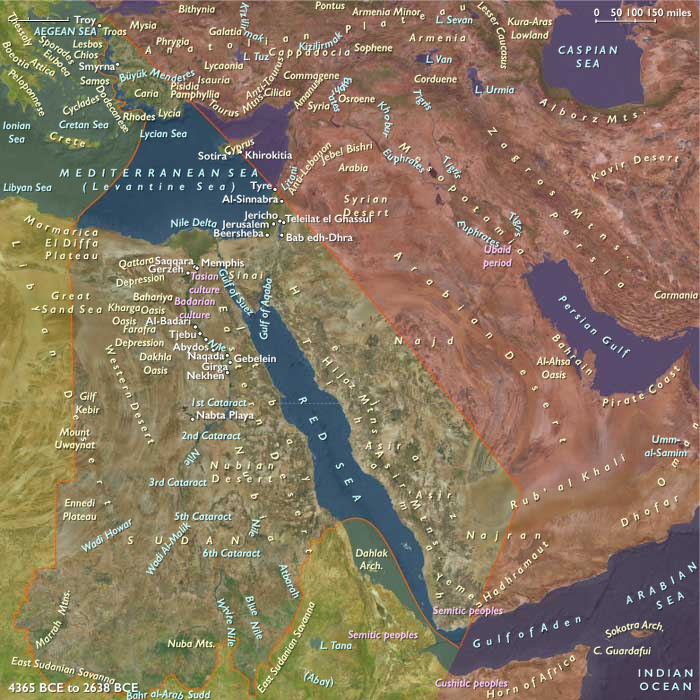
Djer may have pushed Egypt’s boundaries farther south beyond the First Cataract to the Wadi Halfa in present Sudan, where archaeologists will find an inscription of his name (of questioned authenticity, however).
Inscriptions concerning Djer, on ivory and wood, are in a very early form of hieroglyphs, hindering complete translation, but a label at Saqqarah may depict the early Old Kingdom practice of human sacrifice.
An ivory tablet from Abydos mentions that Djer visited Buto and Sais in the Nile Delta.
One of his regnal years on the Cairo Stone was named "Year of smiting the land of Setjet", which often is speculated to be Sinai or beyond.
Similarly to his father Hor-Aha, Djer was buried in Abydos.
Djer's tomb is tomb O of Petrie.
His tomb contains the remains of three hundred retainers who were buried with him.
Several objects were found in and around the tomb of Djer.
Women carrying titles later associated with queens, such as great one of the hetes-scepter and She who sees/carries Horus wee buried in subsidiary tombs near the tomb of Djer in Abydos or attested in Saqqara.
These women are thought to be the wives of Djer and include Nakhtneith (or Nekhetneith), buried in Abydos and known from a stela; Herneith, possibly a wife of Djer, buried in Saqqara; Seshemetka, buried in Abydos next to the king, and said to be a wife of Den in Dodson and Hilton; Penebui, her name and title found on an ivory label from Saqqara, and bsu, known from a label in Saqqara and several stone vessels (reading of name uncertain; name consists of three fish hieroglyphs).
The tomb of Djer is associated with the burials of three hundred and thirty-eight individuals, most likely retainers sacrificed upon the king’s death.
Locations
People
Groups
Topics
- Piora Oscillation ending the Neolithic Subpluvial
- Early Bronze Age II (Near and Middle East)
- Subboreal Period
Commodoties
Subjects
- Commerce
- Watercraft
- Environment
- Labor and Service
- Conflict
- Mayhem
- Faith
- Government
- Custom and Law
- Technology
- Anthropology
- Archaeology
Regions
Subregions
Related Events
Showing 10 events out of 68612 total
Years: 3009BCE - 2998BCE
Locations
People
Groups
Topics
- Piora Oscillation ending the Neolithic Subpluvial
- Early Bronze Age II (Near and Middle East)
- Subboreal Period
Commodoties
Subjects
- Commerce
- Watercraft
- Environment
- Labor and Service
- Conflict
- Mayhem
- Faith
- Government
- Custom and Law
- Technology
- Anthropology
- Archaeology
Regions
Subregions