
Dispute between Poland and the Teutonic Order …
Years: 1450 - 1450
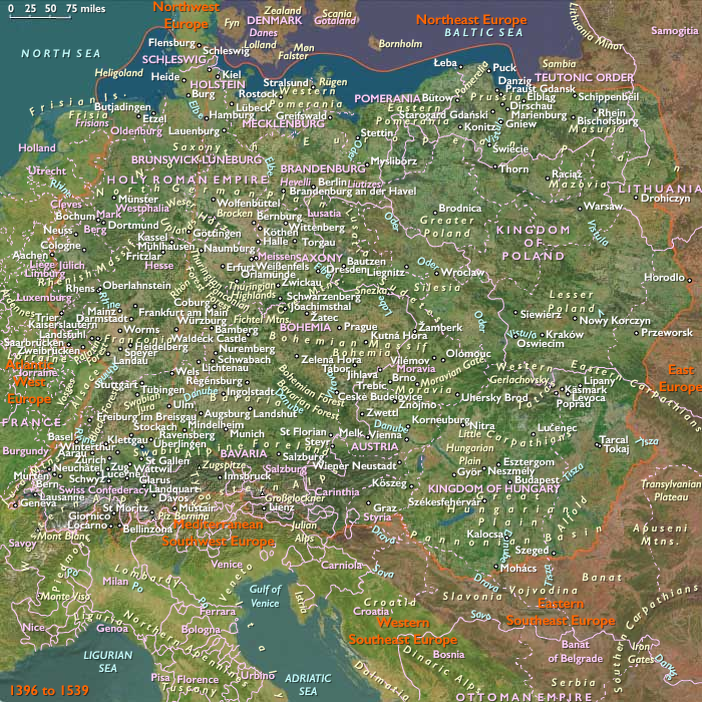
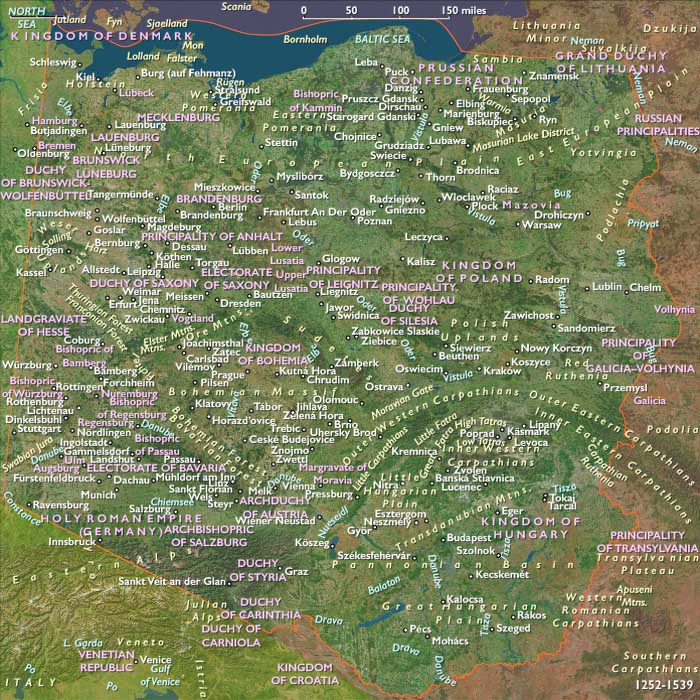
Dispute between Poland and the Teutonic Order over the control of Gdańsk Pomerania has lasted since the 1308 Teutonic takeover of Danzig (Gdańsk), when that territory had been taken from Poland and annexed by the Teutonic Order.
This result of this event is a series of Polish–Teutonic Wars throughout the fourteenth and fifteenth centuries.
In the fifteenth century, the towns of Prussia experience rapid economic growth, which is not, however, paralleled by an increase in their political influence.
The rule of the Teutonic Knights is seen as increasingly anachronistic—taxes (customs) and the system of grain licenses (every trader has to pay large fees for the privilege of trading grain) are hindering economic development in the province.
At the same time, the nobility wants a greater voice in the running of the country, and regard with envy neighboring Poland, where the nobility enjoys wider privileges.
The Knights are also accused of violating the few existing privileges of the nobility and the cities.
Craftsmen are discontented because of competition from so-called partacze, or artisans settled by the Knights near their castles.
Kashubians, Poles, Germans, and Prussians are slowly melting into one nation, and as national differences disappeared, the common goals of all the ethnic and social groups of Prussia became more prominent, and the Prussian estates leaned increasingly towards Poland.
Prussian knights had in 1397 founded a secret organization called the Eidechsenbund (English translation: Lizard Union), more or less against the Teutonic Knights, but that organization had failed as it was not supported by the urban population.
After the victory by the Polish and Lithuanian forces at Grünfelde near Tannenberg during the Polish-Lithuanian-Teutonic War from 1409 to 1411, the Prussian estates had eagerly pledged allegiance to King Władysław II Jagiełło (Jogaila) of Poland, but they had quickly returned to the order's rule after the Poles were unable to conquer Marienburg (Malbork).
A clause in the peace treaty stated that it was guaranteed by the Prussian states, which would gain the right to defy the Teutonic Order if it broke the treaty.
In the succeeding wars, the Prussian estates had opposes any conflict, and pushed the Grand Masters of the Teutonic Knights to make peace.
A group made up of individuals from the Prussian cities, nobility and clergy, had formed the Prussian Confederation on February 21, 1440 The main contributors were from the nobility of Culmerland (Chełmno Land), Thorn, Culm (Chełmno), and from the Hanseatic cities of Elbing (Elbląg) and Danzig.
Grand Master Paul von Rusdorf was seen to approve the existence of the confederacy, but his successor, Konrad von Erlichhausen, had opposed it.
His non-compromising policy is followed and intensified by Ludwig von Erlichshausen, who takes this office in 1449 or 1450.
Locations
Groups
- Prussians, Old, or Baltic (Western Balts)
- Germans
- Kashubians
- Poland of the Jagiellonians, Kingdom of
- Prussian Confederation
- Ordensstaat (Monastic state of the Teutonic Knights)
Topics
- Ostsiedlung (German: Settlement in the East), a.k.a. German eastward expansion
- Thirteen Years' War, or War of the Cities
Commodoties
Subjects
Regions
Subregions
Years: 1450 - 1450
Locations
Groups
- Prussians, Old, or Baltic (Western Balts)
- Germans
- Kashubians
- Poland of the Jagiellonians, Kingdom of
- Prussian Confederation
- Ordensstaat (Monastic state of the Teutonic Knights)
Topics
- Ostsiedlung (German: Settlement in the East), a.k.a. German eastward expansion
- Thirteen Years' War, or War of the Cities
Commodoties
Subjects
Regions
Subregions