
Displaced Goths and other tribes arrive in …
Years: 376 - 387
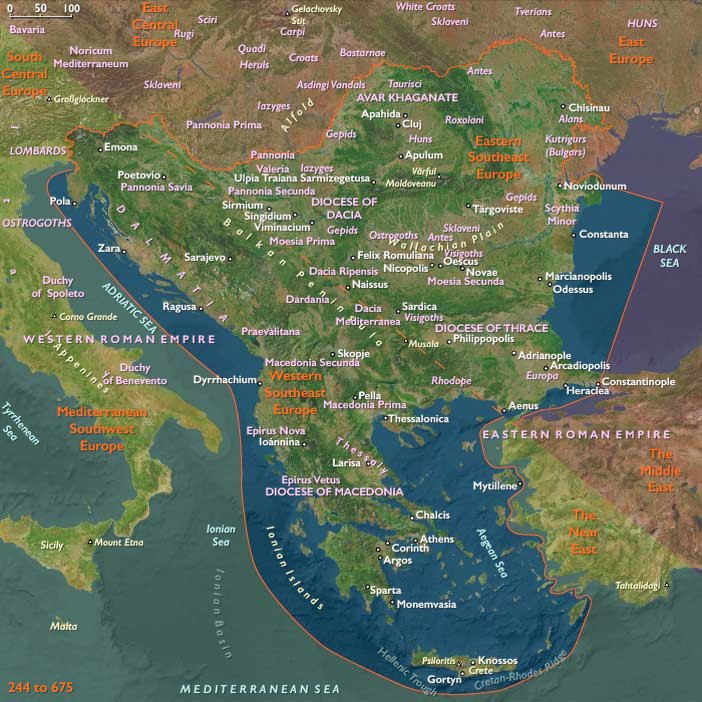
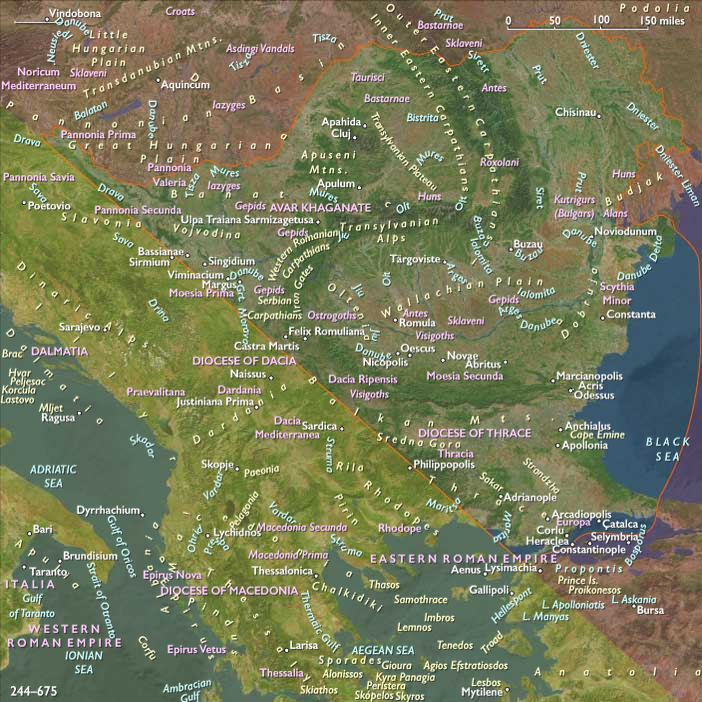
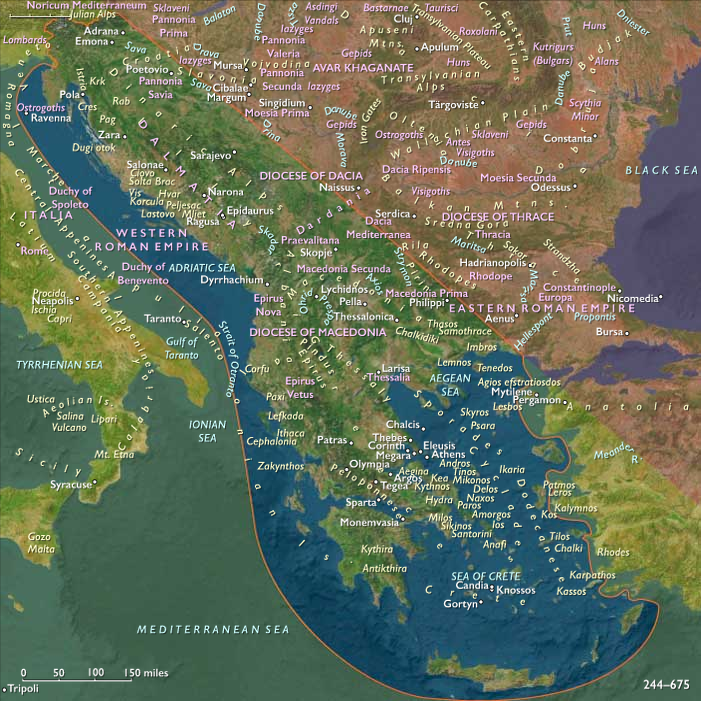
Displaced Goths and other tribes arrive in the summer and fall of 376 on the Danube River, on the border of the Roman Empire, requesting asylum from the Huns.
Fritigern, a leader of the Thervingi, appeas to the Roman emperor Valens to be allowed to settle with his people on the south bank of the Danube, where they hope to find refuge from the Huns, who lack the ability to cross the wide river in force.
Valens permits this, and promises the Goths farming land, grain rations, and protection under the Roman armies as “allies” (foederati).
The ones that crossed are supposed to have their weapons confiscated; however, the Romans in charge accept bribes to allow the Goths to retain their weapons.
With so many people in such a small area, famine strikes the Goths, and Rome is unable to supply them with either the food they were promised or the land; they herd the Goths into a temporary holding area surrounded by an armed Roman garrison.
There is only enough grain left for the Roman garrison, who simply let the Goths starve.
The Romans provide a grim alternative: the trade of slaves (often children and young women) for dog meat.
When Fritigern appeals to Valens for help, he is told that his people will find food and trade in the markets of the distant city of Marcianople.
Having no alternative, some of the Goths trek south in a death march, losing the sickly and old along the path.
When they finally reach Marcianople's gates, they are barred by the city's military garrison and denied entry; moreover, the Romans unsuccessfully try to assassinate the Goth leaders during a banquet.
Open revolt begins.
The main body of Goths spend the rest of 376 and early 377 near the Danube plundering food from the immediate region.
Roman garrisons are able to defend isolated forts but most of the country is vulnerable to Gothic plunder.
War begins in earnest in late winter 377.
The remaining Goths move south from the Danube to Marcianople, and next appear near Adrianople (modern Edirne).
The Roman response is to send a force under Valens to meet and defeat the Goths.
Valens moves north from Constantinople in 378 and is defeated (and himself killed) at the Battle of Adrianople.
The victory gives the Goths freedom to roam at will, plundering throughout Thrace for the rest of 378.
The Goths meet only light Roman resistance in 379 and advance northwest into Dacia, plundering that region.
The Goths divide in 380 into Terving and Greuthung armies, in part because of the difficulty of keeping such a large number supplied.
The Greuthungi move north into Pannonia, where they are defeated by western emperor Gratian.
The Tervingi under Fritigern move south and east to Macedonia, where they take "protection money" from towns and cities rather than sacking them outright.
Forces of the western Empire in 381 drive the Goths back to Thrace, where finally, peace is made on October 3, 382.
The Goths by the end of the war have killed a Roman emperor, destroyed a Roman army and laid waste large tracts of the Roman Balkans, much of which will never recover.
The Roman Empire has for the first time negotiated a peace settlement with an autonomous barbarian tribe inside the borders of the Empire, a situation that a generation before would have been unthinkable.
The lesson is not lost on other tribes, including the Goths themselves, who will not long remain peaceful.
Rome, after the crushing defeat, is no longer in a position to drive all its enemies from its territories.
Tribes that can no longer be expelled begin to be settled within the empire as foederati, receiving subsidies and in return supplying troops.
The Western Empire under the pressure of continued invasions will collapse within a century and be carved up into barbarian kingdoms.
People
Groups
- Goths (East Germanic tribe)
- Thervingi (East Germanic tribe)
- Greuthungi (East Germanic tribe)
- Roman Empire: Valentinian dynasty (Rome)
- Hunnic Empire
- Roman Empire: Theodosian dynasty (Constantinople)
Topics
- Roman Age Optimum
- Three Kingdoms of Korea
- Late Antiquity
- Migration Period
- Sixteen Kingdoms Period in China
- Civil Wars in China triggered by the Wu Hu Invasion
- Arian controversy
- Gupta Dynasty, Conquests of the
- Visigothic Raids on the Roman Empire, Early
- Hun Raids on the Roman Empire
- Roman Gothic War, Fifth, or Gothic War (376–382)
- Fall of the Western Roman Empire
- Adrianople, Battle of
- Roman Civil War of 387-88
Commodoties
Subjects
Regions
Subregions
Years: 376 - 387
People
Groups
- Goths (East Germanic tribe)
- Thervingi (East Germanic tribe)
- Greuthungi (East Germanic tribe)
- Roman Empire: Valentinian dynasty (Rome)
- Hunnic Empire
- Roman Empire: Theodosian dynasty (Constantinople)
Topics
- Roman Age Optimum
- Three Kingdoms of Korea
- Late Antiquity
- Migration Period
- Sixteen Kingdoms Period in China
- Civil Wars in China triggered by the Wu Hu Invasion
- Arian controversy
- Gupta Dynasty, Conquests of the
- Visigothic Raids on the Roman Empire, Early
- Hun Raids on the Roman Empire
- Roman Gothic War, Fifth, or Gothic War (376–382)
- Fall of the Western Roman Empire
- Adrianople, Battle of
- Roman Civil War of 387-88
Commodoties
Subjects
Regions
Subregions