
Diogo Fernandes Pereira had been appointed master …
Years: 1503 - 1503
October
Diogo Fernandes Pereira had been appointed master and captain (a very unusual combination) of a Setúbal ship bound for India, in 1503.
Known lists for the armada and the chronicles do not actually give his ship a name, but just call it "the ship from/of Setúbal", a strong suggestion that it might have been privately outfitted by the merchant community of the city of Setúbal and captained by one of their own.
Diogo Fernandes Pereira's name is usually given simply as 'Diogo Fernandes'.
He is sometimes referred to as Diogo Fernandes de Setúbal (his hometown), to distinguish him from another Indian Ocean adventurer of this period with a similar name, known as Diogo Fernandes de Beja.
A Portuguese seaman of obscure background, he served as master on several ships: as third officer, below the pilot and captain, a position that requires trained navigational expertise.
He may have served as pilot on other occasions.
The Setúbal ship had originally been assigned to the third squadron of the Fifth Portuguese Armada, under the vice-admiral António de Saldanha, but navigational errors on Saldanha's part had led to the separation of the ships shortly after Cape Verde.
Diogo Fernandes had been forced to sail on alone.
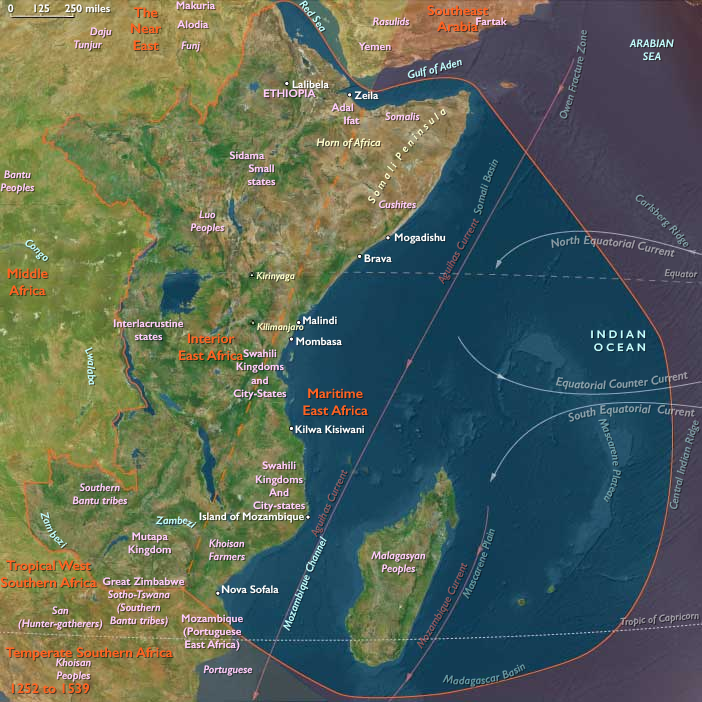
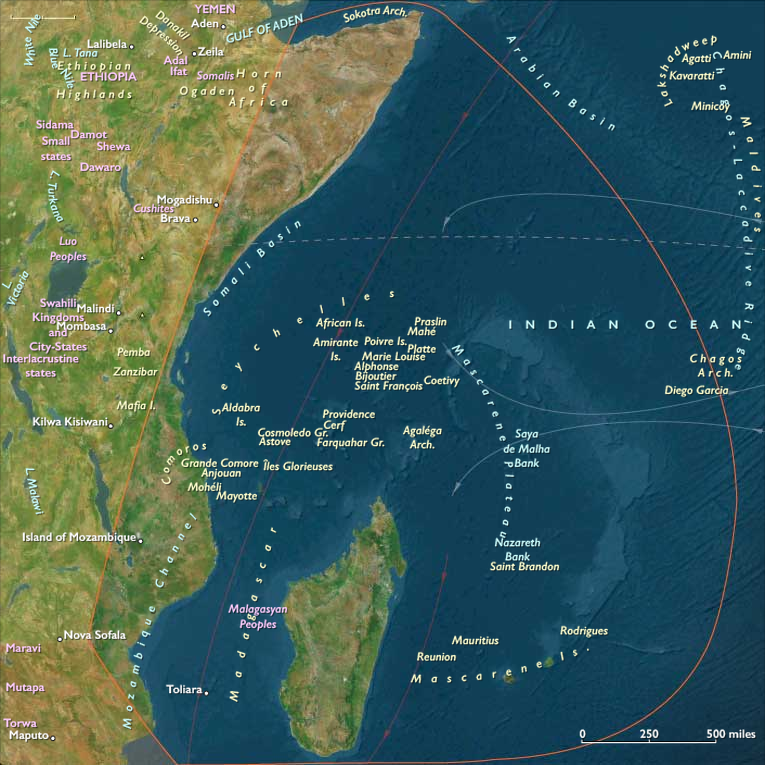
The chronicler Gaspar Correia (p. 418) claims that after doubling the Cape of Good Hope by himself, Fernandes did not turn into the Mozambique Channel, but rather pushed east, sailing under the island of Madagascar, and then turned north, sailing up east of Madagascar.
This would make him the first known ship to sail the 'outer route' to the East Indies.
(Although there remains the possibility that Diogo Dias also did precisely that in 1500.)
Although Correia's account is not corroborated by other chroniclers, Diogo Fernandes Pereira seems to almost certainly have missed Mozambique Island, the usual collection point for Portuguese ships, and where one of his squadron, Rui Lourenço Ravasco, was known to be waiting.
Instead, we next hear of Fernandes up near Cape Guardafui, which strongly suggests that he did take the outer route, as, sailing north by that route, he would not have sighted African coast before the horn.
Locations
People
- Afonso de Albuquerque
- Diogo Fernandes Pereira
- Duarte Pacheco Pereira
- Estêvão da Gama
- Gaspar da Gama
- João da Nova
- Manuel I of Portugal
- Nicolau Coelho
- Vasco da Gama
Groups
- Hinduism
- Arab people
- Khoikhoi
- Indian people
- Christians, Eastern (Diophysite, or “Nestorian”) (Church of the East)
- Swahili people
- Nair
- Islam
- Kilwa Sultanate
- Christians, Roman Catholic
- Cochin, Kingdom of
- Castile, Crown of
- Portugal, Avizan (Joannine) Kingdom of
- Portuguese Empire
- Vijayanagara, (Saluva) Kingdom of
- Adil Shahi dynasty (Bijapur, Sultanate of)
- Mutapa, Kingdom of
- Portuguese Mozambique
Topics
- India, Medieval
- Sub-Saharan Africa, Medieval
- Interaction with Subsaharan Africa, Early European
- Age of Discovery
- Colonization of the Americas, Portuguese
- Colonization of the Americas, Spanish
- Columbian Exchange
- Colonization of Asia, Portuguese
Commodoties
- Fish and game
- Weapons
- Gem materials
- Colorants
- Domestic animals
- Grains and produce
- Textiles
- Strategic metals
- Slaves
- Sweeteners
- Lumber
- Land
- Spices
- Tobacco
Subjects
- Commerce
- Products
- Symbols
- Watercraft
- Engineering
- Labor and Service
- Decorative arts
- Mayhem
- Exploration
- Faith
- Government
- Custom and Law
- Finance
Regions
Subregions
Years: 1503 - 1503
October
Locations
People
- Afonso de Albuquerque
- Diogo Fernandes Pereira
- Duarte Pacheco Pereira
- Estêvão da Gama
- Gaspar da Gama
- João da Nova
- Manuel I of Portugal
- Nicolau Coelho
- Vasco da Gama
Groups
- Hinduism
- Arab people
- Khoikhoi
- Indian people
- Christians, Eastern (Diophysite, or “Nestorian”) (Church of the East)
- Swahili people
- Nair
- Islam
- Kilwa Sultanate
- Christians, Roman Catholic
- Cochin, Kingdom of
- Castile, Crown of
- Portugal, Avizan (Joannine) Kingdom of
- Portuguese Empire
- Vijayanagara, (Saluva) Kingdom of
- Adil Shahi dynasty (Bijapur, Sultanate of)
- Mutapa, Kingdom of
- Portuguese Mozambique
Topics
- India, Medieval
- Sub-Saharan Africa, Medieval
- Interaction with Subsaharan Africa, Early European
- Age of Discovery
- Colonization of the Americas, Portuguese
- Colonization of the Americas, Spanish
- Columbian Exchange
- Colonization of Asia, Portuguese
Commodoties
- Fish and game
- Weapons
- Gem materials
- Colorants
- Domestic animals
- Grains and produce
- Textiles
- Strategic metals
- Slaves
- Sweeteners
- Lumber
- Land
- Spices
- Tobacco
Subjects
- Commerce
- Products
- Symbols
- Watercraft
- Engineering
- Labor and Service
- Decorative arts
- Mayhem
- Exploration
- Faith
- Government
- Custom and Law
- Finance
Regions
Subregions