Diogo Dias and António Noli, captains in …
Years: 1462 - 1462
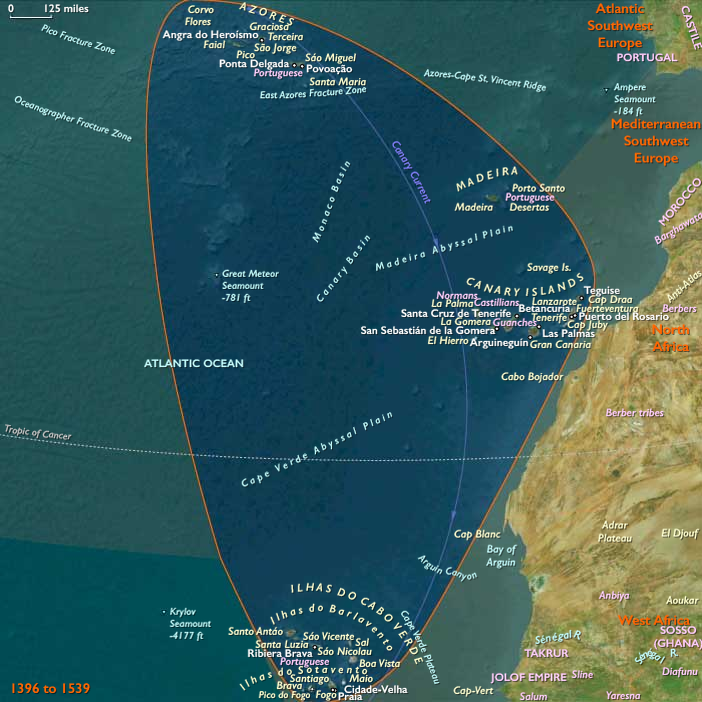
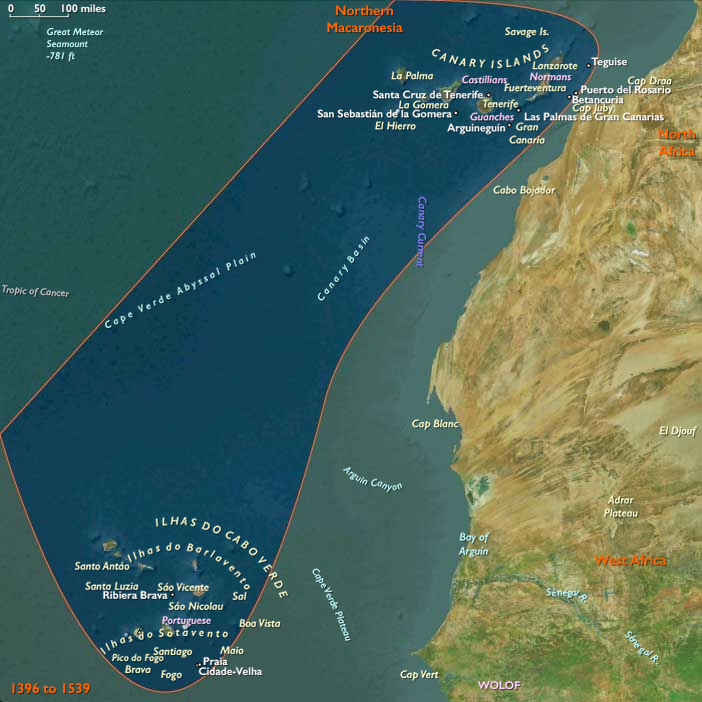
Diogo Dias and António Noli, captains in the service of the late Prince Henry the Navigator, had discovered the remaining islands of the Cape Verde archipelago.
The Portuguese return in 1462 later to the island of São Tiago to found Ribeira Grande (now Cidade Velha)—the first permanent European settlement city in the tropics.
Locations
Groups
Topics
Subjects
Regions
Subregions
Related Events
Filter results
Showing 10 events out of 41190 total
The military campaigns of 1441-60 have increased Moscow's hold over Suzdal, the Vyatka lands and the republican governments of Novgorod and Pskov.
In the later reign of Vasily II, the blind prince has been greatly helped by Metropolitan Jonah, boyars, and finally by his older son Ivan, who has been styled co-ruler since the late 1450s.
On Vasily's death on March 28, 1462, his son succeeds him as Grand Prince Ivan III.
eventually to be known as Ivan the Great, referred to as the "gatherer of the Russian lands", he will ultimately triple the territory of his state, renovate the Moscow Kremlin, and lay the foundations of the Russian state.
He is to become one of the longest-reigning Russian rulers in history.
Poland, in 1462, acquires from Mazovia the areas around Gostynin and Rawa, but the duchy itself, with its capital at Warsaw, remains independent.
A Sienese village called Corsignano was the birthplace of Aeneas Silvius Piccolomini, a Renaissance humanist born into an exiled Sienese family.
Having become Pope Pius II, he has had the entire village rebuilt as an ideal town and commune, renamed Pienza.
Intended as a retreat from Rome, it represents the first application of humanist urban planning concepts, creating an impetus for planning that will be adopted in other Italian towns and cities and eventually spread to other European centers.
The rebuilding is done by Florentine architect Bernardo Gambarelli (known as Bernardo Rossellino) who may have worked with the humanist and architect Leon Battista Alberti, though there are no documents to prove it for sure.
Alberti is in the employ of the Papal Curia at this time and serves as an advisor to Pius.
Construction had started about 1459.
Italian painter, sculptor, and architect Vecchietta, born Lorenzo di Pietro in 1412, works in a linear but naturalistic style that reflects Florentine influences.
In 1461-62, he creates his masterwork, The Assumption of the Virgin, an altarpiece for the Duomo at Pienza, which Pius consecrates on August 29, 1462, during his long summer visit.
Pope Pius II condemns slavery of newly baptized Christians as a "great crime" in an address of 1462 to the local ruler of the Canary Islands.
Pius instructs bishops to impose penalties on transgressors.
Pius does not condemn the concept of trading in slaves, only the enslavement of the recently baptized, who represent a very small minority of those captured and taken to Portugal.
The dome of the Florence Cathedral is completed, after numerous enlargements and delays, in 1462.
Franciscans establish the Monti di pietá, pity funds, to offer interest-free loans in direct competition with Jewish moneylenders, as a reform against moneylending.
(Both the Italian term monte di pietà and the French term mont de piété translate into English as mount of piety.)
The Franciscan Marco di Matteo Strozzi, who has preached about the benefits of a Monte di Pietà in combating usury, leaves a set of memoirs that outline his goal to rid Perugia of Jewish money lenders and to replace them with Christian pawn shops that allow the poor to acquire cheap credit.
The organization of the Monte di Pietà depends on acquiring a monte or a collection of funds from voluntary donations by financially privileged people who have no intentions of regaining their money.
The people in need would then be able to come to the Monte di Pietà and give an item of value in exchange for a monetary loan.
The term of the loan is to last the course of a year and only be worth about two-thirds of the borrower’s item value.
A predetermined interest rate is applied to the loan and these profits are to be used to pay the expenses of operating the Monte di Pietà.
Viewed as a lesser evil than money lending because the principle of the organization is based on the benefit of the borrower and not the profit of the lender, it is an example of one of the earliest forms of organized charity.
As a result, Jews begin to lose business, and therefore become subject to expulsion.
Castilian forces capture Gibraltar from the Nasrids on August 20, 1462, in what is known as the Eighth Siege of Gibraltar.
An immediate dispute breaks out between the House of Medina Sidonia (the Guzmán family) and the House of Arcos (the Ponce de León family) about the possession of the town.
Finally, the initiative of Juan Alonso de Guzmán, 1st Duke of Medina Sidonia succeeds and he takes possession of the town as personal property.
However, the King of Castile, Henry IV, declares Gibraltar to be Crown property and not the personal property of the Guzman family.
Restoring the charter granted to Gibraltar in 1310, Henry takes two additional measures: the lands previously belonging to Algeciras (destroyed in 1369) are granted to Gibraltar; and the status of collegiate church is solicited from Pope Pius II and granted to the Santa María Church (the present day Cathedral of St. Mary the Crowned on the site of the old Moorish Mosque).
St. Bernard of Clairvaux, whose feast falls on August 20, becomes the Patron Saint of Gibraltar.
King Ferdinand, shortly after succeeding to the throne of Naples in mid-1458, had been faced with a baronial revolt in favor of the rival king, René d’Anjou.
An authoritarian ruler, he suppresses the revolt in 1462.
François Villon and Le Grand Testament (1461–1462)
Between 1461 and 1462, the enigmatic poet and vagabond François Villon composed his magnum opus, Le Grand Testament ("The Large Testament"), widely regarded as one of the seminal works of late medieval French literature. Reflecting on themes of mortality, regret, and human frailty, the Testament embodies Villon's distinctive poetic voice—one that blends profound sincerity, biting satire, and spiritual introspection in stark contrast to the courtly idealism dominant in contemporary literature.
Literary Form and Mastery
In Le Grand Testament, Villon artfully employs traditional poetic forms—especially the ballade and rondeau—to showcase his stylistic ingenuity and technical mastery. Composed primarily in octosyllabic verse, this extensive poem follows a structured yet highly inventive pattern, including numerous ballads often arranged into three ten-line stanzas followed by shorter concluding stanzas known as envois, which vary from four to seven lines. This structural complexity underscores Villon's profound knowledge and command of medieval poetic conventions, while also subverting them through his deeply personal and often irreverent voice.
Themes and Cultural Significance
Written under the shadow of imprisonment and imminent threat of execution, Le Grand Testament reflects Villon’s preoccupation with mortality, existential uncertainty, and the transience of earthly pleasures. His sardonic and darkly humorous bequests—his soul to the Holy Trinity, his body to the earth, stolen wine to a friend, spectacles to a madman, and women to a lover—demonstrate his bitter yet poignant reflections on the absurdities of human existence. Through this blend of compassion, cynicism, irony, and sincerity, Villon’s poetry uniquely captures the gritty realities of fifteenth-century Parisian life, contrasting starkly with the idealized conventions of contemporary courtly poetry.
Political and Social Context
Villon's poetic voice emerges vividly against the tumultuous backdrop of mid-fifteenth-century France—a time marked by economic hardship, political instability, and widespread social inequality. His gritty realism, direct engagement with themes of social injustice, and explicit acknowledgment of life's harsh realities broke sharply with prevailing literary norms, elevating the experiences of the marginalized and downtrodden into poetic subject matter of enduring resonance.
Later Life and Mysterious Disappearance
After completing Le Grand Testament, Villon's tumultuous life took a mysterious turn. His release from prison in late 1462—after narrowly escaping execution—marks the last known record of his life. At roughly thirty-one years of age, Villon vanished from historical record without explanation, his final fate entirely unknown.
Long-Term Legacy
Villon's innovative, intensely personal poetry profoundly reshaped French literary traditions, laying groundwork for future generations of poets, from Renaissance humanists to modernists. Le Grand Testament is celebrated for its complex interplay of tragedy, irony, religious devotion, and visceral realism, ensuring Villon’s lasting place among Europe's greatest literary figures. His pioneering poetic voice resonates centuries later, epitomizing the transformative cultural currents of late medieval Atlantic West Europe.

Fust's firm had produced the Benedictine Psalter, in 1459, the forty-eight-line Bible in 1462, and an edition of Cicero's “De officiis.”
The Jewish community of Mainz, which dates to the tenth century, is noted for its religious education: Rabbi Gershom ben Judah (960–1040), who taught here, among others, had concentrated on the study of the Talmud, creating a German Jewish tradition.
The Jews of Mainz, Speyer and Worms in the twelfth century had created a supreme council to set standards in Jewish law and education.
The city of Mainz has responded to the Jewish population in a variety of ways, behaving, in a sense, in a bipolar fashion towards them.
Sometimes they have been allowed freedom and have been protected; at other times, they have been persecuted.
The city in 1462 expels its Jews.