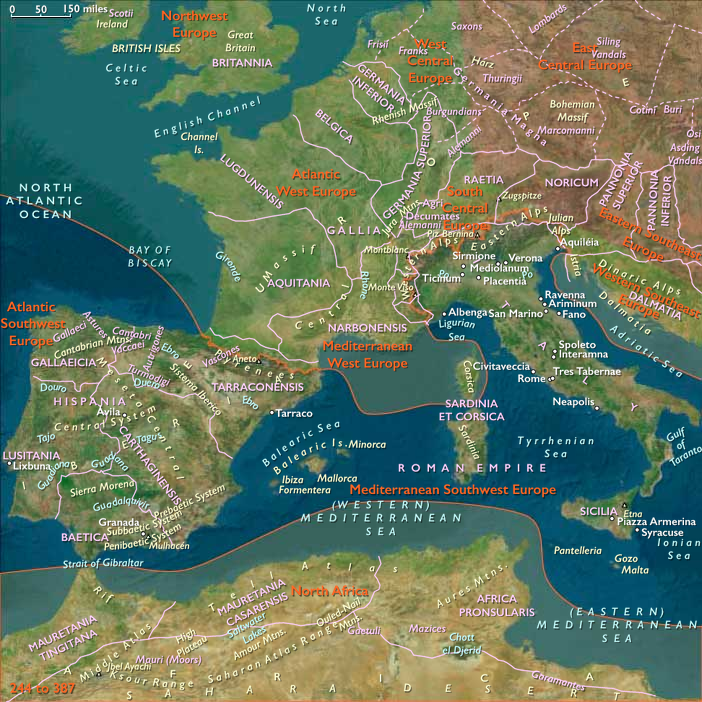
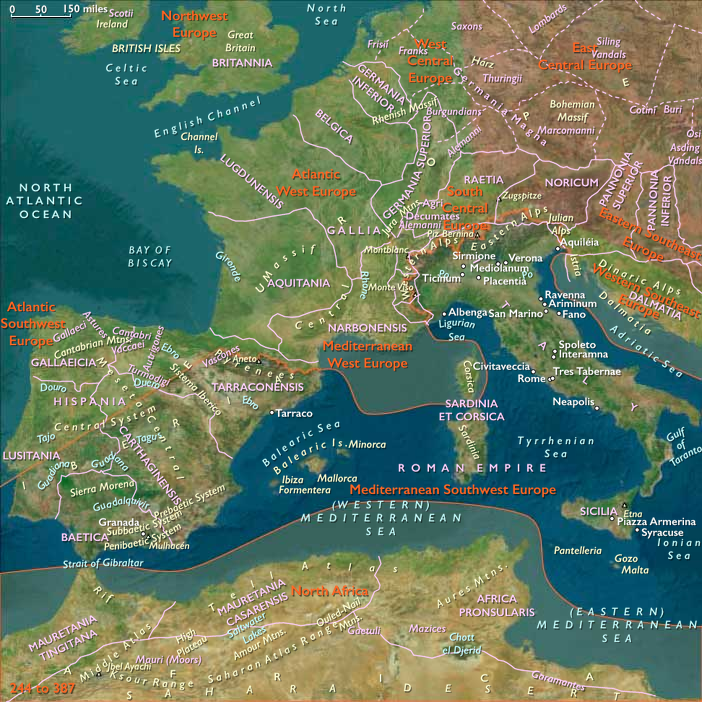
Bagaudae (also spelled bacaudae) are groups of peasant insurgents who emerge during the "Crisis of the Third Century", and persist particularly in the less Romanized areas of Gaul and Hispania.
The name probably means "fighters".
C.E.V. Nixon assesses the bagaudae, from the official Imperial viewpoint, as "bands of brigands who roamed the countryside looting and pillaging."
J.C.S. Léon interprets the most completely assembled documentation as identifying the bagaudae as the impoverished local free peasants, reinforced by bandits and deserters from the legions, who are resisting the extension of proto-feudal privileges and control in marginal areas of the Empire.
Léon sees the invasions, usurpers and disorders of the third century crisis not as causative, but as providing a chaotic relaxation of local power, within which the bagaudae achieve some temporary and scattered successes, under the leadership of lesser members of the ruling class.
The bagaudae first come to the attention of the central authorities in 285.
The fourth-century historian Eutropius describes them as rural people under the leadership of Amandus and Aelianus, while Aurelius Victor called them bandits.
The historian David S. Potter suggests that they were more than peasants, seeking either Gallic political autonomy or reinstatement of the recently deposed Carus (a native of Gallia Narbonensis, in what would become southern France): in this case, they would be defecting imperial troops, not brigands.
Although poorly equipped, led and trained—and therefore a poor match for Roman legions—Diocletian certainly considered bagaudae a threat sufficient to merit an emperor to counter them.
E.M. Wightman, in Gallia Belgica, claims that Amandus and Aelianus were likely local Gallic landowners who became "tyrants" and fought back against the Romans.
The Panegyric of Maximian, dating to 289 and attributed to Claudius Mamertinus, relates that during the bagaudae uprising of 284–285, "inexperienced farmers sought military garb; the plowman imitated the infantryman, the shepherd the cavalryman, the rustic ravager of his own crops the barbarian enemy".
In fact, they share several similar characteristics with the Germanic Heruli.
Mamertinus also called them "two-shaped monsters" (monstrorum biformium), emphasizing that while they were technically Gallo-Roman farmers and citizens, they were also marauding rogues who had become foes of the empire.
Maximian travels to Gaul late in the summer of 285, engaging the Bagaudae.
Details of the campaign are sparse and provide no tactical detail: the historical sources dwell only on Maximian's virtues and victories.
The 289 panegyric to Maximian records that the rebels were defeated with a blend of harshness and leniency.
As the campaign was against the Empire's own citizens, and therefore distasteful, it went unrecorded in titles and official triumphs.
Indeed, Maximian's panegyrist declares: "I pass quickly over this episode, for I see in your magnanimity you would rather forget this victory than celebrate it." (Panegyrici Latini 10(2), quoted in Williams, 46; Southern, 137.)
The revolt has significantly abated by the end of the year, and Maximian moves the bulk of his forces to the Rhine frontier, heralding a period of stability.