
Diego Osorio de Escobar y Llamas, who …
Years: 1664 - 1664
Diego Osorio de Escobar y Llamas, who has held the offices of canon, inquisitor and vicar-general in the diocese of Toledo, is a member of the secular clergy, but a friend of the Jesuits; he had been chosen bishop of Puebla on the recommendation of Cardinal Moscoso, taking up the position in 1656, in which he will remain until his death in 1673.
There he builds the convent of La Santísima Trinidad, hastens the construction of the cathedral, and pays for the chapel and altar of Nuestra Señora de Guadalupe.
He was in 1663 named archbishop of Mexico City, but he declined the office in order to remain in Puebla (although he does administer the diocese for a few months until the arrival of the new archbishop, Alonso de Cuevas Dávalos).
Spain is still at war with England when Osorio, apparently accepting the position with reluctance, is named to replace Viceroy Juan de Leyva de la Cerda, who has been ordered back to Spain because of corruption.
During his brief administration, Osorio sends thirty thousand pesos to Cuba for the repair of the Castle of Santiago and the rebuilding of the city, destroyed in 1662 by the English under Christopher Myngs.
He also founds a gunpowder factory and sends some of the production to Cuba.
He takes steps to see that the Armada de Barlovento (coast guard) is prepared for an attack on the Gulf coast of New Spain.
He advances money for the fortification of Campeche.
He reforms the postal service, which was very bad before his administration and much more efficient after his reforms.
He also reforms the marketing of mercury and intervenes in a dispute between the Franciscans and the governor of Yucatán.
Osorio serves as viceroy for less than four months, from June to October 1664.
A stranger to profane affairs, he resigns as viceroy at the first opportunity in order to return to his diocese in Puebla.
Afterward experiencing difficulties with his successor, Antonio Sebastián de Toledo, the bishop goes into seclusion in the town of Tlatlauquitepec.
Toledo, born in Spain, had grown up in Peru, where his father, Pedro de Toledo, 1st Marquis of Mancera, was viceroy from 1639 to 1648.
As a young adult, he joined the colonial navy and commanded squads against Dutch pirates.
Retuning to Spain with his father in 1648, he was subsequently majordomo of the royal palace, then ambassador in Venice and Germany.
On December 30, 1663, King Philip IV of Spain had named him viceroy of New Spain, although the Council of the Indies had initially rejected him on grounds of his poor health.
Arriving in Chapultepec, the Marquis had remained there some days before making his formal entry into Mexico City.
While in Chapultepec, he gave orders that no celebration was to accompany his arrival, because the treasury of the colony has been exhausted by remittances to Spain and the war against the English.
However he also ordered that the 16,000 pesos intended for the celebration be used for a filigreed golden box to be sent as a present to the king.
He enters Mexico City October 15, 1664, and takes up his office.
Locations
People
- Antonio Sebastián de Toledo Molina y Salazar, 2nd Marquis of Mancera, Grandee of Spain
- Diego Osorio de Escobar y Llamas
- Sir Christopher Myngs
Groups
- Franciscans, or Order of St. Francis
- Cuba (Spanish Colony)
- New Spain, Viceroyalty of
- Jesuits, or Order of the Society of Jesus
- Spain, Habsburg Kingdom of
- England, (Stewart, Restored) Kingdom of
Topics
- Colonization of the Americas, Spanish
- Colonization of the Americas, English
- Piracy, Golden Age of
- Spanish-Portuguese War of 1657-68
Commodoties
- Fish and game
- Weapons
- Hides and feathers
- Gem materials
- Strategic metals
- Slaves
- Sweeteners
- Land
- Tobacco
Subjects
- Commerce
- Products
- Watercraft
- Engineering
- Labor and Service
- Conflict
- Faith
- Government
- Technology
- Finance
- Piracy
Regions
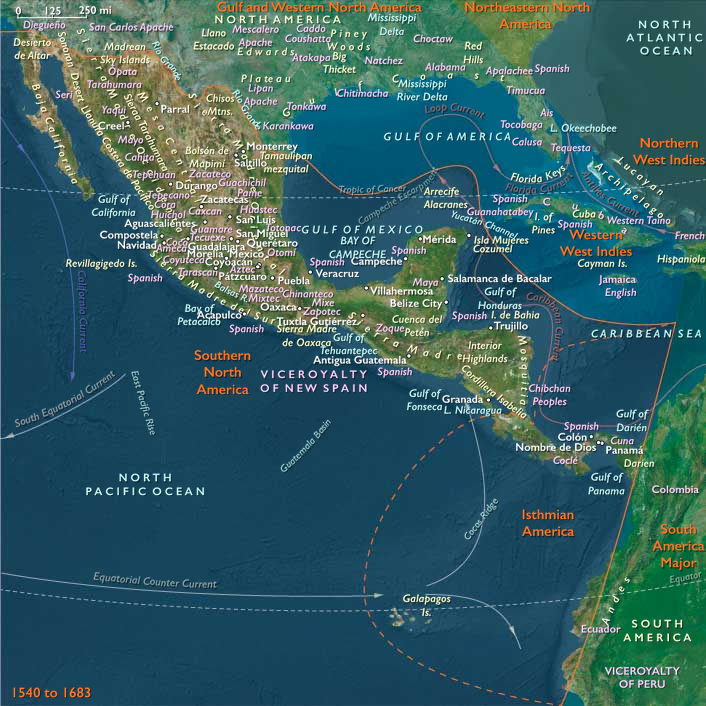
Subregions

Related Events
Showing 10 events out of 31075 total
Years: 1664 - 1664
Locations
People
- Antonio Sebastián de Toledo Molina y Salazar, 2nd Marquis of Mancera, Grandee of Spain
- Diego Osorio de Escobar y Llamas
- Sir Christopher Myngs
Groups
- Franciscans, or Order of St. Francis
- Cuba (Spanish Colony)
- New Spain, Viceroyalty of
- Jesuits, or Order of the Society of Jesus
- Spain, Habsburg Kingdom of
- England, (Stewart, Restored) Kingdom of
Topics
- Colonization of the Americas, Spanish
- Colonization of the Americas, English
- Piracy, Golden Age of
- Spanish-Portuguese War of 1657-68
Commodoties
- Fish and game
- Weapons
- Hides and feathers
- Gem materials
- Strategic metals
- Slaves
- Sweeteners
- Land
- Tobacco
Subjects
- Commerce
- Products
- Watercraft
- Engineering
- Labor and Service
- Conflict
- Faith
- Government
- Technology
- Finance
- Piracy
Regions
Subregions