
Didius Julianus, the commander of the Rhine …
Years: 172 - 183
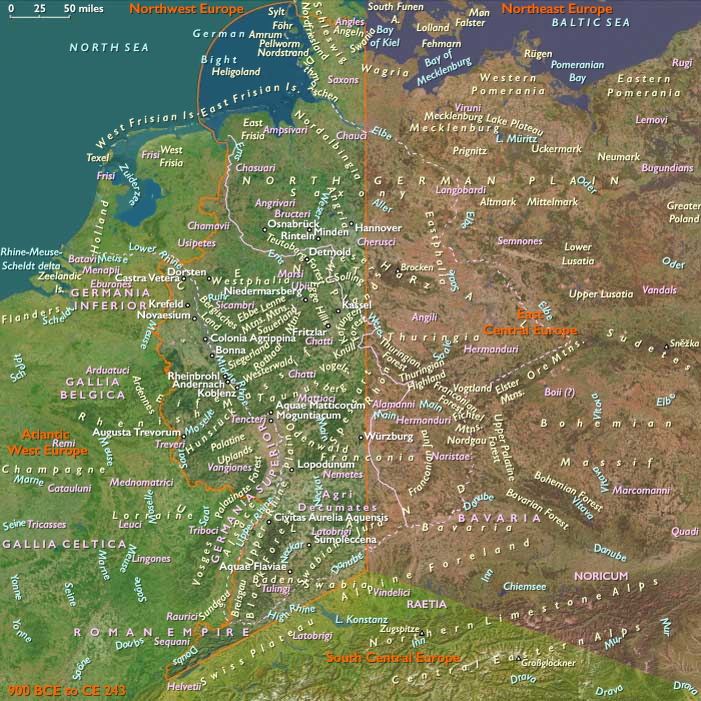
Didius Julianus, the commander of the Rhine frontier and future Roman emperor, repels another invasion of the Chatti and the Hermunduri in 173.
He had held in succession the offices of quaestor and aedile, and around 162, had been named as Praetor.
Nominated to the command of the Legio XXII Primigenia in Mogontiacum (now Mainz), he had in 170 become praefectus of Gallia Belgica and will serve for five years.
As a reward for his skill and gallantry in repressing an insurrection among the Chauci, he is raised in 175 to the consulship, along with Pertinax.
Locations
People
Groups
- Chatti (Germanic tribe)
- Chauci (Germanic tribe)
- Gallia Belgica (Roman province)
- Hermunduri (Germanic tribe)
- Roman Empire (Rome): Nerva-Antonine dynasty
Topics
Subjects
Regions

Subregions
Related Events
Filter results
Showing 10 events out of 60962 total
A Possible Connection Between the Antonine Plague and the Eastern Han Epidemics (2nd Century CE)
The Antonine Plague (165–180 CE) devastated the Roman Empire, while China’s Eastern Han dynasty suffered multiple outbreaks of disease during the reigns of Emperor Huan (r. 146–168) and Emperor Ling (r. 168–189). Some historians, including Rafe de Crespigny and Raoul McLaughlin, have suggested a possible link between these epidemics, proposing that a deadly contagion spread across Eurasia via trade routes, particularly the Silk Road and Indian Ocean networks.
1. The Han Dynasty’s Epidemics and the Yellow Turban Rebellion
- The Eastern Han Empire faced severe plagues, with outbreaks recorded in 151, 161, 171, 173, 179, 182, and 185 CE.
- These epidemics coincided with political instability, fueling popular unrest and millenarian movements, such as the Yellow Turban Rebellion (184–205 CE), led by Zhang Jue, a faith healer who promoted divine healing to counter the plague.
- De Crespigny speculates that these outbreaks may have been part of the same pandemic afflicting Rome, suggesting that disease played a role in destabilizing both empires.
2. The Roman Embassy to Han China (166 CE) and the Spread of Disease
- In 166 CE, a Roman embassy from "Daqin" (the Roman Empire) arrived at the Han court, claiming to represent "Andun" (安敦), possibly a reference to Marcus Aurelius Antoninus or Antoninus Pius.
- McLaughlin notes that this could have been the beginning of intensified Rome-Han trade, yet instead, it may have been a harbinger of something far more ominous—the spread of a deadly pandemic.
3. The Plague’s Possible Origins in Central Asia
- McLaughlin theorizes that the plague originated in Central Asia, potentially from an isolated nomadic population, before spreading to both China and Rome.
- The Silk Road and maritime trade routes facilitated the movement of goods, people, and diseases, creating a pathway for pandemics to spread across Eurasia.
- The plague’s transmission may have followed a westward route, affecting China first before reaching the Roman Empire through Parthia and Mesopotamia.
4. The Plague’s Impact on Rome’s Economy and Indian Ocean Trade
- The Antonine Plague killed roughly 10% of Rome’s population, weakening the empire’s military and economy.
- McLaughlin argues that the epidemic caused "irreparable" damage to Roman trade in the Indian Ocean, as evidenced by:
- Archaeological records showing a decline in Roman trade goods from Egypt to India.
- A significant drop in commercial activity in Southeast Asia, indicating reduced Roman maritime trade.
- This decline in long-distance commerce affected Rome’s ability to sustain wealth and maintain its eastern provinces, leading to further economic instability.
Conclusion: The Plague as a Eurasian Pandemic?
- While definitive evidence linking the Antonine Plague to the Han epidemics remains inconclusive, historians like de Crespigny and McLaughlin highlight the possibility of a shared pandemic that affected both Rome and China.
- The Roman embassy to China in 166 CE may have played a role in transmitting disease, demonstrating the unintended consequences of early global trade.
- The epidemic’s devastating impact weakened both empires, contributing to political instability in China and economic decline in Rome.
The plagues of the 2nd century CE may represent one of the earliest known instances of pandemics spreading across Eurasia via trade networks, shaping the trajectory of both the Roman and Han empires in ways that would affect world history for centuries to come.
The Military Struggles and Philosophical Reflections of Marcus Aurelius (161–180 CE)
During the reign of Marcus Aurelius (161–180 CE), Rome faced an increasing number of internal revolts and external attacks, placing significant strain on the empire’s stability. The majority of his rule was spent defending Rome’s frontiers, particularly against the Germans and Sarmatians in the Marcomannic Wars (166–180 CE).
The Marcomannic Wars: Rome’s Struggle Against the Germanic and Sarmatian Tribes
- Beginning in 166 CE, Germanic and Sarmatian tribes launched devastating invasions into Rome’s northern provinces.
- The Marcomanni, Quadi, and Sarmatians crossed the Danube River, ravaging Pannonia and Noricum and even reaching Italy, an event unprecedented since the days of the Republic.
- Marcus Aurelius personally led the Roman legions, spending much of his reign campaigning in the Danube region.
Marcus Aurelius and the Writing of Meditations
- During these campaigns, Marcus Aurelius composed parts of his philosophical masterpiece, Meditations, a reflection on Stoic philosophy and personal ethics.
- The second book of Meditations bears the note "Among the Quadi at the Granua," indicating that it was written during his campaign against the Quadi, a Germanic tribe along the Danube.
- His writings emphasized duty, resilience, and inner peace, offering insight into his philosophical approach to leadership during a time of constant war and hardship.
A Time of Internal and External Crises
- Apart from the Germanic wars, Rome faced rebellions and internal strife:
- Revolts in the Eastern provinces, particularly in Egypt and Syria, required military intervention.
- The empire was still recovering from the Antonine Plague (165–180 CE), which devastated both the population and the military.
- Economic difficulties and political instability added to the empire’s growing vulnerabilities.
The Legacy of Marcus Aurelius' Reign
- His reign is often seen as the last phase of the Pax Romana, after which Rome would enter a prolonged period of instability.
- Despite his successful campaigns, the Germanic pressure on the Danube frontier persisted, leading to further conflicts in later years.
- His death in 180 CE and the succession of his son Commodus marked the beginning of Rome’s gradual decline, culminating in the Crisis of the Third Century (235–284 CE).
Marcus Aurelius remains one of Rome’s most respected emperors, both for his military leadership and for his philosophical contributions, which continue to influence Stoic thought and ethical leadership today.
East Central Europe (172–183 CE): The Marcomannic Wars, Antonine Plague, and Frontier Crisis
Between 172 and 183 CE, East Central Europe—covering Poland, Czechia, Slovakia, Hungary, and those portions of Germany and Austria lying east of 10°E and north of a line stretching from roughly 48.2°N at 10°E southeastward to the Austro-Slovenian border near 46.7°N, 15.4°E—was profoundly disrupted by the Marcomannic Wars (166–180 CE) and further destabilized by the devastating Antonine Plague (165–180 CE). Under Emperor Marcus Aurelius (161–180 CE), intense military conflicts with tribal confederations (Marcomanni, Quadi, and the Sarmatian Iazyges) coincided with severe demographic and economic stress caused by widespread illness, dramatically reshaping frontier conditions and regional stability.
Political and Military Developments
Peak of the Marcomannic Wars
-
During Marcus Aurelius’s reign, Roman provinces (Pannonia Superior, Pannonia Inferior, and Noricum) faced significant invasions from the Marcomanni, Quadi, and Iazyges, severely challenging Roman defensive lines along the Danube.
Antonine Plague and Military Weakness
-
The Antonine Plague (165–180 CE) further weakened Roman military capabilities along the frontier, resulting in substantial manpower shortages and logistical challenges.
-
Roman forces, already under intense pressure from warfare, found it increasingly difficult to maintain effective defense and counteroffensives due to the widespread loss of personnel to disease.
Major Battles and Roman Counteroffensive
-
Major confrontations occurred near frontier settlements, notably Carnuntum, Vindobona, and Aquincum, as Roman forces sought to repel tribal incursions.
-
Despite plague-induced setbacks, Marcus Aurelius successfully conducted counteroffensives by 175 CE, temporarily restoring stability. Sporadic warfare continued until his death in 180 CE.
Economic and Technological Developments
Severe Economic Disruption
-
Trade networks along the Danube frontier experienced severe disruptions due to combined pressures of warfare and the Antonine Plague. Frontier settlements faced declining populations, reduced productivity, and impaired economic vitality.
Military and Defensive Innovation
-
The conflicts and plague encouraged improvements in Roman military fortifications, logistics, and defensive strategies. New structures and technologies emerged to adapt to this heightened crisis.
Cultural and Artistic Developments
Militarization and Crisis Reflected in Artifacts
-
Artifacts from this period increasingly emphasized military themes, protection motifs, and practical defensive use, reflecting societal responses to warfare and disease.
Settlement and Urban Development
Reinforced Frontier Fortifications
-
Significant defensive improvements reshaped urban settlements such as Carnuntum, Vindobona, and Aquincum, which transformed into heavily fortified towns responding to increased threats and reduced population.
Population Decline and Migration
-
Warfare and plague caused notable population declines and migration away from vulnerable frontier zones, creating demographic shifts throughout the region.
Social and Religious Developments
Altered Tribal Social Structures
-
Tribal societies experienced intensified pressure from conflict and economic hardship, increasing the prominence of warrior elites who provided leadership through crisis conditions.
Religious Intensification During Crisis
-
Traditional tribal religious practices intensified amid conflict and disease, emphasizing protective rites, warrior culture, and communal solidarity rituals.
Long-Term Consequences and Historical Significance
The period 172–183 CE significantly reshaped East Central Europe due to the combined devastation of the Marcomannic Wars and the Antonine Plague. Demographic losses weakened Roman frontier control, allowed temporary tribal advances, and shifted regional dynamics, laying important groundwork for future tribal migrations and regional realignments.
The Middle East: 184–195 CE
Continuing Religious Conflicts and Parthian Instability
From 184 to 195 CE, the Middle East experiences ongoing religious and political tensions, particularly highlighted by the lingering influence of the Montanist movement. Despite sustained opposition from Church authorities, Montanism continues to attract adherents, especially in Phrygia and other parts of Asia Minor. The movement’s persistent apocalyptic messaging and rigorous moral doctrines maintain its appeal among Christians disillusioned by the perceived moral laxity and hierarchical rigidity of the mainstream Church.
Simultaneously, political stability in the region deteriorates due to internal strife within the Parthian Empire. Succession disputes and factional rivalries weaken central authority, undermining Parthia's ability to effectively govern its vast territories. This internal instability is compounded by increased Roman interest in exploiting these divisions, as Emperor Septimius Severus, ascending to power in 193 CE, turns his ambitions toward securing Rome’s eastern borders and enhancing Roman influence in Armenia and Mesopotamia.
The interplay of religious fervor and geopolitical instability during this era underscores the complexities and shifting dynamics of power and belief in the Middle East at the close of the second century CE.
The Kama Sutra, a Hindu treatise on the art of love composed in Sanskrit sometime between the first and fourth centuries CE, is widely considered to be the standard work on human sexual behavior in Sanskrit literature written by Vātsyāyana, an Indian philosopher in the Cārvāka tradition.
A portion of the work consists of practical advice on sexual intercourse.
Partly a marriage manual, the text imparts such specific sexual information as the arts of scratching, biting, and pinching.
Vatsyayana discusses women, courtship, and the place of erotic pleasure in the urbane life of a man or woman of leisure in the Kama Sutra.
The Indian woman, whose duty it is in her culture to appear alluring to her lover, also uses cosmetics and perfumes to pay homage to the body.
The Kama Sutra advises women to learn the arts of tattooing and of "coloring the teeth, garments, hair, nails, and bodies."
Historian John Keay states that the Kama Sutra is a compendium that was collected into its present form in the second century CE. (Keay, John [2000]. India: A History. New York: Grove Press.)
Near East (172–183 CE): Christianity Expands Amidst Cultural and Intellectual Flourishing
During this era, Christianity continues its gradual expansion across the Near East, becoming firmly established in urban centers throughout Asia Minor, Syria, and Egypt. Despite periodic Roman persecutions, Christian communities grow stronger and increasingly structured, benefiting from improved communication networks throughout the Roman Empire.
Concurrently, Alexandria, as a major intellectual hub, witnesses a flourishing of Hellenistic thought and learning. Intellectual exchanges between Jewish, Christian, and pagan scholars enrich religious and philosophical discourse. The city's famed library and educational institutions foster advanced studies in literature, philosophy, and science, influencing the broader Near Eastern intellectual landscape.
In Judea and Galilee, the recovery from previous rebellions and persecutions continues. Jewish scholars, following the precedent set by Judah ha-Nasi, further refine religious teachings, interpretations, and traditions, laying the groundwork for the eventual creation of the Gemara, the extensive rabbinic commentary that complements the Mishnah.
Legacy of the Era
The period from 172 to 183 CE strengthens the religious and intellectual foundations in the Near East. The growth and institutional consolidation of Christianity, coupled with a renewed intellectual and spiritual vitality among Jewish communities, particularly through ongoing work on rabbinic traditions, prepares the region for the complex religious and cultural transformations that lie ahead.
Mediterranean Southwest Europe (172–183 CE): Marcus Aurelius’s Reign and Continued Philosophical Influence
The era 172–183 CE in Mediterranean Southwest Europe continues under the philosophically-driven reign of Marcus Aurelius, witnessing significant military and political challenges alongside sustained intellectual and cultural dynamism.
Marcus Aurelius and the Marcomannic Wars
During this period, Emperor Marcus Aurelius devotes considerable attention to military affairs, notably the Marcomannic Wars (166–180 CE), a series of conflicts against Germanic tribes along Rome's northern borders. Despite his preference for philosophical contemplation, Aurelius demonstrates resilience and strategic skill in managing these prolonged military campaigns, safeguarding imperial stability.
Philosophical Reflections: Meditations
Throughout these turbulent years, Marcus Aurelius composes his philosophical masterpiece, Meditations. This introspective work embodies Stoic principles, emphasizing duty, rationality, and personal virtue in the face of adversity. The Meditations become influential beyond their era, profoundly shaping philosophical thought and ethical reflection in Roman society and beyond.
Continuing Artistic and Cultural Flourishing
Cultural and artistic vitality remains strong, highlighted by ongoing innovations in sculpture, architecture, and literature. Roman sarcophagi continue to be intricately crafted, exemplifying high-relief techniques depicting detailed mythological narratives and reinforcing the cultural sophistication of the period.
Early Christian Communities and Continued Debates
This era witnesses sustained growth and theological development within early Christian communities, marked by ongoing doctrinal debates and philosophical exchanges. Intellectual figures following in the footsteps of Justin Martyr and Tatian further elaborate Christian theology, addressing Roman philosophical traditions and religious controversies, and contributing to Christianity’s gradual expansion and intellectual integration.
Economic Resilience and Infrastructure Development
Mediterranean Southwest Europe maintains robust economic health, supported by consistent trade, stable governance, and sustained infrastructure development. Imperial patronage ensures the continued enhancement of roads, ports, aqueducts, and public facilities, facilitating economic prosperity and urban cohesion.
Legacy of Marcus Aurelius and Cultural Continuity
The era 172–183 CE solidifies Marcus Aurelius’s legacy as both a capable ruler and an influential philosopher-emperor. His thoughtful governance during military crises, combined with profound philosophical insights captured in the Meditations, reinforces the era’s intellectual and cultural strengths. This period leaves an enduring impact, influencing subsequent Roman imperial philosophy, ethics, and governance.
North Africa (172–183 CE)
Roman Stability, Urban Prosperity, and Saharan Trade Continuity
Roman Governance and Provincial Stability
From 172 to 183 CE, Roman provincial administration in Africa Proconsularis continues to maintain regional stability, fostering economic growth through consistent governance and ongoing infrastructure investments. Prominent cities such as Utica, Leptis Magna, and Caesarea (Cherchell) experience sustained urban development and enhanced commercial activities, further solidifying their importance within the extensive Roman Mediterranean trade network.
Numidia: Economic Growth and Cultural Harmony
Numidia maintains its robust economic growth under effective Roman oversight. Continued agricultural productivity, expanded trade routes, and infrastructural improvements enhance provincial prosperity. Numidian communities effectively balance traditional cultural practices with Roman administrative frameworks, ensuring regional cohesion, cultural continuity, and economic stability.
Mauretania: Continued Prosperity and Cultural Dynamism
Mauretania continues to flourish economically and culturally. Caesarea remains a critical hub for significant trade in grain, olive oil, and luxury commodities. Consistent Roman investments in infrastructure support ongoing commercial expansion, reinforcing Mauretania’s strategic significance in Roman North Africa.
Cyrenaica: Economic Resilience and Scholarly Prominence
Cyrenaica sustains its economic resilience and scholarly reputation. The Greek Pentapolis—Cyrene, Barce (Al Marj), Euhesperides (Benghazi), Teuchira (Tukrah), and Apollonia (Susah)—continues vigorous trade, particularly in grain, wine, wool, and livestock. Cyrene further solidifies its role as a center of intellectual exchange, consistently attracting scholars and enhancing its Mediterranean-wide academic prominence.
Berber Communities: Economic Integration and Cultural Stability
Berber communities actively engage in regional commerce through coastal trade hubs such as Oea (Tripoli). Inland Berber tribes maintain traditional governance structures and cultural practices, benefiting indirectly from vibrant coastal trade networks. This continued economic interaction promotes regional stability, cultural resilience, and sustained prosperity.
Garamantes: Persistent Saharan Trade Leadership
The Garamantes maintain their pivotal role in managing trans-Saharan trade networks. Their advanced agricultural techniques and effective control of caravan routes enable extensive commerce between sub-Saharan Africa and Mediterranean markets, reinforcing regional economic stability and cultural integration.
Mauri (Moors) and Saharan Pastoral Nomads
The Mauri (Moors) maintain regional influence through ongoing diplomatic and economic activities, significantly contributing to the stability and prosperity of western North Africa.
Saharan pastoral nomads persist as critical facilitators of trade, cultural exchanges, and information dissemination, effectively bridging diverse ecological and economic zones and reinforcing regional interconnectedness.
Cultural Syncretism and Regional Integration
Continued interactions among Berber, Roman, Greek, Garamantian, Musulami, Gaetulian, Mauri, and Saharan pastoral communities enrich regional traditions in arts, crafts, and religious practices. Religious syncretism remains vibrant, harmoniously blending indigenous Berber beliefs with Roman, Greek, Phoenician, and Saharan spiritual customs, enhancing the cultural diversity of North Africa.
Foundation for Enduring Stability and Prosperity
By 183 CE, North Africa maintains robust economic stability, cultural resilience, and regional prosperity. The effective Roman provincial governance, sustained urban growth, resilient Berber communities, and enduring Saharan trade networks collectively reinforce North Africa’s ongoing strategic importance within the broader Mediterranean geopolitical context.
Atlantic Southwest Europe (172–183 CE): Provincial Stability, Economic Vitality, and Cultural Continuity under Marcus Aurelius and Commodus
Between 172 and 183 CE, Atlantic Southwest Europe—covering northern and central Portugal, Galicia, Asturias, Cantabria, and northern Spain south of the Franco-Spanish border (43.05548° N, 1.22924° W)—continued to experience notable stability, economic prosperity, and cultural vitality under the final years of Marcus Aurelius’s rule (161–180 CE) and the early reign of Commodus (180–192 CE). Despite broader imperial challenges elsewhere, this province remained remarkably peaceful, economically dynamic, and culturally resilient. Indigenous identities persisted robustly, integrating dynamically within the established Roman provincial framework.
Political and Military Developments
Continued Stability Amidst Imperial Transitions
-
The provincial administration remained stable and effective throughout the transitional period from Marcus Aurelius to Commodus. Provincial governance provided internal peace and continuity, supported by well-established bureaucratic structures, permanent military presence, fortified settlements, and urbanized infrastructure.
-
Local elites continued integrating deeper into Roman civic and administrative structures, facilitating effective governance and contributing significantly to regional cohesion.
Northern Tribes: Ongoing Integration and Stability
-
Northern tribal regions—including the Gallaeci, Astures, and Cantabri—remained peaceful, economically prosperous, and thoroughly integrated within Roman provincial administration, actively participating in provincial development and civic institutions.
-
The Vascones continued successfully preserving territorial autonomy, diplomatic neutrality, cultural distinctiveness, and internal stability under stable provincial rule.
Economic and Technological Developments
Sustained Economic Prosperity and Mediterranean Integration
-
Atlantic Southwest Europe’s economy continued thriving, deeply integrated into Roman-controlled Mediterranean trade networks. Regional exports—valuable metals (silver, copper, tin), agricultural products, timber, salt, textiles, livestock products, and slaves—remained robust, while imports of luxury goods, fine ceramics, wine, olive oil, and sophisticated iron products further enriched local economies.
-
Provincial elites enjoyed ongoing prosperity, reinforcing regional economic specialization, social stratification, and reliance upon Roman trade and economic networks.
Persistent Reliance on Slave Labor
-
Slavery remained fundamental to regional economic activities, prominently utilized in mining, agriculture, domestic labor, artisanal crafts, and urban infrastructure. The active slave trade continued embedding slavery firmly within the regional economic and social structures.
Infrastructure Investment and Technological Advancement
-
Investments in provincial infrastructure continued under Marcus Aurelius and Commodus, including expanded roads, aqueducts, public baths, amphitheaters, temples, forums, bridges, and port facilities. Such developments significantly enhanced provincial connectivity, urban amenities, and economic efficiency.
-
Technological innovation, particularly in metallurgy, agriculture, and construction, continued enhancing agricultural productivity, artisanal craftsmanship, urbanization, and regional prosperity.
Cultural and Religious Developments
Cultural Resilience and Mature Artistic Expression
-
Material culture continued demonstrating a dynamic synthesis of indigenous Iberian traditions, Celtic motifs, and Roman artistic influences. Elaborate metalwork, sophisticated jewelry, fine pottery, ceremonial objects, and everyday household items showcased resilient regional identities and ongoing cultural vitality.
-
Indigenous communities—especially among Lusitanians, Gallaeci, Astures, Cantabri, and Vascones—remained culturally robust, creatively adapting their traditions and identities within the integrated Roman provincial context.
Ritual Continuity and Cultural Adaptation
-
Ritual and religious traditions persisted actively, blending indigenous Iberian, Celtic, and Roman elements. Sacred landscapes, temples, and communal ceremonies continued reinforcing regional identities, cultural continuity, and tribal cohesion.
-
Traditional ancestral rites, warrior ceremonies, and regional festivals continued robustly, strengthening regional solidarity, identity, and cultural resilience amidst stable Roman governance.
Continued Expansion of Roman Citizenship
-
Roman citizenship continued expanding gradually, extending beyond elites and military veterans to broader layers of society. Commodus’s reign supported ongoing civic integration, deepening identification with Roman institutions and setting the stage for universal citizenship under the Constitutio Antoniniana in 212 CE.
Notable Tribal Groups and Settlements
-
Lusitanians: Economically prosperous, culturally vibrant, and increasingly integrated into Roman civic and social structures.
-
Vettones and Vaccaei: Maintained regional stability, prosperity, and autonomy through ongoing diplomatic cooperation and deeper civic integration.
-
Gallaeci, Astures, Cantabri: Remained peaceful, prosperous, and culturally resilient under provincial administration, actively preserving local identities and traditions.
-
Vascones: Successfully preserved autonomy, territorial integrity, diplomatic neutrality, and cultural distinctiveness within the provincial system.
Long-Term Significance and Legacy
Between 172 and 183 CE, Atlantic Southwest Europe:
-
Maintained remarkable provincial stability, administrative continuity, and economic vitality despite broader imperial transitions.
-
Continued robust economic integration with Mediterranean trade networks, further embedding slavery as a critical economic institution.
-
Demonstrated enduring cultural resilience and mature artistic expression, dynamically preserving vibrant indigenous identities alongside expanded Roman civic identity and cultural influence.
This period significantly reinforced Atlantic Southwest Europe’s legacy as a stable, economically prosperous, culturally vibrant province within the Roman Empire, laying critical groundwork for broader citizenship integration and cultural evolution in the subsequent decades.
Atlantic West Europe: 172–183
From 172 to 183 CE, Atlantic West Europe—covering Aquitaine, the Atlantic coast, northern and central France, Alsace, and the Low Countries—faced subtle but growing pressures as the broader Roman Empire experienced renewed external conflicts and internal challenges during the reign of Marcus Aurelius and the brief sole rule of his son, Commodus (r. 180–192).
Political and Military Developments
-
Increasing Military Pressures (172–180):
-
While Marcus Aurelius directed military efforts primarily toward conflicts along the Danube against Germanic tribes (Marcomannic Wars, 166–180), the indirect impact reached Atlantic West Europe in the form of heavier taxation and increased troop levies.
-
Few direct military threats touched the region, but the demands of prolonged eastern conflicts strained local administration.
-
-
Transition to Commodus (180):
-
The death of Marcus Aurelius (180) and succession by Commodus introduced political instability. Commodus, less adept than his father, relied heavily on advisers, initiating tensions that gradually filtered down to provincial governance.
-
Economic Developments
-
Moderate Economic Strain:
-
Costs related to the prolonged Marcomannic wars caused increased taxation, putting some strain on local economies and trade networks.
-
Bordeaux and other trade centers continued profitable wine export, but higher imperial demands constrained prosperity and local economic flexibility.
-
-
Infrastructural Stress:
-
Investments in infrastructure maintenance slowed slightly, as imperial resources focused on frontier military needs.
-
Urban and Rural Developments
-
Continued Urban Stability:
-
Cities such as Lyon, Autun, and Bordeaux maintained urban populations and municipal functions, though growth rates slowed.
-
Increased taxation likely resulted in more conservative urban spending and slowed ambitious construction projects.
-
-
Rural Pressures:
-
Agricultural productivity remained stable, but growing imperial demands and slightly increased fiscal burdens placed modest pressure on rural economies.
-
Cultural and Religious Life
-
Cultural Continuity Amidst Stress:
-
Romanization remained deeply embedded, with Latin cultural dominance in urban areas.
-
Religious syncretism continued, though subtle signs of social tension and dissatisfaction with Roman authority began appearing.
-
Signs of Emerging Challenges
-
Gradual economic pressures and increased imperial taxation set the stage for future instability. Though the region remained broadly prosperous, underlying tensions hinted at the political and economic stresses that would emerge more explicitly in subsequent eras.
Long-term Significance
The era (172–183 CE) marked a transitional phase in Atlantic West Europe, balancing stability inherited from previous peaceful eras against emerging pressures stemming from broader imperial challenges. These subtle but mounting stresses hinted at significant political, economic, and social transformations to come.
Years: 172 - 183
Locations
People
Groups
- Chatti (Germanic tribe)
- Chauci (Germanic tribe)
- Gallia Belgica (Roman province)
- Hermunduri (Germanic tribe)
- Roman Empire (Rome): Nerva-Antonine dynasty
Topics
Subjects
Regions
Subregions