
Details from Chinese sources seem to indicate …
Years: 123BCE - 123BCE
Details from Chinese sources seem to indicate that the nomad invasion did not end civilization in Bactria entirely.
Hellenized cities continue to exist for some time, and the well-organized agricultural systems are not demolished.
Some time after 124 BCE, possibly disturbed by further incursions of rivals from the north and apparently vanquished by the Parthian king Mithridates II, successor to Artabanus, the Yuezhi move south to Bactria.
Bactria had been conquered by the Greeks under Alexander the Great in 330 BCE and since settled by the Hellenistic civilization of the Seleucids and the Greco-Bactrians for two centuries.
This event is recorded in Classical Greek sources, when Strabo presented them as a Scythian tribe and explained that the Tocharians—together with the Assianis, Passianis and Sakaraulis—took part in the destruction of the Greco-Bactrian kingdom in the second half of the second century BCE: "Most of the Scythians, beginning from the Caspian Sea, are called Dahae Scythae, and those situated more towards the east Massagetae and Sacae; the rest have the common appellation of Scythians, but each separate tribe has its peculiar name.
All, or the greatest part of them, are nomads.
The best known tribes are those who deprived the Greeks of Bactriana, the Asii, Pasiani, Tochari, and Sacarauli, who came from the country on the other side of the Jaxartes, opposite the Sacae and Sogdiani."
(Strabo, 11-8-1) A description of the Greco-Bactrian kingdom is made by Zhang Qian after the conquest by Yuezhi: "Daxia (Greco-Bactria) is located over 2,000 li southwest of Dayuan, south of the Gui (Oxus) river.
Its people cultivate the land and have cities and houses.
Their customs are like those of Ta-Yuan.
It has no great ruler but only a number of petty chiefs ruling the various cities.
The people are poor in the use of arms and afraid of battle, but they are clever at commerce.
After the Great Yuezhi moved west and attacked the lands, the entire country came under their sway.
The population of the country is large, numbering some 1,000,000 or more persons.
The capital is called the city of Lanshi (Bactra) (modern Balkh) and has a market where all sorts of goods are bought and sold."
In a sweeping analysis of the physical types and cultures of Central Asia that he visited in 126 BCE, Zhang Qian reports that "although the states from Dayuan west to Anxi (Parthia), speak rather different languages, their customs are generally similar and their languages mutually intelligible.
The men have deep-set eyes and profuse beards and whiskers.
They are skillful at commerce and will haggle over a fraction of a cent.
Women are held in great respect, and the men make decisions on the advice of their women."
Locations
People
Groups
- Tocharians
- Iranian peoples
- Yuezhi
- Scythians, or Sakas
- Dayuan
- Greeks, Hellenistic
- Greco-Bactrian Kingdom
- Parthian Empire
- Han Dynasty (Western)
Topics
Commodoties
Subjects
Regions
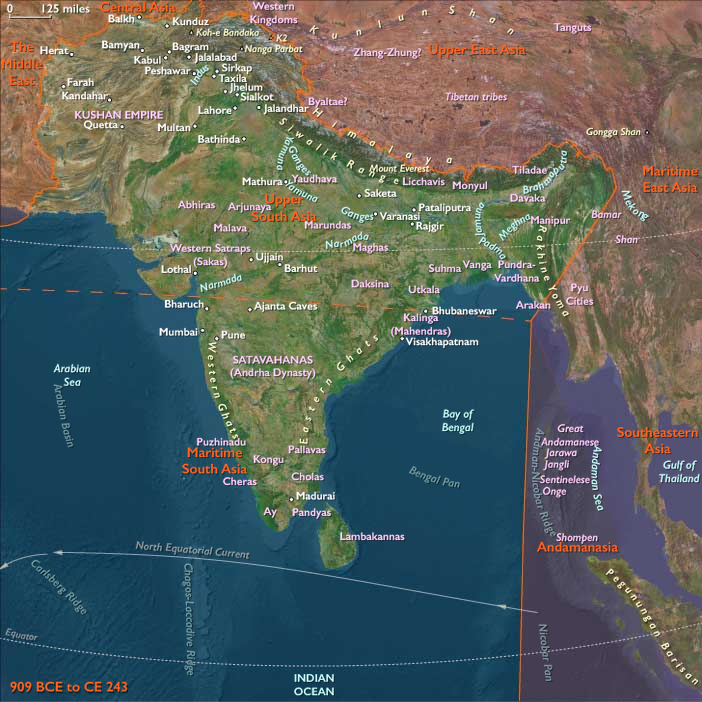
Subregions
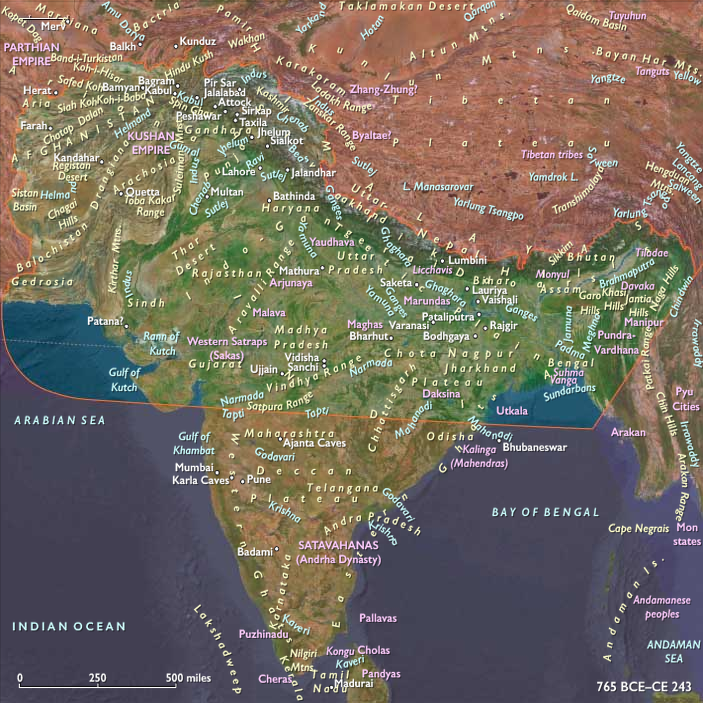
Related Events
Showing 10 events out of 62989 total
Years: 123BCE - 123BCE
Locations
People
Groups
- Tocharians
- Iranian peoples
- Yuezhi
- Scythians, or Sakas
- Dayuan
- Greeks, Hellenistic
- Greco-Bactrian Kingdom
- Parthian Empire
- Han Dynasty (Western)
Topics
Commodoties
Subjects
Regions
Subregions