
The non-Spanish forces, despite their success in …
Years: 1212 - 1212
June
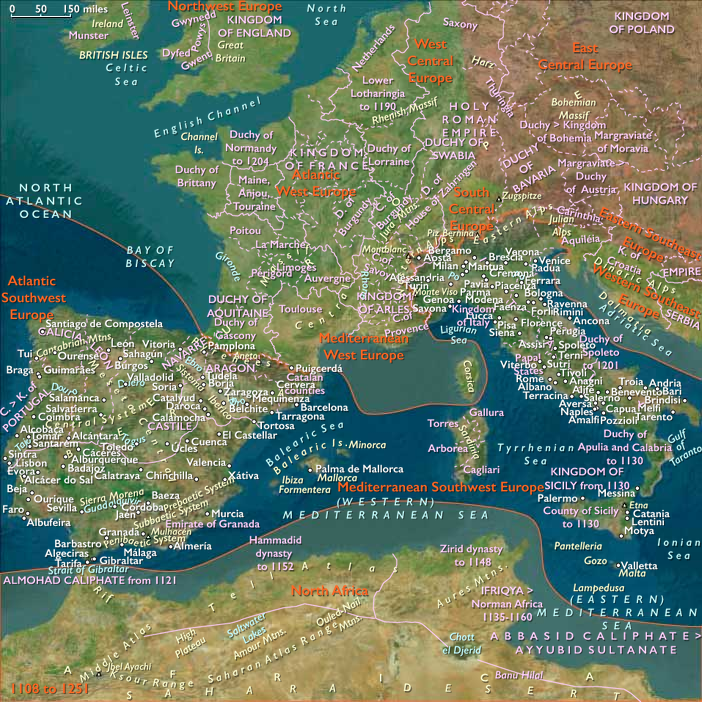
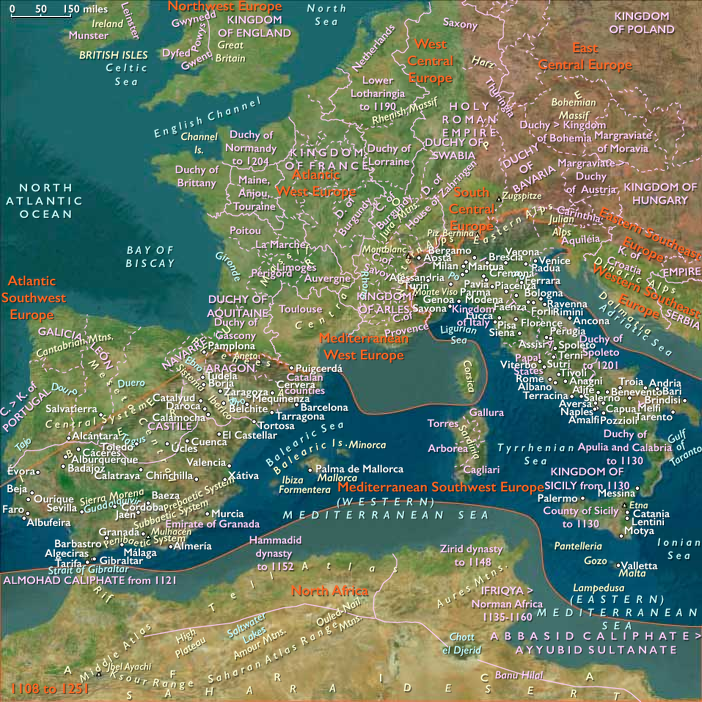
The non-Spanish forces, despite their success in taking two Muslim fortresses, are soon discouraged by adverse climatic and living conditions and return home.
The armies of Navarre, however, are now recruited for the expedition.
Locations
People
- Afonso II of Portugal
- Alfonso VIII of Castile
- Muhammad al-Nasir
- Peter II of Aragon
- Pope Innocent III
Groups
- Moors
- Muslims, Sunni
- Papal States (Republic of St. Peter)
- Navarre, Kingdom of
- Christians, Roman Catholic
- Castile, Kingdom of
- Cistercians, Order of the (White Friars)
- Aragón, Kingdom of
- Almohad Caliphate
- Salvatierra, Order of
Topics
Commodoties
Subjects
Regions
Subregions
Related Events
Filter results
Showing 10 events out of 47406 total
Genghis Khan is wounded by an arrow to his knee in 1212 after the Mongols return from their relaxation in the borderlands between grass and Gobi.
Meanwhile, as the Mongols under Genghis Khan invaded Jin, a Khitan chief, Yelü Liuge, had revolted against the dynasty in Liaodong in 1211 and made contact with the Mongol Empire in the next year.
Kamo no Chōmei, an author, poet (in the waka form), and essayist had witnessed a series of natural and social disasters, and, having lost his political backing, had been passed over for promotion within the Shinto shrine associated with his family.
Deciding to turn his back on society and take Buddhist vows, he had become a hermit, living outside the capital.
This is unusual for the time, when those who turn their backs on the world usually join monasteries.
Along with the poet-priest Saigyô he is representative of the literary recluses of his time, and his celebrated essay Hōjōki ("An Account of a Ten-Foot-Square Hut") is representative of the genre known as "recluse literature" (sōan bungaku).
Written in 1212, it describes the disasters that had befallen the people of Kyoto from earthquakes to famine and fire.
The Kara-Khitan Khanate had not destroyed the Karakhanid dynasty.
Instead, the Khitans had stayed at Semirech'e with their headquarters near Balasaghun, and allowed some of the Karakhanids to rule as vassals in Samarkand and Kashgar, with the Karakhanids acting as their tax-collectors and administrators on Muslim sedentary populations (the same practice will be adopted by the Golden Horde on the Russian Steppes).
The Kara-Khitans are Buddhists and shamanists ruling over largely Muslim Karakhanids, although they are considered fair-minded rulers whose reign is marked by religious tolerance.
Islamic religious life has continued uninterrupted and Islamic authority has been preserved, while Kashgar is a Nestorian metropolitan see and Christian gravestones in the Chu valley appear beginning this period.
The population of Samarkand stages a revolt in 1212 against the Khwarezmians, a revolt that Uttman supports, and massacres them.
The Khwarezm-Shah returns, recaptures Samarkand and executes Uthman.
He demands the submission of all leading Karakhanids, and finally extinguishes the Western Karakhanid state.
The increasingly powerful Kingdom of Bohemia now functions as an independent state although it remains a dominant force within the Holy Roman Empire.
Its ruler, Ottokar, taking advantage of the German civil war between the Hohenstaufen claimant Philip of Swabia and the Welf candidate Otto IV, had declared himself King of Bohemia.
This title was supported by Philip of Swabia who needed Czech military support against Otto (1198).
In 1200, with Otto IV in the ascendancy, to had abandoned his pact with Philip and declared for the Welf faction.
Both Otto and Pope Innocent III had subsequently accepted Ottokar as hereditary King of Bohemia.
Philip's consequent invasion of Bohemia was successful.
Ottokar, having been compelled to pay a fine, again ranged himself among Philip's partisans and still later was among the supporters of the young king, Frederick II.
In 1212, Frederick grants to Bohemia the Golden Bull of Sicily, which document recognizes Ottokar and his heirs as Kings of Bohemia.
The King is no longer subject to appointment by the Emperor, and is only required to attend Diets close to the Bohemian border.
Although a subject of the Holy Roman Empire, the Bohemian King is to be the leading electoral prince of the empire and to furnish all subsequent Emperors with a bodyguard of three hundred knights when they go to Rome for their coronation.
Ottokar's reign is also notable for the start of German immigration into Bohemia and the growth of towns in what have until this point been forest lands.
Geoffrey of Villehardouin, Marshal of Champagne and of Romania, involved in most of the important developments during the Fourth Crusade and rewarded with a fief in Thrace after the fall of Constantinople in 1204, dies in about 1212.
Considered one of the most important historians of the age, he leaves, in his unfinished account of the Crusade, an important prose history—the first written in French—including his eyewitness account of the sacking of the imperial city.
Villehardouin's account is generally read alongside that of Robert of Clari, a French knight of low station, Niketas Choniates, a high-ranking imperial official and historian who gives an eyewitness account, and Gunther of Pairis, a Cistercian monk who tells the story from the perspective of Abbot Martin who accompanied the Crusaders.
The Nicaeans win minor victories against the Latins in 1212.
Catholic forces capture much of the province of Toulouse in 1212.
Francis, with the collaboration of eighteen-year-old Clare of Assisi—who, like Francis, left her noble Italian family for a life of austerity and prayer—establishes a branch of his order for women, called the Poor Clares, in 1212.
Although, according to tradition, Clare’s family wanted to take her back by force, her dedication to holiness and poverty inspires the friars to accept her resolution.
She is given the habit of a nun and transferred to Benedictine convents, first at Bastia and then of Sant Angelo di Panzo, for her formation.
The Construction of Notre-Dame de Reims (1212 CE): The Coronation Cathedral of France
In 1212, construction began on Notre-Dame de Reims, the Roman Catholic cathedral destined to serve as the traditional coronation site of the kings of France. The new Gothic cathedral replaced an earlier church, which had been destroyed by fire in 1211. This earlier structure had itself been built on the site of the basilica where Clovis, the first Christian king of the Franks, was baptized by Saint Remi in 496 CE. The location, already deeply symbolic in French royal history, became the most important site of royal consecration in medieval France.
The Historical and Religious Significance of the Site
- The cathedral's location has deep historical and religious roots.
- The original basilica of Saint Remi, where Clovis was baptized, was a foundational moment in French Christian history, marking the beginning of the alliance between the Frankish monarchy and the Church.
- This basilica itself was constructed over an ancient Roman bath complex, reflecting the site's long-standing importance.
The Destruction of the Earlier Church (1211) and the New Gothic Cathedral (1212)
- The previous cathedral, which had stood on the site for centuries, burned down in 1211.
- In 1212, construction began on a new cathedral in the Gothic style, following the architectural trends of the time.
- Notre-Dame de Reims was designed to surpass its predecessor in grandeur, both architecturally and symbolically, as the spiritual heart of French monarchy.
Architectural Features of Notre-Dame de Reims
- Built in the High Gothic style, the cathedral emphasized height, light, and elaborate sculptural decoration.
- Key features include:
- A soaring façade with intricate Gothic sculptures depicting biblical kings, saints, and historical figures.
- A massive rose window, rivaling those of Notre-Dame de Paris and Chartres Cathedral.
- Flying buttresses, allowing for large stained-glass clerestory windows, illuminating the interior with divine light.
The Coronation Cathedral of France
- From the 13th century onward, nearly every king of France was crowned in Notre-Dame de Reims, reinforcing its central role in French royal ideology.
- The grandeur of the cathedral symbolized the divine right of kings, legitimizing their rule through sacred anointing and ceremony.
Legacy
- Notre-Dame de Reims remains one of the most significant medieval cathedrals in Europe, embodying both religious and political power.
- Its construction was a turning point in Gothic architecture, influencing later cathedrals in France and beyond.
- Despite damage during World War I, the cathedral remains a UNESCO World Heritage site, preserving its legacy as the historic heart of French monarchy.
The construction of Notre-Dame de Reims in 1212 transformed the city into the spiritual and political center of Capetian France, ensuring its place as the cathedral of kings for centuries to come.
Philip II's Opportunistic Strategy in the Anglo-German-Papal Conflicts (1212 CE)
By 1212, John of England and Otto IV of Germany were both embroiled in power struggles with Pope Innocent III, providing Philip II of France with an opportunity to advance Capetian interests in both Germany and England.
- John’s conflict with the papacy arose from his refusal to accept Pope Innocent III’s nominee for the Archbishop of Canterbury, leading to his excommunication in 1209.
- Otto IV’s struggle with Innocent III stemmed from his attempt to seize Sicily from the Pope’s favored candidate, Frederick II, violating previous agreements.
Philip sought to exploit these disputes:
- In Germany, he supported the rebellion of the German princes in favor of young Frederick II, undermining Otto’s rule.
- In England, he saw an opportunity for invasion, hoping to topple John and expand Capetian influence across the Channel.
The Marriage of Ferdinand of Portugal and Jeanne of Flanders (January 1212)
- On January 1212, Prince Fernando of Portugal, Count of Flanders, married Jeanne, the eldest daughter of Baldwin IX of Flanders (who had briefly reigned as Latin Emperor of Constantinople).
- Fernando (now known as Ferdinand, Count of Flanders) became entangled in a territorial dispute over Jeanne’s paternal inheritance, particularly Artois.
Philip’s Intervention in Flanders: The Capture of the Newlyweds
- As Jeanne and Ferdinand traveled to Flanders, they were ambushed and captured by Prince Louis (future Louis VIII of France), the eldest son of Philip II.
- Louis aimed to force Jeanne to surrender her claim to Artois, which had been taken back by force by her father after the death of her aunt, Elizabeth of Flanders.
- To secure their release, Jeanne was compelled to cede these Flemish lands to Philip, expanding Capetian control over Flanders.
Jeanne and Ferdinand Join the Anti-French Alliance
- After their release, Jeanne and Ferdinand aligned themselves with Philip’s enemies, reviving an anti-French coalition consisting of:
- John of England.
- Otto IV of Germany.
- The discontented Flemish nobility.
- This new alliance set the stage for a renewed war between France and its rivals, culminating in the Battle of Bouvines in 1214, where Philip II would secure his greatest military triumph.
Philip’s manipulation of the Anglo-German conflicts and his intervention in Flanders allowed him to consolidate power in northern France, though it also provoked new enemies who would challenge him militarily in the coming years.
Years: 1212 - 1212
June
Locations
People
- Afonso II of Portugal
- Alfonso VIII of Castile
- Muhammad al-Nasir
- Peter II of Aragon
- Pope Innocent III
Groups
- Moors
- Muslims, Sunni
- Papal States (Republic of St. Peter)
- Navarre, Kingdom of
- Christians, Roman Catholic
- Castile, Kingdom of
- Cistercians, Order of the (White Friars)
- Aragón, Kingdom of
- Almohad Caliphate
- Salvatierra, Order of
