
Caravaggio, despite his success in Naples, had …
Years: 1608 - 1608
Caravaggio, despite his success in Naples, had left after only a few months in the city for Malta, the headquarters of the Knights of Malta, presumably hoping that the patronage of Alof de Wignacourt, Grand Master of the Knights, could help him secure a pardon for Tomassoni's death.
De Wignacourt proves so impressed at having the famous artist as official painter to the Order that he inducts him as a knight, and the early biographer Bellori records that the artist was well pleased with his success.
Major works from his Malta period include a huge Beheading of Saint John the Baptist (the only painting to which he puts his signature, which he has placed in red blood spilling from the Baptist's cut throat).
According to Andrea Pomella in Caravaggio: An Artist through Images (2005), the work is widely considered to be Caravaggio's masterpiece and one of the most important works in Western painting.
He also executes a Portrait of Alof de Wignacourt and his Page, as well as portraits of other leading knights.
Yet by late August 1608 he is arrested and imprisoned.
The circumstances surrounding this abrupt change of fortune have long been a matter of speculation, but recent investigation has revealed it to have been the result of yet another brawl, during which the door of a house was battered down and a knight seriously wounded.
By December, he has been expelled from the Order "as a foul and rotten member.
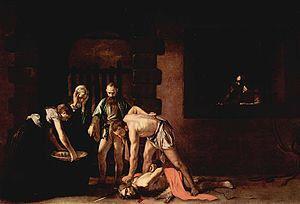
Caravaggio: The Beheading of Saint John the Baptist (1608) Oil on canvas, 361 cm × 520 cm (142 in × 200 in), St. John's Co-Cathedral, Valletta
Locations
People
Groups
- Papal States (Republic of St. Peter)
- Malta
- Christians, Roman Catholic
- Naples, Kingdom of
- Knights of Malta, Sovereign and Military Order of the
Topics
Subjects
Regions
Subregions
Related Events
Showing 3 events out of 3 total
Years: 1608 - 1608
Caravaggio: The Beheading of Saint John the Baptist (1608) Oil on canvas, 361 cm × 520 cm (142 in × 200 in), St. John's Co-Cathedral, Valletta
Locations
People
Groups
- Papal States (Republic of St. Peter)
- Malta
- Christians, Roman Catholic
- Naples, Kingdom of
- Knights of Malta, Sovereign and Military Order of the
Topics
Subjects
Regions
Subregions