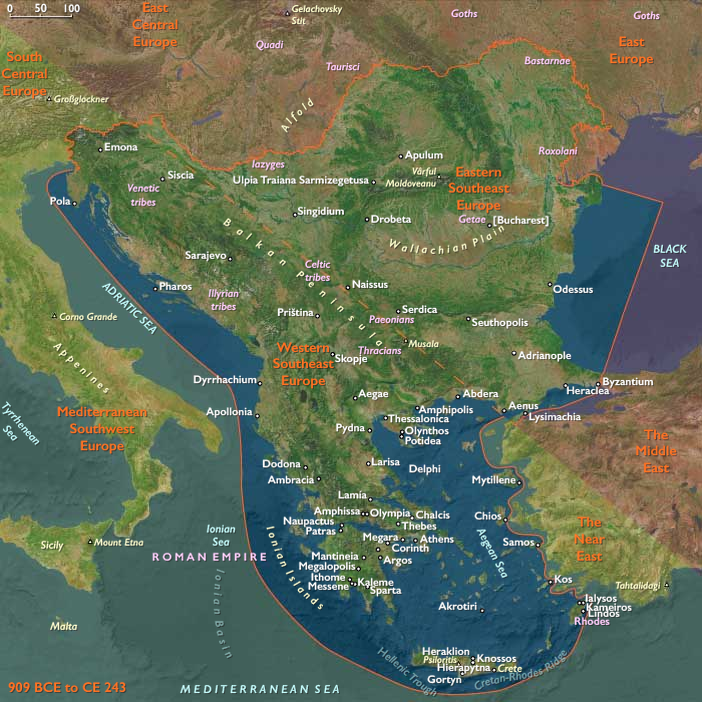
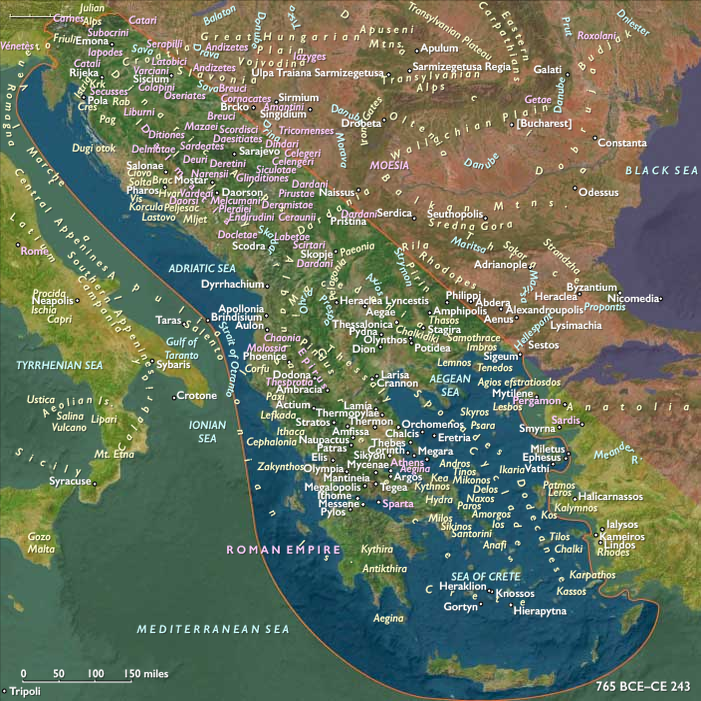
…Delphi. He is admitted to membership …
Years: 346BCE - 346BCE
…Delphi.
He is admitted to membership of the Delphic Amphictyony, an association of neighboring states.
The votes of the Thessalians and their clients give him a control of its council, which can be used on occasion for political and diplomatic ends.
Locations
People
Groups
- Thebes, City-State of
- Greece, classical
- Thessalian League
- Macedon, Argead Kingdom of
- Boeotian League
- Athens, City-State of
- Athenian Empire or Confederacy, Second
Topics
Commodoties
Subjects
Regions
Subregions
Related Events
Filter results
Showing 10 events out of 64636 total
The Phocians surrender to Philip, who exacts an indemnity and receives their Amphictyonic votes.
Many individual Phocian troops, branded as temple robbers, have already fled (some of them in the late 340s will eventually join Timoleon in Sicily).
The cities of Phocis are physically destroyed and the remaining inhabitants distributed among villages.
It is doubtful whether Philip ever seriously intended any other solution to the war in its Phocian dimension.
Philip under the peace terms, gains control of northern and central Greece, including Thermopylae and …
Athens is forced in April 346 BCE to conclude the notorious Peace of Philocrates—notorious because of the attempts by various leading Athenian orator-politicians to saddle each other with responsibility for what is in fact inevitable.
Athens has reason to fear that Philip's next campaign in Thrace (346 BCE) might challenge its own control of the sea route to southern Russia, its main source for imported corn.
Significantly, however, it had been Philip, and not Athens, who had made the first overtures for peace, though all the military initiatives lay in his own hand.
His plans for the future, in Greece and farther afield, include Athens as a willing ally, not as a defeated enemy.
Demosthenes, partly to gain time to prepare for the long struggle he sees ahead, agrees to the peace and goes as one of the ambassadors to negotiate the treaty with Philip.
Philip, recognizing Demosthenes' eloquence as a threat to his plans, ignores him during the negotiations and instead addresses his fellow ambassador Aeschines.
The two men return from the embassy bitter foes, Demosthenes denouncing Aeschines and Aeschines assuring everyone of Philip's good intentions, seeking to reconcile the Athenians to Macedonian expansion into Greece.
In his oration On the Peace late in 346 Demosthenes, though condemning the terms of the treaty of Philocrates, argues that it must be honored.
Even before the peace with Athens is ratified, the Athenian publicist Isocrates had, in the letter To Philip, invited Philip to reconcile the four leading cities of Greece and to lead a united Greek alliance in a war of expansion against Persia.
The Getae, together with kindred tribes living in the Carpathian Mountains north of the Danubian Plain and in the Transylvanian Basin, have developed a distinct society and culture by the second half of the fourth century BCE.
Closely related to the Getae are the Dacians, who live south of the lower Danube (some historians even suggest that these are names applied to a single people by different observers or at different times).
Their combined culture is sometimes called Geto-Dacian.
An agricultural people, they work their rich mines of silver, iron, and gold.
They speak a Thracian dialect but are influenced culturally by the neighboring Scythians and by the Celtic invaders of the fourth century BCE.
They first appear in the Athenian slave market at this time.
The Middle East: 345–334 BCE
Persian Decline and the Rise of Alexander the Great
The era from 345 to 334 BCE marks the final years of Persian authority under Artaxerxes III Ochus and his successors, a period characterized by internal instability, palace intrigue, and diminishing imperial cohesion. Artaxerxes III attempts to reverse the gradual weakening of Persian dominance through harsh and often violent methods, including punitive campaigns against rebellious provinces such as Phoenicia and Egypt. In 343 BCE, after a fiercely contested military campaign, he successfully reconquers Egypt, reinstating Persian control after decades of independence.
Artaxerxes III's reign abruptly ends in 338 BCE when he is poisoned by his court eunuch and advisor, Bagoas, who subsequently installs Artaxerxes’s son, Arses, on the throne. However, Arses rules briefly, himself falling victim to assassination orchestrated by Bagoas two years later. In 336 BCE, Bagoas places Darius III Codomannus on the Persian throne. Contrary to Bagoas's expectations, Darius swiftly eliminates the manipulative eunuch, securing power for himself but inheriting a fragile and fractious empire.
This internal turmoil coincides with the rapid ascent of Macedonia under Philip II and, following Philip’s assassination, his son Alexander the Great. By 334 BCE, Alexander commences his historic invasion of Persian territory, crossing the Hellespont into Anatolia. The Persian Empire, weakened by internal conflicts and incapable of mounting an effective defense, faces an unprecedented existential threat as Alexander’s campaign signals the imminent end of centuries-long Persian dominance in the Near East.
Near East (345–334 BCE): Cultural Milestones and Continued Persian Authority
From 345 to 334 BCE, the Near East sees continued cultural development under ongoing Persian hegemony, punctuated by significant artistic achievements and regional political stability.
In southwestern Anatolia, cultural expression reaches a celebrated pinnacle with the creation of the famed Aphrodite of Cnidus, sculpted by Praxiteles. Renowned for its groundbreaking portrayal of the nude female form, this statue depicts the goddess Aphrodite preparing for her ritual purification, modest yet elegantly poised. Rejected by the initial patrons in Kos for its boldness, the sculpture finds acclaim and a permanent home in Knidos, becoming one of antiquity's most admired and replicated masterpieces. Its fame underscores the vibrant cultural and artistic life thriving within the Persian-controlled Greek cities.
Meanwhile, Persian authority remains consistent yet occasionally strained in Yehud, where Jerusalem continues as the religious and administrative center under the high priests. The emphasis on religious purity and adherence to the Torah keeps the Jewish community distinct within the Persian empire, reinforcing their cultural identity amidst broader regional influences.
Egypt remains a region of tenuous Persian control, its administration marked by ongoing local resistance and dissatisfaction, despite attempts to integrate the region more effectively into imperial governance. This resistance highlights Egypt’s enduring quest for autonomy and self-governance, despite significant Persian military and administrative pressure.
By 334 BCE, the Near East stands as a mosaic of Persian political dominance, Greek cultural flourishing, and local identities fiercely maintained, setting the stage for the profound changes that will follow Alexander the Great's imminent arrival.
Contemporary writers praise Praxiteles’s statue of the goddess Aphrodite—a standing nude in a languorous pose, her drapery half-covering a water jar—as the Aphrodite of Cnidus.
The statue becomes famous for its beauty, meant to be appreciated from every angle, and for being the first life-size representation of the nude female form.
It depicts the goddess Aphrodite as she prepared for the ritual bath that restored her purity (not virginity), discarding her drapery in her left hand, while modestly shielding herself with her right hand.
According to a possibly apocryphal account by Pliny, Praxiteles received a commission from the citizens of Kos for a statue of the goddess Aphrodite.
Praxiteles then created two versions—one fully draped, and the other completely nude.
The shocked citizens of Kos rejected the nude statue and purchased the draped version.
The design and appearance of the draped version is today unknown as it didn't survive, nor did it appear to have merited attention, to judge from the lack of surviving accounts.
The rejected nude is purchased by some citizens of Knidos and set up in an open air temple that permits viewing of the statue from all sides.
It quickly becomes one of the most famous works by Praxiteles for the bold depiction of Aphrodite as proudly nude.
Praxiteles was alleged to have used the courtesan Phryne as a model for the statue, which added to the gossip surrounding its origin.
The statue becomes so widely known and copied that in a humorous anecdote the goddess Aphrodite herself came to Knidos to see it.
The Cnidian Aphrodite has not survived.
Possibly the statue was removed to Constantinople (modern Istanbul) and was lost in a fire during the Nika riots.
It was one of the most widely copied statues in the ancient world, so a general idea of the appearance of the statue can be gleaned from the descriptions and replicas that have survived to the modern day.

The rise of Macedon from a small Greek kingdom at the periphery of Classical Greek affairs to one that will come to dominate the entire Hellenic world (and beyond) has occurred between 359 BCE and 336 BCE in the space of just twenty-five years.
This ascendancy is largely attributable to the personality and policies of Philip II.
When his son and successor Alexander is triumphantly campaigning in the north of Greece, a rumor of his death causes the Thebans and Athenians to rebel against Macedonian hegemony once more.
Alexander reacts immediately but, while the other cities hesitate when he advances into Greece, Thebes decides to resist with the utmost vigor.
However, the resistance is useless, and the city is captured and razed to the ground, and its territory is divided between the other Boeotian cities.
The fall of Thebes cows Athens into submission, and leaves all of Greece at least outwardly at peace with Alexander.
With Macedon's vassals and allies once again peaceable, Alexander is finally free to take control of his late father’s stalled war with Persia, and in early 334 BCE he crosses with an army of forty-two thousand men into Asia Minor.
Mediterranean Southwest Europe (345–334 BCE): Conflicts in Sicily, the Latin War, and the Samnite Wars
The era 345–334 BCE in Mediterranean Southwest Europe is marked by continued conflicts in Sicily, significant shifts in Rome’s internal political structure, the critical Latin War, and early phases of Rome's prolonged conflict with the Samnites.
Timoleon’s Intervention in Sicily
Responding to appeals from Syracuse for assistance against ongoing internal strife and external threats from Sparta and Carthage, Timoleon of Corinth arrives in Sicily in 344 BCE. Swiftly gaining control of Syracuse by 343 BCE, Timoleon reestablishes democratic governance based on the laws of Diocles. He then decisively defeats the forces of Hicetas, tyrant of Leontini, and a Carthaginian army at the battle of the Crimissus. By 338 BCE, Carthage agrees to limit its influence in Sicily west of the Halycus (Platani) River, pledging no further support to local tyrants.
Roman Political and Territorial Transformations
In Rome, the Latin War (340–338 BCE) reshapes regional politics significantly. This conflict between the Roman Republic and the Latin League concludes with the league's dissolution and the extension of Roman influence throughout Latium. The territories of defeated Latin states become partially incorporated into Roman jurisdiction, with their peoples receiving varying degrees of citizenship and rights.
Further political transformations occur within Rome as plebeians gain increasingly influential positions. After 367 BCE, one of Rome’s two consuls is consistently drawn from the plebeian class, gradually enabling plebeian entry into the Senate.
The First Samnite War
The early stages of the First Samnite War (traditionally dated 343–341 BCE, though its historicity is debated), are sparked when the Samnites attack the Sidicini and subsequently threaten the powerful city-state of Capua in Campania. Capua appeals to Rome, resulting in Roman military intervention under consul Lucius Aemilius Mamercinus Privernas in 341 BCE. Rome initially ravages Samnite territory, leading the Samnites to sue for peace. The Romans withdraw after agreeing to renew their earlier treaty with the Samnites, marking the end of this brief conflict.
Cultural and Artistic Continuity
Artistic achievements continue during this period. The Ficoroni Cista, created around 350 BCE, exemplifies Etruscan craftsmanship, although possibly produced in Rome. Such artifacts demonstrate the enduring cultural vitality amidst political upheaval.
Legacy of the Era
The era 345–334 BCE significantly influences Mediterranean Southwest Europe, featuring critical shifts in Roman territorial control, decisive conflict resolution in Sicily, and foundational developments for future Roman expansion through internal reforms and external alliances. These events set crucial precedents for Rome’s ascendancy as a dominant Mediterranean power.
The Latin War, a conflict between the Roman Republic and its neighbors, the Latin peoples of ancient Italy, ends in the dissolution of the Latin League, and incorporation of its territory into the Roman sphere of influence, with the Latins gaining partial rights and varying levels of citizenship.
Years: 346BCE - 346BCE
Locations
People
Groups
- Thebes, City-State of
- Greece, classical
- Thessalian League
- Macedon, Argead Kingdom of
- Boeotian League
- Athens, City-State of
- Athenian Empire or Confederacy, Second