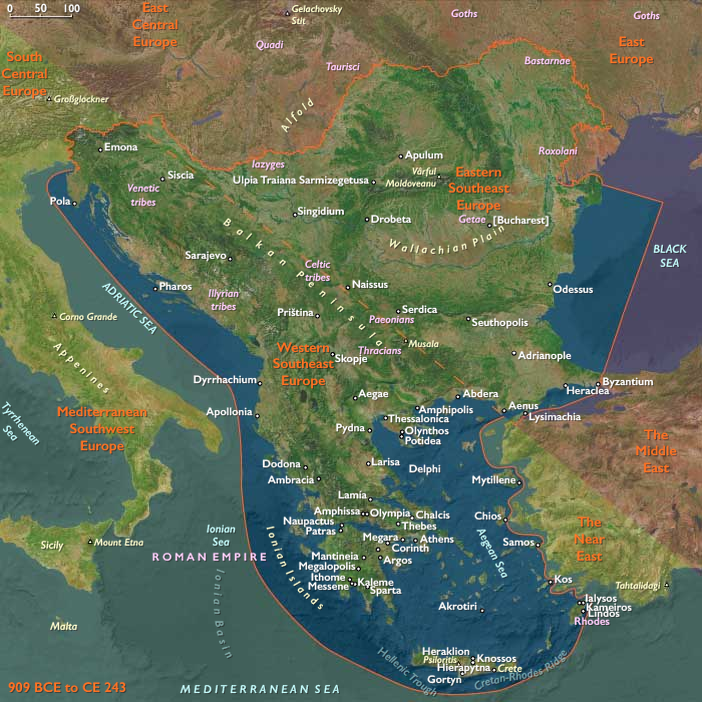
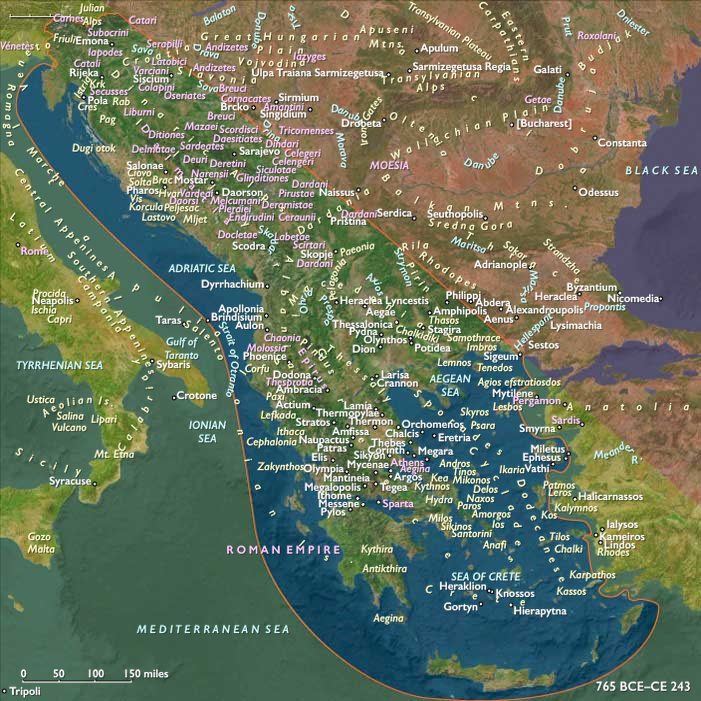
Delos, the smallest of the Cyclades, becomes …
Years: 322BCE - 322BCE
Delos, the smallest of the Cyclades, becomes independent of Athens in 322 BCE.
Locations
Groups
- Macedon, Argead Kingdom of
- Athens, City-State of
- Alexander, Empire of
- Greece, Hellenistic
- Greeks, Hellenistic
Topics
Commodoties
Subjects
Regions
Subregions
Related Events
Filter results
Showing 10 events out of 64291 total
Perdiccas, wielding wide authority in Asia as “supreme general” and regent of the Macedonian empire, conquers Cappadocia in 322 and installs as satrap (provincial governor) his most reliable and efficient subordinate, Eumenes of Cardia, Alexander's former secretary.
Perdiccas begins to act as if he means to make himself king, a move resisted by his colleagues in the regency, Craterus and Antipater, and by the regional governors, including …
…Antigonus Monophthalmus in Phrygia.
The nineteen-year-old Chandragupta, ably guided by Chankya, turns his attention after the death of Alexander to northwestern India (modern Pakistan), where he defeats the satrapies (described as "prefects" in classical Western sources) left in place by Alexander (according to Justin), and may have assassinated two of his governors, Nicanor and Philip.
Having consolidated power in the northwest, Chandragupta pushes east towards the Nanda Empire.
Alexander had received divine honors following his death in Babylon both in Egypt and elsewhere in the Greek cities.
Kings in Macedonia by custom assert their right to the throne by burying their predecessor.
Ptolemy, to preempt Perdiccas, the imperial regent, has Alexander’s body brought to Memphis, Egypt and buried here in a gold sarcophagus.
Ptolemy now marries Alexander's mistress, Thaïs, and commences to reign as king of Egypt and the adjacent Libyan and Arabian regions.
Demosthenes is the voice and symbol of anti-Macedonian feeling; he and other orators again flee Athens at the approach of Antipater, the regent in Macedon.
Demades is reinstated in 322 as an Athenian citizen so that he can negotiate a peace with Antipater concluding the Lamian War.
Before setting out, he persuades the citizens to pass the death sentence upon his former friend Demosthenes and his followers.
The result of Demades' embassy, which includes Athenian statesman and general Phocion, is a peace disadvantageous to the Athenians.
Phocion, while managing to reduce his city's huge indemnities, is forced to accept the occupation of Athens' port, Piraeus.
Antipater, abandoning Alexander's liberal policy, forces Athens to accept an oligarchical government subservient to him and arranges death sentences for Hyperides and Demosthenes, leaders of the anti-Macedonian party.
Phocion rules Athens as Macedonia's agent.
Theophrastus, after receiving his first introduction to philosophy in Lesbos from one Leucippus or Alcippus, had proceeded to Athens, and become a member of the Platonic circle.
After Plato's death he had attached himself to Aristotle, and in all probability accompanied him to Stagira.
The intimate friendship of Theophrastus with Callisthenes, the fellow-pupil of Alexander the Great, the mention made in his will of an estate belonging to him at Stagira, and the repeated notices of the town and its museum in the nine books of his Enquiry into plants and his six books of Causes of Plants point to this conclusion.
Aristotle, who dies in 322, in his will made him guardian of his children, bequeathed to him his library and the originals of his works, and had in 322 designated him as his successor at the Lyceum on his own removal to Chalcis.
Eudemus of Rhodes also had some claims to this position, and Aristoxenus is said to have resented Aristotle's choice.
As leader of the Lyceum’s Peripatetic school of philosophy (so named for the prominent peripatos, or covered walking place, that belongs to the school building, Theophrastus elaborates on metaphysical and psychological theory and emphasizes the study of the natural sciences.
He will presides over the Peripatetic school for thirty-five years, and die at the age of eighty-five according to Diogenes.
He is said to have remarked "we die just when we are beginning to live".

Demosthenes’ long service to the Athenian state ends in abandonment by its fickle citizenry.
While fleeing Antipater's soldiers, he kills himself by taking poison, his death a symbol of the decline of Athenian democracy.
Aristotle, a target of rising anti-Macedonian sentiments following Alexander’s death, had retired in 323 to Chalcis, where he dies the following year, having in his lifetime systematized the disciplines of ethics, logic, politics and science. (His theories, though often speculative and sometimes incorrect, will deeply affect the course of scientific thinking.)
The combined Athenian-Aetolian army maintains the blockade of Antipater and his Macedonians at Lamía.
Antipater calls for reinforcements from Asia.
Alexander's general Leonnatus intervenes in the spring of 322, setting out from his satrapy to relieve Antipater; nominally a supporter, he is in fact ambitious to usurp Antipater's power.
Leonnatus is a member of the royal house of Lyncestis, a small kingdom that had been included in Macedonia by King Philip II of Macedon.
Leonnatus was the same age as Alexander and was very close to him.
He had later been one of Alexander's seven bodyguards, or somatophylakes.
After Alexander died in 323 BCE, the regent, Perdiccas, made Leonnatus satrap of Hellespontine Phrygia.
Alexander's sister Cleopatra, the widow of king Alexander of Molossia, has offered Leonnatus her hand.
If they marry, Leonnatus will be a powerful rival to Perdiccas, and might reasonably claim the throne, and a victory over the Greeks will certainly enhance his claim.
The marriage never takes place, however: Leonnatus is killed in action, although the reinforcements force the Greeks to raise the siege.
Antipater is thus able escape from Lamia and merge his army with that of the slain Leonnatus.
The arrival of a third Macedonian force under the leadership of Craterus decidedly shifts the numerical superiority to the Macedonian side.
Antipater and Craterus now march their combined army south to force the Greeks to battle.
The Greeks, after calling together their dispersed forces in September 322, meet the Macedonians near Crannon in Thessaly.
The Athenian general Antiphilus, relying on the high reputation of the Thessalian horse, decides, as in the battle with Leonnatus, to try to win the battle with cavalry.
The battle therefore opens with the clash of the Athenia-led and Macedonian cavalry.
With the cavalry of both sides occupied, Antipater orders his infantry to charge the Greek line.
The Greek infantry is driven back by the more numerous Macedonians and withdraw to the high ground from where they can easily repulse any Macedonian assault.
The Greek cavalry, seeing their infantry in retreat, disengages from the battle, leaving the field and victory in Macedonian hands.
While the Athenian-led army is still intact, it is clear that the Macedonians have gained the advantage in the war.
Antiphilus, after conferring with his cavalry commander Menon of Pharsalus, therefore sends an embassy to Antipater the next day asking for terms.
Antipater, however, refuses to conclude any general peace with the Athenian-led alliance as a whole, insisting instead that each city send its own ambassadors.
While these terms are at first rejected, the subsequent Macedonian capture of several Thessalian cities causes a rush of defections as each city strives to make a separate peace.
Athens, abandoned by her allies, is at last forced to surrender unconditionally.
In the peace imposed by Antipater, the Athenians are forced to accept a Macedonian garrison as well as a replacement of democracy with an oligarchy under the leadership of Phocion.
Years: 322BCE - 322BCE
Locations
Groups
- Macedon, Argead Kingdom of
- Athens, City-State of
- Alexander, Empire of
- Greece, Hellenistic
- Greeks, Hellenistic