
The Council of …
Years: 845 - 845
January
The Council of Meaux (c. 845) and Amulo’s Anti-Jewish Policies
The conversion of Deacon Bodo to Judaism deeply unsettles Archbishop Amulo of Lyon, fueling his fears that social interaction between Jews and Christians could lead to further Christian apostasy. This fear intensifies Amulo’s longstanding anti-Jewish stance, which he had inherited from his predecessor, Agobard of Lyon.
Deacon Bodo’s Apostasy and Its Impact
- Bodo, once a respected deacon, renounces Christianity and converts to Judaism, reportedly fleeing to Muslim Spain, where he takes the name Eleazar.
- His defection is scandalous, as he had been part of the Carolingian religious elite, making his conversion a high-profile case.
- Amulo seizes upon the event as proof that Jews pose a spiritual danger to Christians and must be socially and legally segregated.
The Council of Meaux and the Attempt to Reinstate Anti-Jewish Laws
Under Amulo’s influence, the Council of Meaux (c. 845) proposes reinstating canonical restrictions on Jews that had been imposed centuries earlier under:
- Constantine the Great (4th century)
- Theodosius II (5th century)
These earlier laws had:
- Prohibited Jews from holding public office over Christians.
- Restricted Jewish-Christian interactions, particularly in matters of employment, trade, and social relations.
- Limited Jewish influence in Christian society, particularly within Carolingian governance and the economy.
Charles the Bald’s Response and Jewish Protection
- Despite Amulo’s efforts, Charles the Bald does not fully enforce these restrictions, continuing the more pragmatic Carolingian policy of tolerating Jewish communities due to their economic contributions, especially in trade and taxation.
- However, the Council of Meaux signals a rising tide of ecclesiastical hostility, reinforcing later medieval restrictions on Jewish communities across France and Europe.
Long-Term Consequences
- The Council of Meaux’s proposals contribute to the gradual erosion of Jewish legal status in Carolingian lands, paving the way for future expulsions and restrictions in medieval France.
- The Jewish-Christian divide deepens, as Church leaders increasingly frame Jewish presence as a threat to Christian faith.
- The case of Deacon Bodo/Elezar remains one of the most remarkable instances of apostasy in the medieval period, symbolizing the tensions between religious identity, conversion, and social control in the Carolingian world.
Though Amulo fails to immediately enact his full agenda, his rhetoric influences later Church councils and helps solidify medieval anti-Jewish policies, making the Council of Meaux a key moment in the history of Christian-Jewish relations.
Locations
People
Groups
- Jews
- Franks
- Christianity, Chalcedonian
- Frankish, or Carolingian (Roman) Empire
- Francia Occidentalis (West Francia, or France), Kingdom of
Topics
Subjects
Regions
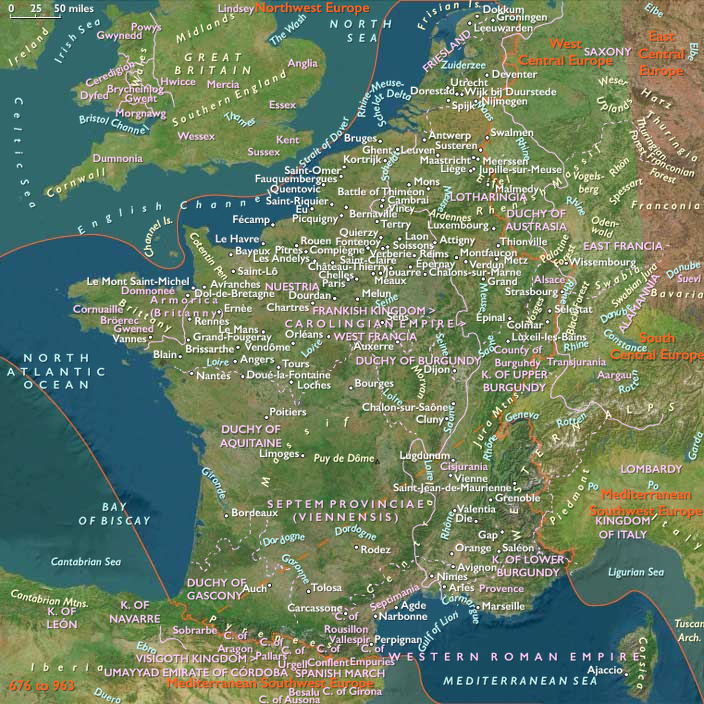
Subregions
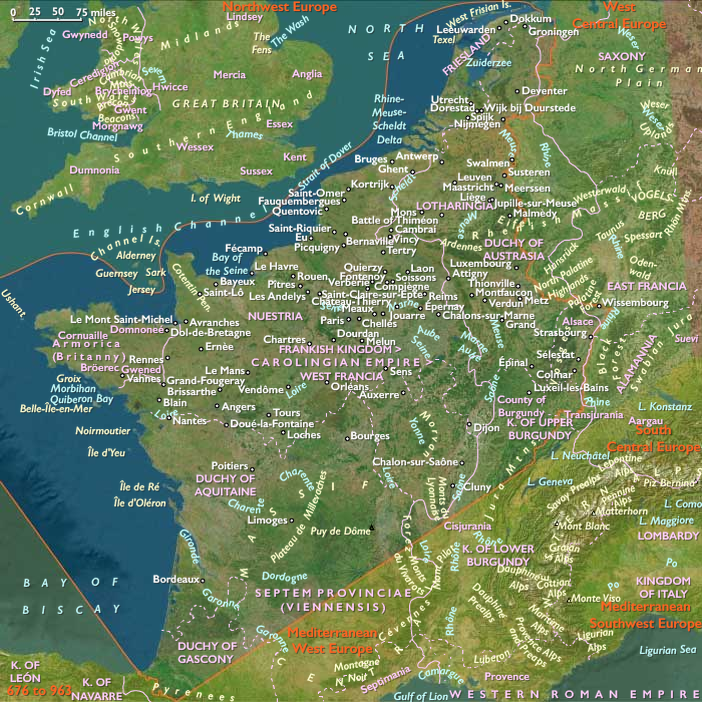
Related Events
Filter results
Showing 10 events out of 54184 total
The Intensification of Viking Raids and the Establishment of Winter Bases (845)
By 845, Viking raids against the Frankish Empire escalate as larger bands of Norse warriors begin to winter on small islands at the mouths of the Loire and Thames Rivers. These permanent encampments provide them with year-round operational bases, allowing them to conduct more sustained and organized raids deeper into Frankish and Anglo-Saxon territories.
The Evolution of Viking Raiding Tactics
- Early Raids (799–834):
- The first Viking raid on the Frankish Empire occurs in 799, six years after the attack on Lindisfarne (793) in England.
- Charlemagne responds in 810 by implementing a coastal defense system along the northern Frankish coast.
- After Charlemagne’s death, this system successfully repulses a Viking attack at the mouth of the Seine in 820, but by 834, defenses fail against Danish raids in Frisia and Dorestad.
- Systematic Raiding Begins (830s–840s):
- Unlike the 820 and 834 raids, which were unrelated and isolated, the mid-830s mark the beginning of more systematic and coordinated Viking incursions, alternating between both sides of the English Channel.
- Viking raids are often linked to Scandinavian power struggles, as ambitious Danish nobles use plunder to gain prestige and political dominance.
- The Vikings also exploit the Frankish civil wars (830–843), taking advantage of weakened defenses and political instability.
Major Viking Raids on the Frankish Empire (836–842)
- Antwerp and Noirmoutier (836) → Coastal monasteries and trading centers are targeted.
- Rouen (841) → The first Viking attack on the Seine River.
- Quentovic and Nantes (842) → The Vikings sack these major trading towns, killing Bishop Gohard of Nantesand further destabilizing West Francia.
The Establishment of Viking Winter Bases (845)
- By 845, Viking bands establish winter settlements on islands at the mouths of the Loire and Thames Rivers.
- These bases allow them to:
- Stockpile resources and repair their ships, making raiding more efficient.
- Launch longer, coordinated campaigns rather than returning to Scandinavia after the summer season.
- Dominate maritime trade routes, controlling the movement of goods and people in and out of Francia.
Impact on the Frankish Empire
- The Carolignian civil wars (840s) have weakened regional defenses, making it easier for the Vikings to plunder deep into Frankish territory.
- Viking incursions disrupt trade and tax revenues, especially in Frisia, the Seine Valley, and the Loire region.
- The Frankish response remains fragmented, as Charles the Bald and his nobles struggle to contain the growing Norse threat while still contesting their own internal power struggles.
Foreshadowing the Great Raids
- The Viking winter bases of 845 set the stage for even larger-scale invasions, including:
- The siege and sack of Paris in 845 by the Viking leader Ragnar Lothbrok.
- The eventual Norman settlement of Normandy (911) under Rollo.
- The Viking integration into Frankish politics, as some Norse leaders begin receiving land in exchange for military service.
By the mid-9th century, Viking raids have evolved from seasonal plundering to strategic territorial control, reshaping the political and economic landscape of Western Europe.
Ragnar’s Viking Invasion of the Seine and the Sack of Paris (845)
In March 845, a massive Viking fleet of 120 ships, carrying over 5,000 men, sails up the Seine River under the command of a Danish chieftain named Reginherus, or Ragnar. His identity has often been tentatively linked to the legendary Ragnar Lodbrok, though historians debate whether this is the same historical figure or if the saga character is a later mythologized version of multiple Viking leaders.
Ragnar’s History with Charles the Bald
- In 841, Charles the Bald had awarded Ragnar land in Turholt, Frisia, likely as part of a strategy to appease Viking leaders in exchange for protection or military service.
- However, Ragnar eventually loses his land and the favor of Charles, prompting him to launch a large-scale invasion of West Francia in retaliation.
The Viking Raid on Rouen and the March Up the Seine
- As the fleet moves up the Seine, the Vikings plunder Rouen, a key trade and religious center.
- The primary objective of the Viking expedition is Paris, which was not only a wealthy city but also a symbol of Frankish royal power.
Charles the Bald’s Response
- Determined to defend Paris and the royal Abbey of Saint-Denis, Charles the Bald gathers an army.
- He divides his forces, stationing one division on each side of the Seine to block Ragnar’s advance.
The Viking Attack and the Mass Execution
- Ragnar strikes first, defeating one half of the Frankish army.
- To intimidate the remaining Frankish forces, Ragnar takes 111 Frankish prisoners and hangs them on an island in the Seine.
- This ritualistic mass execution is likely done:
- As an offering to Odin, the Norse god of war and death.
- To spread terror among the remaining Frankish defenders, undermining morale.
The Consequences of the Raid
- The Viking defeat of Charles’ forces leaves Paris defenseless.
- The sack of Paris follows, leading to one of the most devastating Viking raids on West Francia.
- Charles the Bald, unable to mount an effective defense, agrees to pay a ransom of 7,000 pounds of silver (Danegeld) to persuade Ragnar to leave.
- This sets a precedent for future Viking raids, as Norse chieftains realize that the Franks are willing to pay for peace, making Francia an attractive target for future large-scale invasions.
Legacy of Ragnar’s Raid
- The 845 sack of Paris is the first recorded major Viking attack on the city, foreshadowing the larger Viking sieges of 885–886.
- The Danegeld ransom system becomes a recurring strategy in Frankish-Viking interactions, as successive Frankish rulers struggle to maintain defenses against Viking incursions.
- The Vikings become a long-term threat to the Carolingian Empire, contributing to the further weakening of royal authority and the rise of localized feudal powers.
Thus, Ragnar’s campaign in 845 not only establishes the Seine as a Viking invasion route but also marks the beginning of continuous Viking pressure on West Francia, fundamentally shaping the political and military strategies of future Carolingian rulers.
The Viking Siege and Sack of Paris (845): Ragnar’s Revenge and the First Danegeld
On Easter Sunday, March 28, or Easter Day, March 29, 845, Ragnar’s Viking forces finally arrive in Paris, plundering the city in what becomes the first recorded large-scale Norse attack on the Frankish capital. This event marks a major turning point in the Viking invasions of West Francia, as it leads to the first significant ransom payment (Danegeld) to Viking raiders.
The Siege and the Plague in the Viking Camp
- As Ragnar’s army sacks Paris, plague breaks out among the Vikings.
- Having been exposed to Christianity, the Norse warriors first pray to their gods, but the disease persists.
- On the advice of a Christian prisoner, the Vikings undertake a fast, and the plague subsides, an event that may have left some impression on Norse views of Christianity.
Charles the Bald’s Response: The First Danegeld
- The Franks fail to mount an effective defense, as Charles the Bald’s forces are unable to counter the Viking invasion.
- With no clear military option, Charles agrees to pay a massive ransom to secure Ragnar’s withdrawal.
- The Vikings receive 7,000 livres (French pounds) of silver and gold, roughly 2,570 kg (5,670 pounds)—a staggering sum in early medieval terms.
- This payment may have been perceived as compensation for Ragnar’s earlier loss of land in Turholt, making the entire invasion an act of revenge against Charles the Bald.
Ragnar’s Departure and Continued Raiding
- Despite accepting the ransom, Ragnar does not immediately return home but instead pillages more sites along the coast on his return journey, including the Abbey of Saint Bertin.
- This raid sets a dangerous precedent, as it proves to Viking leaders that the Franks are willing to pay large sums to avoid destruction.
The Political Context: Why Did Charles Pay the Vikings?
- Charles is already preoccupied with multiple internal and external threats:
- Dynastic disputes with his brothers following the Treaty of Verdun (843).
- Regional revolts in his kingdom.
- Disgruntled nobles, some of whom are reluctant to raise armies against the Vikings.
- External pressure from East Francia and Middle Francia.
- Given these challenges, paying the ransom buys Charles time, allowing him to focus on other pressing conflicts while potentially securing temporary Viking peace.
The First of Many Danegeld Payments
- Though the term "Danegeld" is not yet in use, this ransom payment marks the first of thirteen such tributes paid by the Franks to Viking raiders over the next several decades.
- The precedent set by Charles' payment only encourages more Viking raids, as the Franks now become a proven source of wealth for Norse leaders.
Long-Term Impact of the 845 Raid on Paris
- The siege of Paris exposes the vulnerability of West Francia, foreshadowing future Viking sieges in 856, 861, and the great siege of 885–886.
- The payment of Danegeld sets a model that other European rulers—including the English kings in the 10th and 11th centuries—will later follow.
- The continued Viking presence in Francia will eventually lead to land concessions, culminating in the formation of Normandy under Rollo in 911.
Conclusion: A Viking Triumph and a Frankish Dilemma
The siege of Paris in 845 is a defining moment in the Viking invasions of Francia. While Charles the Bald secures short-term peace by paying off the invaders, this decision only encourages further raids, forcing the Carolingians to continuously deal with the Viking threat through a mixture of military campaigns, fortifications, and ransom payments. The Viking siege exposes the weaknesses of the Carolingian defense system, foreshadowing the further fragmentation of West Francia and the rise of feudal strongholds as the primary defense against Norse incursions.
Gudfred, King of the Danes, known for his successful raids and wars against Charlemagne's Frankish empire and against the Abodrites, had been assassinated in 810 by one of his own sons, and his nephew and successor Hemming had made peace with Charlemagne.
Hemming did not last long.
His brother Horik and another of Gudfred's sons had taken power in 811, later expelling a rival named Harald Klak, who took refuge at the court of Charlemagne's son and successor, Louis the Pious.
Louis in 819 had forced Gudfred's sons to accept Harald as co-ruler.
Harald in 826 had converted to Christianity, with Louis standing as his godfather, but Harald had been driven out of Denmark for the second and final time one year later.
Horik was by then the only son of Gudfred's still alive, making him the sole king of the Danes.
Danish raids against Frisia had continued.
The Franks lack an effective fleet, so the Danes can raid more or less with impunity.
The Danes had in 834, 835, and 836 sacked the silver minting center of Dorestad, and in 837 plundered Walcheren.
King Horik seems to have disapproved of these raids, for successful raiders constitute possible rivals.
Horik even punishes raiders occasionally.
Horik in 836 had sent an embassy to King Louis declaring that he had nothing to do with the raids on Frisia, and that he had executed those responsible.
Hamburg had been elevated to an archbishopric by Pope Gregory IV in 831 on the initiative of Louis the Pious in order to oversee the Saxon territory and to support the introduction of Christianity to Scandinavia.
Hamburg had been united with Bremen two years later as the bishopric of Hamburg-Bremen.
The first bishop, Ansgar, will become known as the Apostle of the North.
Horik has refused to convert to Christianity, as it is his enemies' religion, and resists attempts by Bishop Ansgar to proselytize the Danes.
Six hundred Viking ships sail up the River Elbe in 845, sack Hamburg, at this time a town of around five hundred inhabitants, and destroy St. Mary's Cathedral.
The East Frankish king Louis the German in response sends a diplomatic mission, headed by Count Cobbo (one of two court counts), to the court of Horik, demanding of the Danish king that he submit to Frankish overlordship and pay reparations for the invasion.
Horik eventually agrees to the terms and requests a peace treaty with Louis, while also promising to turn back the treasure and captives from the raid.
Horik most likely wants to secure the border with Saxony as he faces a conflict with King Olof of Sweden and domestic struggles.
By the treaty, Louis demands Horik's obedience, which is further secured by Horik regularly sending embassies and gifts to Louis, and his suspension of support to Viking raiders.
The Viking warlord Ragnar had attacked Paris and extorted just a few hundred pounds short of six tons of gold and silver, but many Vikings had died in the plague during the siege of the city.
According to a story originating from a member of Cobbo's embassy, Ragnar, having attacked the Abbey of Saint-Germain-des-Prés, then in the outskirts of medieval Paris, and which Cobbo later visited, attributed the plague to the power of Saint Germain of Paris.
Ragnar had lived to return home to King Horik.
While Ragnar showed the gold and silver he had acquired to Horik and boasted about how easy he thought the conquest of Paris had been, he reportedly collapsed, crying, while relating that the only resistance he had met was by the long deceased saint.
As Ragnar and several of his men die not long after, the king is so frightened that he orders the execution of all the survivors, and the release of all his Christian captives.
This event, in part, leads Horik to receive Archbishop Ansgar, "Apostle of the North", on friendly terms in his own kingdom.
The Abbasids are unable to exploit their success due to the internal instability of the Caliphate.
Likewise, the Empire prefers to focus its strength against the ongoing conquest of Sicily by the Aghlabids.
Thus, an imperial embassy is sent to Samarra in 845, which is warmly received.
The Abbasids reciprocate with an embassy to Constantinople, where the two states agree on a truce and a prisoner exchange, which is held at the river Lamos on September, 16, 845.
A winter raid by the Arab governor of Tarsus shortly after the prisoner exchange fails disastrously, after which the frontier between Caliphate and Empire will remain quiet for six years.
Nominoe’s Defiance and the Battle of Ballon (845): The Rise of Breton Independence
By 845, tensions between Nominoe, the ruler of Brittany, and Charles the Bald reach their breaking point. While Lambert II of Nantes and Pepin II of Aquitaine comply with the ecclesiastical order to renew their fealty to Charles, Nominoe refuses to submit, further asserting Breton autonomy.
Nominoe’s Position in Brittany
- Following his split with Charles in 843, Nominoe’s hold on the Vannetais weakens, and sources such as Lupus of Ferrières report "unrest" in Brittany.
- Some Bretons defect, conspiring with Charles the Bald to restore Frankish control over the region.
- Nominoe, recognizing the growing instability, prepares for an inevitable Frankish invasion.
The Frankish Invasion and the Battle of Ballon (November 22, 845)
- In response to Breton defectors, Charles marches into Brittany to restore his authority but faces stiff resistance.
- The two armies meet north of Redon, across the Vilaine River, at Ballon on November 22, 845.
- The Bretons, using their knowledge of the terrain, ambush and defeat Charles’ forces, marking the first major victory of Brittany over West Francia.
Consequences of the Battle
- The defeat forces Charles to recognize Nominoe’s de facto independence, though he does not formally grant him sovereignty.
- Nominoe consolidates power, effectively ruling as the first King of Brittany, further weakening Carolingian influence in the region.
- The victory at Ballon emboldens the Bretons, leading to further expansion into Frankish territory in the following years.
Legacy of Nominoe’s Victory
- The Battle of Ballon represents a turning point in Breton history, marking the emergence of an autonomous Brittany that will continue to resist Frankish rule.
- While Charles remains distracted by internal struggles and Viking incursions, Brittany grows in strength, setting the stage for the eventual recognition of Breton independence.
- Nominoe’s defiance and military success solidify his legacy as the "Father of Breton Independence", laying the foundations for the Duchy of Brittany in later centuries.
With the Frankish failure at Ballon, Brittany begins a new chapter as a territory no longer under direct Carolingian control, challenging the unity of the Carolingian Empire and further contributing to its fragmentation.
The “sangha”—the community of Buddha’s followers—has grown so large and rich by 845 that its tax-exempt status now makes it a severe drain on the Chinese imperial economy.
For this and other reasons, it becomes the target of a brief but effective nationwide persecution.
The majority of Buddhist temples suffer destruction and the loss of their contents, thousands of monks and nuns are laicized, and the state confiscates the vast landholdings of monasteries.
More than forty-six hundred monasteries and forty thousand temples and shrines are destroyed.
More than two hundred and sixty thousand Buddhist monks and nuns are forced to return to secular life.
The Chan sect, although suffering the same persecutions as other sects, recovers from the yearlong persecution better than do the others, partly because, in contrast to other monastic communities, Chan monks practice physical labor, which creates less dependency on state and lay support.
Years: 845 - 845
January
Locations
People
Groups
- Jews
- Franks
- Christianity, Chalcedonian
- Frankish, or Carolingian (Roman) Empire
- Francia Occidentalis (West Francia, or France), Kingdom of
Topics
Subjects
Regions
Subregions