
De Troyes returns to Quebec; word of …
Years: 1686 - 1686
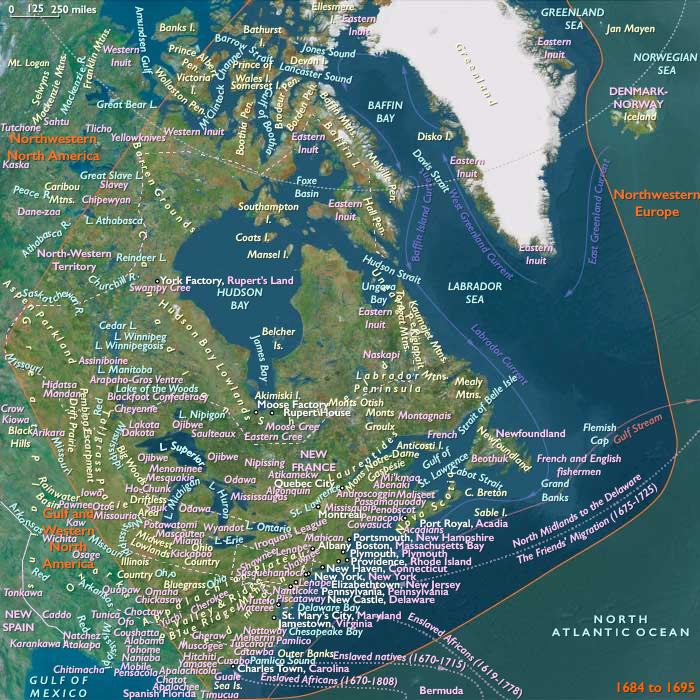
De Troyes returns to Quebec; word of the French attack will not reach the English for months.
Locations
People
- Jacques-René de Brisay de Denonville
- Jean-Baptiste Le Moyne de Bienville
- Pierre Le Moyne d’ Iberville
Groups
- Iroquois (Haudenosaunee, also known as the League of Peace and Power, Five Nations, or Six Nations)
- Seneca (Amerind tribe)
- Onondaga people (Amerind tribe)
- New France (French Colony)
- France, (Bourbon) Kingdom of
- England, (Stewart, Restored) Kingdom of
- Hudson's Bay Company (HBC)
Topics
Commodoties
Subjects
Regions

Subregions
Related Events
Filter results
Showing 10 events out of 16 total
Mediterranean Southwest Europe (1696–1707 CE): Dynastic Shifts and Cultural Innovations
The era 1696–1707 CE in Mediterranean Southwest Europe is shaped by significant dynastic changes, intensified political struggles, and vibrant cultural developments that lay critical foundations for the eighteenth century.
Spain: The End of the Habsburg Dynasty and Succession Crisis
In Spain, the death of Charles II in 1700 marks the end of the Spanish Habsburg line. Severely affected by generations of intermarriage, Charles II's inability to produce an heir triggers a major succession crisis. Despite Habsburg claims, Charles II wills the throne to his grand-nephew, Philip of Anjou, a Bourbon and grandson of Louis XIV of France. Philip ascends as Philip V (1700–1746), igniting fears across Europe of a Franco-Spanish union. The resulting tensions erupt into the War of the Spanish Succession (1702–1714), the first significant European conflict of global scale.
An Anglo-Austrian coalition opposes Bourbon control, supporting Archduke Charles of Austria. Although Castile warmly accepts Philip, Catalonia resists Bourbon centralization, aligning with the Austrians to defend their traditional liberties (fueros). This internal division underscores deep-seated tensions between centralized monarchy and regional autonomy, significantly impacting Spain's internal political landscape.
Italy: Papal Reforms and Cultural Vibrancy
In Italy, the pontificate of Pope Innocent XII (Antonio Pignatelli, 1691–1700) emphasizes moral and administrative reform. Innocent XII vigorously combats nepotism with his landmark bull, Romanum decet Pontificem (1692), promoting meritocracy and austere governance. His successor, Pope Clement XI (Giovanni Francesco Albani, 1700–1721), assumes leadership during turbulent times, navigating between French and Austrian interests amid the Spanish succession turmoil.
This period also witnesses key cultural innovations. In Florence, the invention of the piano by Bartolomeo Cristofori around 1700 revolutionizes musical expression and performance. The vibrant cultural scene continues in cities like Venice and Rome, nurturing the arts, architecture, and opera, even as political uncertainties loom.
Malta: Strategic Consolidation and Medical Leadership
Malta continues its strategic consolidation under the Knights Hospitaller, significantly expanding and fortifying Valletta. Following the previous era's medical advancements, Malta solidifies its reputation in public health through continued improvements at the renowned Sacra Infermeria. These developments enhance Malta's resilience against health crises, reinforcing its strategic importance and cultural sophistication in the Mediterranean.
Broader Cultural and Intellectual Shifts
Throughout Mediterranean Southwest Europe, the influence of the early Enlightenment grows steadily. The ongoing influx of global commodities like coffee, introduced through Venetian commerce with the Ottoman Empire, continues to fuel vibrant intellectual exchanges in coffeehouses across the region. Moreover, theatrical traditions, notably the commedia dell'arte, remain influential, reflecting broader social themes and artistic creativity.
Legacy and Transformation
The era 1696–1707 CE thus represents a dynamic period of dynastic transition, cultural innovation, and intellectual ferment. Spain's succession crisis reshapes European diplomacy, while Italy and Malta experience cultural and strategic advancements. Collectively, these developments set the stage for pivotal transformations in the coming decades.
Mediterranean Southwest Europe (1708–1719 CE): War's Resolution and Territorial Realignments
The era 1708–1719 CE in Mediterranean Southwest Europe is characterized by the conclusion of the significant War of the Spanish Succession, territorial realignments, and the reshaping of political and cultural landscapes across the region.
Spain: Resolution and New Realities
The War of the Spanish Succession (1702–1714), initially triggered by the accession of the Bourbon Philip V to the Spanish throne, reaches a decisive conclusion. Despite British and Austrian support for the Habsburg claimant, Archduke Charles of Austria, Philip V's position in Castile remains solid. However, fierce resistance continues in Catalonia, which steadfastly defends its traditional liberties (fueros) against centralizing Bourbon policies. The prolonged and devastating Siege of Barcelona (1713–1714) ultimately forces Catalonia into submission, significantly altering its autonomy and integrating it more directly into a centralized Spanish state.
The Treaty of Utrecht (1713) formally ends the broader European conflict, confirming the Bourbon succession in Spain under the condition that the French and Spanish crowns never unite. This treaty profoundly impacts Spain’s international standing, as it loses substantial European territories: the Spanish Netherlands (subsequently known as the Austrian Netherlands) and its significant Italian possessions revert to Austrian Habsburg control. Britain solidifies its Mediterranean presence by retaining Gibraltar and Menorca, gaining crucial trade concessions in Spanish America. Although Spain maintains internal cohesion and its vast overseas empire, its role in European power dynamics diminishes considerably.
Italy: Shifting Influence and Cultural Continuity
In Italy, territorial shifts reshape the peninsula’s political landscape. Following the Treaty of Utrecht, significant territories such as Naples, Milan, and Sardinia come under Austrian rule. These changes reinforce Austrian influence over Italy, altering power dynamics among Italian states, which increasingly become strategic pawns in broader European diplomacy.
Despite political upheaval, Italy continues to flourish culturally. Cities like Venice and Rome sustain vibrant artistic and intellectual environments, where opera, painting, and architecture thrive amid international political shifts. Intellectual circles increasingly reflect early Enlightenment ideals, encouraging reason, scientific inquiry, and social reform, laying foundations for significant future cultural movements.
Malta: Strategic Consolidation and Stability
Malta remains a crucial Mediterranean stronghold under the governance of the Knights Hospitaller. The fortification of Valletta is further enhanced, strengthening the island’s strategic value amid shifting European alliances. Maltese medical institutions, notably the Sacra Infermeria, gain further prominence for their advanced healthcare standards, continuing Malta’s legacy as a medical leader in Europe.
Broader Regional Implications
Across Mediterranean Southwest Europe, the aftermath of the War of the Spanish Succession reshapes political alliances, territorial boundaries, and strategic priorities. Britain emerges as a significant Mediterranean maritime power, while Austria extends its influence into formerly Spanish territories. These realignments establish a new balance of power, significantly affecting regional stability and setting the stage for future geopolitical developments.
Conclusion: Foundations of a New Order
The era 1708–1719 CE marks a turning point for Mediterranean Southwest Europe, characterized by the resolution of the War of the Spanish Succession, significant territorial changes, and continuing cultural vibrancy. These developments decisively shape the political and cultural trajectory of the region, laying critical groundwork for subsequent eighteenth-century transformations.
Mediterranean Southwest Europe (1720–1731 CE): Centralization and Administrative Reform
The era 1720–1731 CE in Mediterranean Southwest Europe witnesses significant administrative reforms and centralization efforts spearheaded by Philip V of Spain, reshaping the political and governmental structure of the region.
Spain: Administrative Centralization
In Spain, King Philip V actively undertakes comprehensive reforms aimed at modernizing and centralizing governance. Guided by French and Italian advisers, Philip V institutionalizes a centralized administration by systematically abrogating traditional local liberties (fueros), dissolving regional parliaments, and effectively diminishing the independent political influence of the Spanish aristocracy within the councils of state. These actions consolidate royal power, significantly changing the governance of Spain and laying the foundations for a more uniformly governed state, modeled along French lines.
This restructuring is met with resistance, particularly in areas with strong regional identities, but ultimately transforms the Spanish political landscape by centralizing authority in Madrid, marking a significant departure from Spain's historically fragmented political structures.
Italy: Austrian Consolidation and Cultural Adaptation
In Italy, the period is marked by the Austrian consolidation of territories such as Milan, Naples, and Sardinia, reinforcing Austrian Habsburg dominance. These territorial changes bring administrative reforms that mirror those in Spain, with centralizing policies implemented by the Austrians to streamline governance and enhance fiscal control.
Amid these shifts, Italian cultural and intellectual life remains robust. Artistic and intellectual circles in cities like Venice, Naples, and Rome continue to flourish, adapting to the political realignments while increasingly reflecting Enlightenment ideals in their output.
Malta: Stability and Fortification
In Malta, governance under the Knights Hospitaller continues to emphasize strategic stability and military preparedness. The fortifications of Valletta receive continued attention, enhancing Malta’s significance as a strategic military and maritime hub in the Mediterranean. Maltese medical institutions, particularly the Sacra Infermeria, maintain their reputation for exceptional medical care, serving as a beacon of healthcare excellence throughout Europe.
Broader Regional Context
Throughout Mediterranean Southwest Europe, the early eighteenth century's centralization efforts significantly reshape the region’s administrative landscape, setting important precedents for governmental structures in Spain and its former Italian territories. These developments reflect broader European trends towards absolutist governance and administrative modernization, significantly influencing subsequent political and social developments.
Conclusion: Setting the Stage for Enlightenment
The era 1720–1731 CE thus sees crucial administrative transformations in Mediterranean Southwest Europe, driven by centralization and reformist policies. These developments lay important groundwork for subsequent political stability, social reforms, and the spread of Enlightenment ideals across the region.
Mediterranean Southwest Europe (1732–1743 CE): Consolidation and Enlightened Despotism
The era 1732–1743 CE in Mediterranean Southwest Europe marks a period of continuing political consolidation, administrative centralization, and the early adoption of Enlightenment-inspired governance.
Spain: Strengthening Centralized Power
In Spain, King Philip V continues implementing centralization and modernization policies initiated in the previous era. His administration expands fiscal reforms to streamline taxation and enhance the monarchy's financial stability. French and Italian advisors, particularly influential under Philip's wife, Elisabeth Farnese, play pivotal roles in reshaping administrative policies. Spain witnesses an increase in cultural and intellectual activity, notably with the establishment of the Royal Academy of History (Real Academia de la Historia) in 1738, reflecting Enlightenment ideals and a renewed focus on Spain’s historical heritage.
Italy: Habsburg and Bourbon Influences
Italy experiences continued Habsburg consolidation, particularly in Naples, where Charles of Bourbon ascends the throne in 1734 as King Charles VII, shifting the kingdom from Austrian to Bourbon rule. Charles initiates significant administrative and economic reforms aimed at modernizing the Kingdom of Naples, introducing Enlightenment-inspired policies that foster economic growth, education reform, and judicial efficiency. His patronage notably promotes the arts, resulting in the flourishing of Neapolitan opera and Baroque architecture.
In Milan and Lombardy, Austrian administrators intensify efforts to rationalize governance and taxation. Austrian rule promotes economic productivity, enhanced infrastructure, and administrative efficiency, laying the groundwork for subsequent modernization in Northern Italy.
Malta: Military Fortification and Cultural Growth
The Knights Hospitaller in Malta further bolster their strategic maritime and military importance through expanded fortifications around Valletta and the Grand Harbour. Efforts to maintain robust defenses against Barbary pirates and Ottoman naval threats continue, reaffirming Malta’s vital role in Mediterranean geopolitics. Maltese society experiences relative stability, with growth in cultural institutions and continued excellence in medical practice, particularly at the renowned Sacra Infermeria.
Broader Regional Context
Throughout Mediterranean Southwest Europe, the early eighteenth-century political landscape remains shaped by Enlightenment ideals influencing governance, economics, and intellectual life. The embrace of enlightened absolutism in regions like Naples and reforms in Spain reflect broader European trends, emphasizing rational governance, increased state efficiency, and cultural flourishing.
Conclusion: Enlightenment Foundations
The era 1732–1743 CE sees sustained centralization and the early adoption of enlightened despotism, significantly impacting administrative practices and cultural life in Mediterranean Southwest Europe. These developments set the stage for further Enlightenment-driven transformations and cultural advancements across the region.
Mediterranean Southwest Europe (1744–1755 CE): Enlightened Reforms and Regional Stabilization
The era 1744–1755 CE in Mediterranean Southwest Europe continues the region's engagement with Enlightenment ideas, administrative reform, and cultural advancement amid a relatively stable geopolitical climate.
Spain: Bourbon Reforms and Cultural Revival
King Ferdinand VI ascends the Spanish throne in 1746, succeeding Philip V. His reign is characterized by a notable commitment to peace and internal reform, guided by Enlightenment principles. Under the influence of ministers like José de Carvajal y Lancaster and Marquess of Ensenada, Spain introduces extensive administrative, fiscal, and naval reforms, strengthening the central government’s efficiency. The creation of the Royal Academy of Fine Arts of San Fernando in 1752 highlights Ferdinand’s patronage of the arts and dedication to cultural revival.
Economic and infrastructural improvements, including modernization of the Spanish navy and development of transportation networks, further stabilize Spain, preparing it for future commercial expansion.
Italy: Bourbon Naples and Austrian Lombardy
In Naples, King Charles VII (Charles of Bourbon) continues significant Enlightenment-driven reforms, aiming at enhancing economic productivity, administrative efficiency, and intellectual life. His policies foster the expansion of commerce and agriculture, and he notably supports archaeological excavations, such as those at Herculaneum and Pompeii, significantly influencing European neoclassicism and historical studies.
Lombardy under Austrian rule experiences further economic prosperity due to enlightened administrative reforms. Austrian officials emphasize rational economic management, improved taxation systems, and substantial investment in public infrastructure, including roads and canals, further integrating the region into broader European trade networks.
Malta: Continued Fortification and Cultural Flourishing
Under the governance of the Knights Hospitaller, Malta's fortifications continue to expand, reinforcing its strategic importance in the Mediterranean. The Grandmaster Emmanuel Pinto de Fonseca (1741–1773) enhances the island's defenses, notably fortifying Valletta and its harbor. Pinto’s tenure is marked by architectural developments, public works, and a cultural flowering exemplified by baroque art and architecture. The Sacra Infermeria remains a prominent medical institution, renowned across Europe.
Broader Regional Trends
Throughout Mediterranean Southwest Europe, the period sees consolidation of enlightened absolutist policies, with monarchs and local authorities embracing ideas of rational governance, economic efficiency, and cultural patronage. Stability in the region facilitates sustained intellectual exchange, artistic creativity, and economic growth, laying the foundations for future developments across the Mediterranean.
Conclusion: Stability and Enlightenment Foundations
The era 1744–1755 CE solidifies Enlightenment-inspired reforms, administrative centralization, and cultural advancement across Mediterranean Southwest Europe. This period of relative stability and prosperity significantly influences the trajectory of subsequent economic and cultural transformations throughout the region.
Laws prevent them from interacting with the Maltese people, but these are not regularly enforced.
Some of the enslaved also work as merchants, and at times are allowed to sell their wares in the streets and squares of Valletta.
Hungarian, Georgian and Maltese slaves on board the Ottoman ship Lupa had revolted in February 1748, taking over one hundred and fifty Ottomans prisoner, including Mustafa, the Pasha of Rhodes.
They had sailed the captured ship to Malta, where the prisoners were enslaved.
However, Mustafa had been placed under house arrest on the insistence of France due to the Franco-Ottoman alliance, and was eventually freed.
He has converted to Christianity and married a Maltese woman, so he is allowed to remain in Malta.
Mustafa plans to organize a slave revolt on June 29, 1749, the day of the feast of Saints Peter and Paul, during which a banquet is to be celebrated at the Grandmaster's Palace in Valletta.
Slaves are to poison the food at the banquet as well as within the inns, taverns, and other palaces.
After the banquet, a small group of slaves is to assassinate Grand Master Manuel Pinto da Fonseca in his sleep, while one hundred palace slaves overpower the guards.
They will then attack the Slaves' Prison to free the remaining Muslims, while others are to attack Fort Saint Elmo and take weapons from the armories.
The Ottoman Beys of Tunis, Tripoli and Algiers are to send a fleet that is to invade Malta upon receiving a signal from the rebels.
The plot is discovered on June 6, three weeks before it is to take place.
Three slaves had met in a coffee shop in Valletta to win the support of a Maltese guard to the Grand Master, and began to quarrel.
The shop owner, a Jew called Giuseppe Cohen, had overheard them mention the revolt and reported this information to the Grand Master.
The three slaves had been arrested, and they had revealed details of the plan after being tortured.
The leaders are subsequently arrested, and thirty-eight of them are tried and executed.
Some plotters reportedly convert and ask to be baptized just before being killed.
One hundred and twenty-five others are hanged in Palace Square in Valletta, while eight are branded with the letter R (for ribelli) on their forehead, and are condemned to the galleys for life.
On the insistence of France, Mustafa Pasha, who is behind the revolt, is not executed but is taken back to Rhodes on a French vessel.
Laws restricting the movement of slaves are made stricter.
They may not go outside the city limits, and are not to approach any fortifications.
They are forbidden to gather anywhere except in their mosque, and are to sleep only in the Slaves' Prison.
Moreover, they may carry no weapons or keys to government buildings.
Giuseppe Cohen, who had revealed the plan, is given an annual pension of three hundred scudi from the Order's treasury and another two hundred scudi from the Università of Valletta.
Cohen is also given a house in Valletta, which had previously been the seat of the Università until it moved to new premises in 1721.
The house will remain in the Cohen family until 1773, when they will receive an annuity and the building will be taken over to house the Monte di Pietà.
Mediterranean Southwest Europe (1756–1767 CE): Enlightenment, Reform, and Challenges to Tradition
The era 1756–1767 CE in Mediterranean Southwest Europe witnesses a continued emphasis on Enlightenment ideals, significant political and administrative reforms, and a complex interaction between secular and religious authorities.
Spain: Charles III and Enlightened Despotism
Charles III ascends the Spanish throne in 1759 following the death of Ferdinand VI. Known for his enlightened despotism, Charles III brings his prior experience as King of Naples to Spain, promoting economic modernization, infrastructural development, and institutional reforms aimed at revitalizing the Spanish state. His reforms target the reduction of clerical influence, manifesting notably in the expulsion of the Jesuits in 1767, an act that severely impacts education and the intellectual climate in Spain. Under his guidance, Spain experiences a revival of urban planning, trade reforms, and increased secular control over traditionally clerical domains.
Italy: Bourbon Reforms and Intellectual Advances
In Naples, the momentum of Enlightenment reforms continues under King Ferdinand IV, the successor to Charles III. Guided initially by regent Bernardo Tanucci, Naples advances economically and culturally, maintaining archaeological excavations at sites like Pompeii and Herculaneum. These excavations attract European scholars, significantly influencing European Neoclassicism and historical studies.
In Lombardy, under Austrian rule, Maria Theresa’s enlightened administration continues economic and administrative reforms, including rational taxation and significant infrastructure investment, bolstering regional prosperity and enhancing trade links across Europe.
Malta: Strengthening Defenses and Cultural Patronage
Under Grandmaster Emmanuel Pinto de Fonseca, Malta experiences ongoing infrastructural and defensive fortification improvements, solidifying its strategic position in the Mediterranean. The Sacra Infermeria retains its reputation as a leading medical institution. Pinto's governance is marked by extensive architectural projects, baroque artistry, and cultural vibrancy, enhancing Malta’s prestige within Europe.
Religious and Intellectual Tensions
Throughout the region, Enlightenment-driven secular policies clash with entrenched religious traditions. Spain's anti-clerical stance, exemplified by the expulsion of the Jesuits, reflects broader European intellectual currents seeking rational governance and reduced ecclesiastical authority. This tension is mirrored across other Mediterranean societies experiencing similar secular-religious frictions.
Conclusion: Continued Enlightenment Influence
The period 1756–1767 CE in Mediterranean Southwest Europe underscores the ongoing influence of Enlightenment principles in governance and culture, amid notable conflicts between tradition and modernity. The reforms initiated during this period significantly shape the region’s subsequent social, political, and intellectual developments.
Mediterranean Southwest Europe (1768–1779 CE): Artistic Flourishing, Economic Reforms, and Enlightened Governance
The era 1768–1779 CE in Mediterranean Southwest Europe marks a significant phase of artistic achievement, continued Enlightenment-inspired reforms, and complex social transformations across the region.
Artistic and Intellectual Developments
In Rome, the French Academy becomes a center for artistic innovation, hosting artists who profoundly influence European art. Among them, Jacques-Louis David, arriving in 1775, deeply engages with classical antiquity and Renaissance masters, notably Caravaggio, Raphael, and the Carracci. His meticulous studies and the influence of Enlightenment thinkers like Johann Joachim Winckelmann lay foundations for the Neoclassical movement, transforming artistic norms across Europe.
In Naples, archaeological excavations at sites such as Pompeii and Herculaneum continue under King Ferdinand IV, intensifying interest in classical culture and profoundly impacting artistic and intellectual discourse across the continent.
Economic and Administrative Reforms in Spain
Under Charles III, Spain experiences significant administrative improvements and economic revival. Charles continues the modernization initiatives begun during earlier years, emphasizing urban development, trade liberalization, and agricultural innovation. His policies promote industry and commerce, reduce regional trade barriers, and encourage infrastructural advancements, notably road building and urban renewal.
Challenges and Limitations of Reform
Despite these economic advancements, structural reforms under Charles III remain uneven. The persistence of traditional aristocratic landholding patterns and bureaucratic inertia hinder deeper socio-economic transformation. Moreover, Charles III's anti-clerical policies and the expulsion of the Jesuits in 1767 continue to generate significant tensions, limiting educational opportunities and intellectual diversity, and reflecting broader European struggles between Enlightenment ideals and conservative religious forces.
Cultural and Political Developments in Malta
Under Grandmaster Emmanuel Pinto de Fonseca and his successors, Malta maintains its strategic Mediterranean importance. Major fortification projects and extensive baroque architectural endeavors enhance Malta’s defenses and cultural prestige. The Sacra Infermeria sustains its reputation as a premier European medical institution. The island's cultural flourishing is characterized by architectural patronage and continued artistic innovation.
Conclusion: Enlightenment and Complexity
The period 1768–1779 CE in Mediterranean Southwest Europe is characterized by vibrant artistic expression, ongoing Enlightenment-driven reforms, and persistent challenges between modernizing aspirations and traditionalist resistance. These dynamics significantly shape the trajectory of the region’s future social, cultural, and political landscapes.
These have made him unpopular, both with the clergy and the common people.
Ximenes issues an edict banning the hunting of hares, and is opposed by Bishop Giovanni Carmine Pellerano and the clergy.
Other events also create tension between the clergy and the Order.
Due to this tension and the negative public opinion of Ximenes, some priests led by Don Gaetano Mannarino had begun to plot against the Order.
They have chosen September 8 as the day of the rebellion, when the Order's ships are at sea with the Spanish Navy and Valletta is not well defended.
A total of twenty-eight clergymen and a larger number of laymen are involved in the planning of the uprising.
On September 8, 1775, the day of the revolt, only eighteen of the twenty-eight clergymen show up.
Despite this, Mannarino still decides to carry on with the uprising
A group of thirteen people take over Fort Saint Elmo on the northern tip of Valletta, while the rest of the rebels capture Saint James Cavalier on the opposite end of the city.
In both cases, the Order's flag was lowered and the banner of St. Paul is hoisted instead.
When the uprising broke out, Ximenes summons the Council of State to see how to suppress the revolt.
The Council sends the Vicar General to find out the demands of the rebels, who agree to negotiate.
However, at one point they threaten to blow St. Elmo's gunpowder magazine, which would cause severe damage to the fort and the city's fortifications.
Due to this, the Order decides to recapture the occupied fortifications by force.
St. Elmo is captured after a brief exchange of fire, while St. James surrenders soon afterwards.
Of the eighteen priests involved, only twelve remain at their posts to the end.
After surrendering, the rebels are imprisoned in Fort St. Elmo.
The first trials will be held in October 1775, and three people will be executed by strangling.
Trials will continue after the death of Ximenes on November 4.
Other of the rebels are imprisoned, exiled or acquitted.
The ringleader Mannarino is one of those sentenced to life imprisonment.
He will eventually be released along with other political prisoners during the French occupation of Malta in 1798, and will die in 1814, at the age of eighty-one.
Years: 1686 - 1686
Locations
People
- Jacques-René de Brisay de Denonville
- Jean-Baptiste Le Moyne de Bienville
- Pierre Le Moyne d’ Iberville
Groups
- Iroquois (Haudenosaunee, also known as the League of Peace and Power, Five Nations, or Six Nations)
- Seneca (Amerind tribe)
- Onondaga people (Amerind tribe)
- New France (French Colony)
- France, (Bourbon) Kingdom of
- England, (Stewart, Restored) Kingdom of
- Hudson's Bay Company (HBC)
Topics
Commodoties
Subjects
Regions
Subregions