De Grammont and his pirates have for …
Years: 1678 - 1678
December
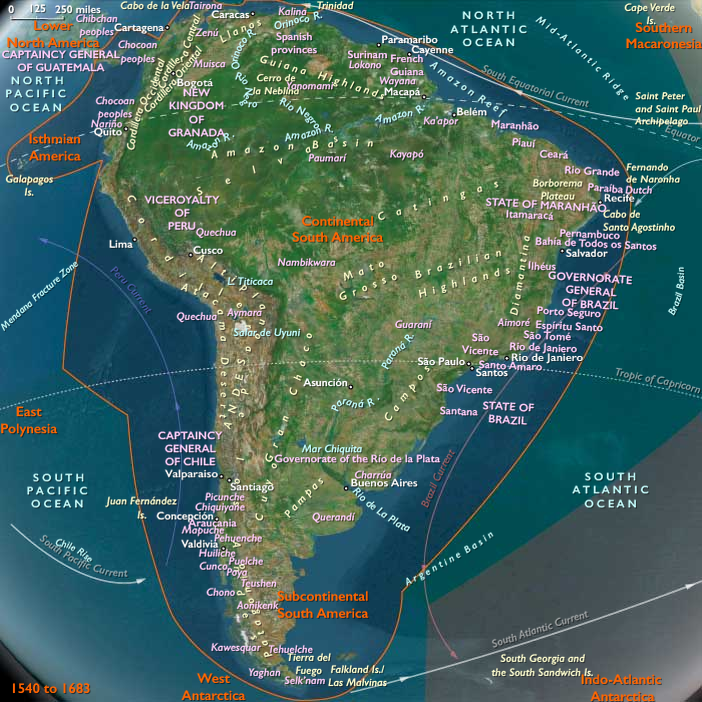
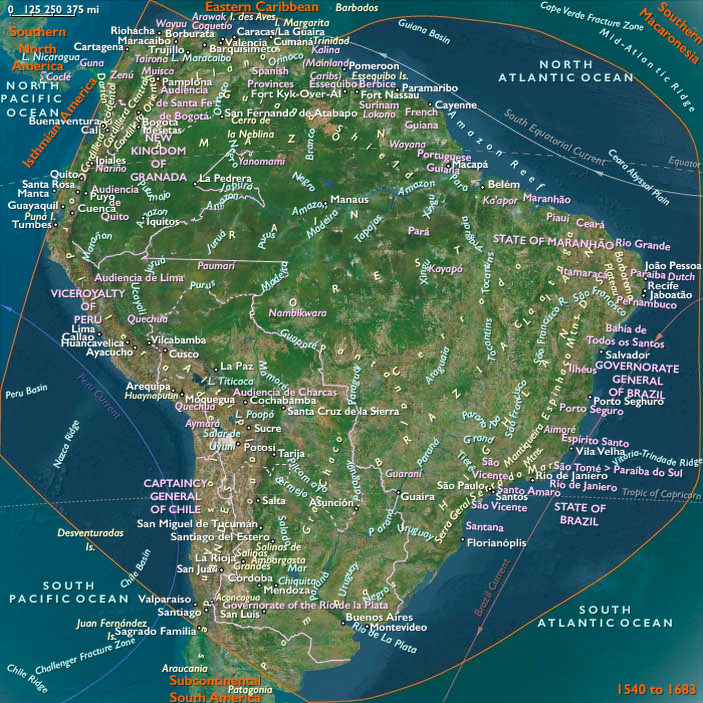
De Grammont and his pirates have for the past six months plundered Venezuela.
This is followed by another successful raid on the Venezuelan port of La Guaira, captured in a daring night attack, though the buccaneers only escape with difficulty when attacked by a larger Spanish force.
Locations
People
Groups
- New Spain, Viceroyalty of
- Spain, Habsburg Kingdom of
- Netherlands, United Provinces of the (Dutch Republic)
- France, (Bourbon) Kingdom of
- Dutch West Indies
Topics
- Colonization of the Americas, Spanish
- Colonization of the Americas, French
- Colonization of the Americas, English
- Colonization of the Americas, Dutch
- Piracy, Golden Age of
- Franco-Dutch War
Commodoties
- Fish and game
- Weapons
- Hides and feathers
- Gem materials
- Strategic metals
- Slaves
- Sweeteners
- Land
- Tobacco
Subjects
Regions
Subregions
Related Events
Filter results
Showing 10 events out of 30409 total
Wu Sangui, not waiting for a response from Wang Fuchen after conquering Hunan, had moved his armies north, while the Qing forces concentrate on recapturing Hunan.
Wu proclaims himself emperor of a new Great Zhou Dynasty in Hengzhou (present-day Hengyang, Hunan province) in 1678 and establishes his own imperial court.
When Wu Sangui dies in autumn of the same year, Kangxi has his corpse dismembered and scattered across the provinces of China.
His grandson Wu Shifan takes over Wu's troops and continues the battle.
Many Albanian converts to Islam had migrated elsewhere within the Ottoman Empire in the early seventeenth century and found careers in the Ottoman military and government.
Some have attained powerful positions in the Ottoman administration. (About thirty Albanians will rise to the position of grand vizier, chief deputy to the sultan himself.)
The Albanian Köprülü family in the second half of the seventeenth century provides four grand viziers, who fight against corruption, temporarily shore up eroding central government control over rapacious local beys, and win several military victories.
Merzifonlu Kara Mustafa Pasa has served during the grand vizierate (1661–76) of his brother-in-law Köprülü Fazil Ahmed Pasa as captain of the fleet, vizier in the State Council, and deputy grand vizier.
Succeeding Fazil Ahmed Pasa as grand vizier, he has led unsuccessful successive campaigns against Poland and Russia.
A Hungarian revolt against Habsburg rule in 1678 allows Kara Mustafa Pasa to move against Austria.
The battles between the Kimpanzu and Kinlaza continue to plunge the Kingdom of Kongo into a chaos not known in centuries.
The fighting between the two lineages leads to the sack of São Salvador in 1678.
Ironically, the capital built by the pact of Mpemba and Mbata is burned to the ground not by the Portuguese or rival African nations but by its very heirs.
The city and hinterlands around Mbanza Kongo are depopulated.
São Salvador becomes the grazing place of wild animals where rival claimants will crown themselves, then retreat before drawing the ire of opposition partisans.
Even after its resettlement, the city will never regain its prominence.
The most famous case of the Affair of the Poisons is Catherine Deshayes Monvoisin or La Voisin, who implicates a number of important individuals in the French court.
Promiscuous throughout her marriage to her husband, an unsuccessful jeweler named Monvoisin, she had practiced chiromancy and face-reading to retrieve her and her husband's fortunes, and had gradually added the practice of witchcraft, in which she had the help of a renegade priest, Etienne Guibourg, whose part was the celebration of the "black mass", a parody of the Christian Mass.
She practices medicine, especially midwifery, procures abortion, and provides love powders and poisons.
Her chief accomplice is one of her lovers, the magician Lesage, whose real name is Adam Cœuret.
The great ladies of Paris had flocked to La Voisin, who has accumulated enormous wealth from them.
Among her clients are Olympe Mancini, Comtesse de Soissons, who had sought the death of the king's mistress, Louise de La Vallière; and the Comtesse de Gramont ("la belle Hamilton"), among others.
Françoise-Athénaïs, marquise de Montespan, is accused of working with La Voisin to poison Louis XIV and Mademoiselle de Fontanges, a woman who is sleeping with Louis.
Although La Voisin never admits to working with Montespan, many other people claim she had worked with La Voisin but there is no sufficient evidence of this and many of the confessor's stories are inconsistent.
Also involved in the scandal is Eustache Dauger de Cavoye, the eldest living son of a prominent noble family.
De Cavoye had been disinherited by his family when, in an act of debauchery, he chose to celebrate Good Friday with a black mass.
Upon being disinherited he had opened a lucrative trade in "inheritance powders" and aphrodisiacs.
He mysteriously disappears after the abrupt ending to Louis's official investigation in 1678.
This contributes to the development of a unique identity, separate from that of Britain.
The first treatise on smallpox and measles appears in America in 1678.
King Philip’s War war has been devastating to both the natives in southeastern New England as well as the English.
More English have died in this war proportionate to population than any other war in American history, but their hard-won victory ensures that natives will never, can never, again launch so large an attack against the English.
Sir Edmund Andros negotiates a treaty with some of the northern native bands on April 12, 1678, as he tries to establish his New York-based royal power structure in Maine's fishing industry.
Sporadic native and French raids will plague Maine, New Hampshire and northern Massachusetts for the next fifty years as France encourages and finances raids on New England settlers.
Most of Massachusetts, Connecticut and Rhode Island is now nearly completely open to New England's continuing settlement, free of interference from the natives.
Frontier settlements in New England will face sporadic native raids until the French and Indian War finally drives the French authorities out of North America in 1763.
King Philip's War, for a time, had seriously damaged the recently arrived English colonists' prospects in New England.
For the English, their society had been badly destroyed and their confidence diminished from the war, but with their extraordinary population growth rate of about three percent a year (doubling every twenty-five years), they will repair all the damage, replace their losses, rebuild the destroyed towns, and continue on with establishing new towns within a few years.
Sugar cane dominates Barbados' economic growth, and the island's cash crop is at the top of the sugar industry.
As sugar has developed into the main commercial enterprise, the island has been divided into large plantation estates which have replaced the small holdings of the early British settlers as the wealthy planters push out the poorer.
Some of the displaced farmers relocate to British colonies in North America, most notably South Carolina.
About twelve hundred Irish families sail from Barbados in 1678 to Virginia and the Carolinas.
Jean II d'Estrées, born in a noble family from Picardie, is the nephew of Gabrielle d'Estrées, who had been the lover of King Henry IV of France.
Like his father François Annibal d'Estrées, also Marshal of France, Jean had pursued a military career from a very young age, becoming a colonel at twenty-three, a maréchal de camp at twenty-five and a lieutenant general at thirty-three.
He had fought in the Battle of Lens (1648) under the grand Condé, afterwards fightiuing under Turenne in Lorraine in 1652 - 1653, then in Flanders.
He was made prisoner at Valenciennes in 1656 and had been loyal to the Royal family during the Fronde.
Joining the new French Navy in 1668 on the demand of his friend Colbert, his patron in this service is the Duke de Beaufort.
He rises through the ranks very fast, thanks to the influence of his family name (he will become Marshal of France in 1681.)
Such advancement is unjustified, as d'Estrées has no naval experience and furthermore possesses a detestable character that alienates his subordinates.
His first campaign was in the Caribbean, to which he has returned four more times, becoming the French naval specialist in the region.
During the Franco-Dutch War, he has been put in command of the French fleet that is to fight alongside the English fleet against the Dutch.
He had participated on board the Saint Philippe in the Battle of Solebay in 1672 and the next year on the la Reine, in the Battle of Schooneveld and the Battle of Texel.
None of these battles were victories and d'Estrées had been faulted for his hesitant attitude.
He had in 1676 and 1677 succeeded in conquering Gorée, Cayenne and Tobago, destroying the Dutch fleet based there, but these successes were soon to be overshadowed by the disaster of the Las Aves Archipelago.
Admiral d'Estrées and his fleet of seventeen vessels, including several hired buccaneers, is in May 1678 dispatched on a mission to conquer the Dutch-occupied islands of Bonaire and Curacao.
When d'Estrées' fleet passes the Los Roques Archipelago on the way to Bonaire, a small fleet of Dutch boats, seeking to defend themselves from the French attack, sets sail from Curacao destined for Las Aves.
Once assembled on the archipelago, the Dutch maneuver their ships into the heart of Las Aves' lagoon.
As night falls, lanterns are lit.
Simulating the lights of a town, the Dutch sailors hope to persuade the French that they had reached Bonaire, and in so doing, attract the French galleons onto the reef.
The Admiral heads his flagship, the seventy-gun le Terrible, straight for the trap and directly towards the coral reef, against the advice of his subordinates, who suspect the danger.
By the time the breakers are spotted, it is too late: le Terrible cannot avoid the reef.
D’Estrées fires guns to warn off the rest of the fleet, but the crews of the other ships, believing he is under attack by the Dutch, rush to his aid.
One by one, the rest of the vessels in the fleet strike the reef and sink, causing five hundred sailors to drown.
This error of navigation is unique in maritime history, but the nephew of Gabrielle d'Estrées is untouchable.
Louis XIV and Seignelay will continue to give him their confidence.

Michel, Chevalier de Grammont, a nobleman who had come into disfavor after killing his sister's suitor in a duel and was forced to leave France, had in about 1670 gone to Hispaniola, where he had been given a French ship.
Serving as a privateer, his first success had been the capture of a Dutch convoy, valued at about four hundred thousand livres (four million US dollars).
On his next voyage he had run up onto a reef and sunk.
Grammont had then moved to Tortuga, where he bought and outfitted a new ship which he uses to attack Spanish shipping.
When war broke out between France and Holland, he had joined the fleet under the command of Comte d'Estrées for an abortive raid on the Dutch island of Curaçao in which the entire fleet of seventeen vessels had been wrecked on the Los Roques Archipelago (Las Aves).
De Grammont is in June 1678 made commander of the six ships and seven hundred men salvaged from the Las Aves Disaster.
He lands his men in Spanish-held Venezuela and captures Maracaibo, ...
Years: 1678 - 1678
December
Locations
People
Groups
- New Spain, Viceroyalty of
- Spain, Habsburg Kingdom of
- Netherlands, United Provinces of the (Dutch Republic)
- France, (Bourbon) Kingdom of
- Dutch West Indies
Topics
- Colonization of the Americas, Spanish
- Colonization of the Americas, French
- Colonization of the Americas, English
- Colonization of the Americas, Dutch
- Piracy, Golden Age of
- Franco-Dutch War
Commodoties
- Fish and game
- Weapons
- Hides and feathers
- Gem materials
- Strategic metals
- Slaves
- Sweeteners
- Land
- Tobacco