
Dai Jin and Shen Zhou of the …
Years: 1444 - 1455
Dai Jin and Shen Zhou of the Zhe school in China use light and color in innovative and dramatic ways to usher in new age of realism in art.
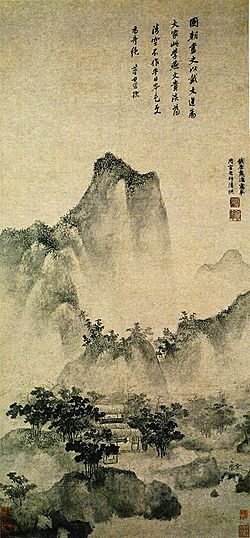
Dai Jin, "Landscape in the Style of Yan Wengui", Early Ming Dynasty (1368-1644); a Chinese landscape painting using "atmospheric perspective" to show recession in space.
Locations
People
Groups
Subjects
Regions
Subregions
Related Events
Filter results
Showing 10 events out of 41742 total
Temple construction begins to decline under the Ming dynasty, along with architecture in general, into mere repetition of Song formulas.
Among the few notable Chinese buildings erected in the fifteenth-century are the Taimiao, in Beijing, a long, narrow assembly building that recalls early Chinese palaces, and the Zhihuasi, completed in 1444 as a Ming version of a traditional Buddhist structure.
Construction of the Zhihua Temple ("Temple of Wisdom Attained") had begun in 1443 at the order of Wang Zhen, a powerful eunuch in the Rites Supervising Office of the court of the Zhengtong Emperor.
The temple, surrounding buildings, and grounds comprise approximately two hectares (four point nine acres).
It is one of the most important original building complexes from the Ming dynasty period in the Old City area, and one of the only wooden structures and groups of buildings from the Ming dynasty to remain intact in Beijing.
It is also striking for its extensive use of black roof tiles.
Later works of the painter-priest Shubun, such as Chikusai Tokusho, display a style perhaps influenced by Korean landscape painting.
Shubun's most well-known painting, designated as a National Treasure in Japan, is Reading in a Bamboo Grove, now kept in the Tokyo National Museum.
In the 1440s, he teaches the young Sesshu Toyo, who becomes his best pupil and the most highly regarded Japanese artist of his time.
Another important pupil may have been Kano Masanobu, who will succeed Shubun as the chief painter of the Ashikaga shogunate, and will also found the Kano school of painting.
The Tumu Crisis, a frontier conflict between the Oirat Mongols and the Chinese Ming Dynasty, leads to the capture of the Zhengtong Emperor on September 8, 1449, largely due to the Chinese army's remarkably bad deployment.
The expedition is regarded as the dynasty’s greatest military debacle.
The Development of Copper Engraving (1430s) and Its Rise Over Woodcut Printing
In the 1430s, a new printing technique—copper engraving—emerged, revolutionizing art reproduction and book illustration. By the second half of the 15th century, engraving had largely replaced the woodcut as the preferred method for producing detailed prints.
Origins and Early Development (1430s–1450s)
- Engraving originated in metalworking traditions, particularly in goldsmithing, where artisans would etch intricate designs into armor, jewelry, and decorative objects.
- The technique was first developed in southern Germany and northern Italy, where metalworkers adapted their craft to printmaking.
- The earliest copperplate engravings date from the 1430s–1440s, and by the 1470s, the method was widely used for illustrations and stand-alone artworks.
Why Copper Engraving Replaced Woodcuts
-
Greater Detail and Precision
- Woodcuts required artists to carve designs into wood, which was less precise and prone to deterioration.
- Copper engraving allowed for finer lines, shading, and greater depth, making it more suitable for complex compositions.
-
Durability and Longevity
- Copper plates lasted much longer than woodblocks, which wore out quickly.
- This allowed for larger print runs with consistent quality.
-
Flexibility and Artistic Freedom
- Artists could create more intricate and delicate designs, giving engravings a smoother, more refined appearance.
- The technique allowed for more realistic human figures, landscapes, and textures, appealing to Renaissance tastes.
Key Figures in Early Engraving
- Master E.S. (Germany, c. 1440–1468) – One of the earliest known engravers, active in the Upper Rhine region.
- Martin Schongauer (c. 1448–1491) – A German artist whose detailed engravings influenced Albrecht Dürer and other Renaissance painters.
- Antonio Pollaiuolo (Italy, c. 1431–1498) – A Florentine engraver who used the technique to depict dynamically posed human figures, anticipating Michelangelo’s studies.
Impact of Copper Engraving on Art and Printing
- Expanded Artistic Reproduction – Allowed detailed reproductions of paintings and drawings, making art more accessible.
- Influenced Renaissance Artists – Engraving spread ideas and artistic styles across Europe, influencing painters and sculptors.
- Improved Book Illustration – The technique was used in early printed books, enhancing the quality of illustrations in Renaissance texts.
- Laid the Foundation for Later Printmaking – Engraving remained dominant until the 16th century, when etching and lithography further evolved.
The rise of copper engraving in the 15th century was a pivotal moment in European print culture, transforming both artistic production and book illustration, and ushering in a new era of visual communication.
The Rapid Spread of Printing After Gutenberg’s Invention (1450s–15th Century)
Johannes Gutenberg’s invention of the printing press with movable type (c. 1440s) revolutionized communication, learning, and the dissemination of knowledge. Following his success in Mainz, Germany, printing spread rapidlyacross Europe as journeymen printers left their masters to establish their own workshops.
The Expansion of Printing in Europe
- Mainz, Germany (1450s) – Gutenberg’s Bible (1455) was the first major book printed using movable type, marking the beginning of the Printing Revolution.
- Italy (1453) – Printing arrived in Italy, with early works appearing in Venice and Rome.
- France (c. 1470) – The first printing press in France was established in Paris.
- England (1476) – William Caxton set up England’s first printing press in Westminster, producing books in English.
- Spain (1473) – Printing began in Valencia, quickly spreading to other Iberian cities.
Why Printing Spread So Rapidly
- Economic Opportunity – Printing was a highly profitable trade, attracting skilled craftsmen who wanted to establish their own presses.
- High Demand for Books – Universities, scholars, and religious institutions needed books, creating a huge market for printed materials.
- Support from Wealthy Patrons – Nobles and merchants funded printing houses, recognizing its value in education and administration.
- Venice as a Printing Hub – By the late 15th century, Venice became Europe’s leading printing center, producing thousands of books annually.
- Standardization of Knowledge – Movable type allowed for accurate reproduction, making texts cheaper, faster to produce, and widely available.
Impact of the Printing Revolution
- Increased Literacy – Books became more affordable, leading to a rise in literacy rates across Europe.
- Spread of Renaissance Ideas – The printing press accelerated the diffusion of humanist thought, strengthening the Renaissance.
- Religious Reformation – Printed Bibles and theological texts enabled wider debate, fueling the Protestant Reformation (1517).
- Scientific Advancement – Scientific works, including Copernicus’ and Galileo’s writings, could be widely circulated, influencing the Scientific Revolution.
The arrival of printing in Italy in 1453 marked an early milestone in the printing revolution, which would transform European society, education, and politics, laying the groundwork for modern knowledge dissemination.
East Europe (1444–1455 CE): Muscovite Centralization and Cultural Enrichment
Political and Military Developments
Expansion and Centralization of Muscovite Authority
From 1444 to 1455 CE, Muscovy continued to expand its territories, centralizing authority and reinforcing administrative governance. Its dominance within East Europe grew significantly, stabilizing regional power dynamics.
Resolution of Remaining Regional Conflicts
Muscovy effectively managed remaining tensions with neighboring principalities, employing diplomacy and targeted military strategies to resolve lingering conflicts, further securing regional peace and stability.
Integration and Empowerment of Ethnic Communities
The ongoing integration of ethnic groups such as the Mari, Mordvins, Udmurts, Komi, and Vepsians into Muscovite governance structures continued to strengthen regional cohesion and administrative efficiency.
Economic and Technological Developments
Economic Stability and Expansion
The period witnessed sustained economic stability and growth, driven by vibrant domestic trade networks and continuing international commerce. Major urban centers, notably Moscow, Novgorod, and Tver, flourished economically.
Continued Advances in Military Infrastructure
Advancements in military technology persisted, especially in fortifications, siege warfare, and cavalry strategies, further enhancing Muscovy’s defense capabilities and strategic preparedness.
Cultural and Artistic Developments
Rich Cultural Development
The era was marked by significant cultural enrichment, blending Rus', Mongol, and ethnic traditions into unique artistic expressions. Architecture, religious iconography, and secular art saw notable advancements.
Literary and Intellectual Achievements
Continued literary and intellectual activities thrived, with chroniclers diligently recording historical, religious, and cultural narratives. These efforts preserved cultural identity and reinforced historical continuity.
Settlement Patterns and Urban Development
Urban Growth and Infrastructure Development
Cities, particularly Moscow, continued to expand both demographically and economically, supported by substantial infrastructure investments and sophisticated urban management. These developments facilitated increased regional administrative effectiveness.
Enhanced Urban Defense Mechanisms
Strategic fortifications and defensive infrastructure saw further improvements, protecting urban centers and securing regional stability.
Social and Religious Developments
Increased Social Harmony and Ethnic Diversity
Societal structures evolved further, effectively accommodating diverse ethnic communities, thus fostering social harmony, cohesion, and regional stability.
Orthodox Church Influence and Social Stability
The Orthodox Church maintained its central societal influence, guiding educational frameworks, moral values, and community interactions. Its prominent role significantly contributed to regional stability and cultural continuity.
Long-Term Consequences and Historical Significance
The period from 1444 to 1455 CE further strengthened Muscovy’s political centralization, economic stability, and cultural vibrancy. These developments provided crucial foundations for the emergence of a unified, culturally enriched Russian state.
The Thirteen Years' War, also called the War of the Cities, starts in 1454 as an uprising by Prussian cities and the local nobility with the goal of gaining independence from the Teutonic Knights.
The Prussian Confederation asks the Polish king for help and offers to incorporate Prussia into the Kingdom of Poland.
When the king agrees, war between Poland and the Teutonic Knights breaks out.
Northeast Europe (1444–1455 CE): Union Struggles, Territorial Adjustments, and Diplomatic Maneuvers
Between 1444 and 1455 CE, Northeast Europe faced ongoing internal tensions within the Kalmar Union, territorial shifts involving the Teutonic Order, and continued geopolitical repositioning among regional powers. Diplomatic engagements and persistent economic resilience significantly shaped the period, laying critical groundwork for future developments.
Internal Tensions and Leadership Changes within the Kalmar Union
During this period, internal strains within the Kalmar Union intensified significantly. The deposition of King Eric of Pomerania in 1439 led to continued political uncertainties and power struggles within the Union. The election of Christopher of Bavaria in 1440 brought temporary stability; however, his reign, lasting until 1448, was marked by unresolved tensions, notably from the Swedish nobility advocating for greater autonomy and lessened Danish influence. Following Christopher's death in 1448, the ascension of Christian I of Oldenburg further reshaped Union dynamics, as internal divisions persisted and political cohesion remained tenuous.
Diplomatic Maneuvers by the Teutonic Order
The Teutonic Order continued its efforts to stabilize territories in Prussia and Estonia, confronting ongoing pressures from the neighboring Polish–Lithuanian Union. Diplomatic initiatives, territorial governance reforms, and fortifications in key centers such as Königsberg and Reval (Tallinn) were critical measures undertaken by the Order, reflecting a strategy focused on maintaining territorial integrity and regional influence despite persistent vulnerabilities.
Livonian Confederation's Economic and Political Stability
The Livonian Confederation, governed from the thriving trade city of Riga, successfully preserved its political autonomy and economic strength. Effective internal governance, strategic diplomacy, and robust trade networks allowed it to navigate complex regional rivalries effectively, reinforcing its status as a stable, prosperous political entity amidst regional uncertainties.
Strengthened Swedish Governance in Finland
Despite internal Union tensions, Sweden reinforced its administrative control and integration of southern Finland, enhancing defensive structures, local governance, and ecclesiastical influence. The sustained focus on regional stability and cohesion underscored Finland’s significance within Sweden’s broader geopolitical and strategic interests.
Economic Stability in Major Urban Centers
Urban centers such as Reval (Tallinn), Riga, Königsberg, and Visby on Gotland continued to prosper, driven by steady maritime trade and expanding commercial networks. Urban governance reforms, merchant activities, and trade stability facilitated broader regional economic resilience despite ongoing political complexities.
Ecclesiastical Institutions and Cultural Cohesion
Ecclesiastical institutions, notably regional bishoprics and the influential Teutonic Order, remained central in maintaining social stability, cultural cohesion, and educational continuity. Their consistent promotion of Latin Christian traditions provided regional stability, reinforcing cohesive social structures during times of political uncertainty.
Strategic Diplomacy and Regional Realignments
Diplomatic interactions remained crucial in managing territorial disputes, internal political tensions, and regional rivalries. Strategic alliances, negotiations, and temporary agreements characterized diplomatic activity among the Kalmar Union members, the Teutonic Order, the Livonian Confederation, and the Polish–Lithuanian Union, reflecting ongoing geopolitical realignments.
Legacy of the Era
The era from 1444 to 1455 CE significantly shaped Northeast Europe's geopolitical trajectory through intensified internal conflicts within political unions, ongoing territorial and diplomatic adjustments, and sustained economic and cultural resilience. These developments influenced subsequent territorial alignments, political structures, and cultural identities, establishing patterns and challenges that would define Northeast Europe’s subsequent historical course.
East Central Europe (1444–1455 CE): Ottoman Confrontation, Hungarian Leadership under Hunyadi, Polish-Lithuanian Dynamics, and Bohemian Stabilization
Between 1444 and 1455 CE, East Central Europe experienced significant geopolitical upheaval marked by renewed Ottoman incursions, the rise of John Hunyadi as Hungary's military leader, critical developments within the Polish-Lithuanian Union, and continued stabilization efforts in post-Hussite Bohemia. These developments profoundly shaped the region's late medieval political landscape, underscoring persistent external threats and internal realignments that redefined East Central European politics and society.
Political and Military Developments
Battle of Varna and Death of Władysław III (1444)
-
In 1444, a major European crusade against the Ottoman Empire ended disastrously at the Battle of Varna, resulting in the death of King Władysław III of Poland and Hungary. This catastrophic defeat severely destabilized Hungary and plunged Poland into a dynastic crisis.
John Hunyadi’s Ascendancy and Regency in Hungary (1446–1453)
-
Following the battle, Hungarian noble John Hunyadi emerged as the kingdom's de facto ruler, becoming regent for the underage Ladislaus the Posthumous (1440–1457), son of Albert II. Hunyadi consolidated his authority, reorganized Hungary’s military forces, and strengthened defenses against Ottoman advances.
-
In 1453, after Ladislaus came of age, Hunyadi relinquished the regency but retained significant influence as Hungary’s foremost military commander and political leader.
Ottoman Pressure and Battle of Kosovo (1448)
-
Ottoman threats persisted relentlessly, culminating in another major conflict at the Second Battle of Kosovo (1448). Despite Hunyadi’s strategic skill, his army suffered defeat against Sultan Murad II, underscoring Ottoman military supremacy and deepening Hungary's defensive vulnerability.
Polish-Lithuanian Union: Dynastic Transition and Kazimierz IV (1447–1492)
-
In 1447, following a three-year interregnum, Kazimierz IV Jagiellon (Casimir IV) ascended to the Polish throne. His accession reinforced the Jagiellonian dynasty, stabilizing Poland-Lithuania politically and strengthening its international standing.
-
Kazimierz IV prioritized internal reforms, improved royal governance, and cautiously balanced external diplomacy, especially managing relations with Hungary, Bohemia, and the Teutonic Order.
Bohemian Stability and George of Poděbrady
-
Post-Hussite Bohemia gradually stabilized, especially under the rising influence of Czech nobleman George of Poděbrady. Appointed governor in 1452, he effectively governed Bohemia on behalf of the young Ladislaus the Posthumous, emphasizing internal peace, economic recovery, and moderate religious tolerance.
Economic and Technological Developments
Hungarian and Polish Economic Recovery
-
Despite continuous Ottoman threats, Hungary under Hunyadi and Poland under Kazimierz IV enjoyed periods of cautious economic recovery, benefiting from revived agricultural productivity, growing commercial trade, and renewed urban prosperity.
-
Key urban centers, including Kraków, Gdańsk, and Buda, regained prominence, strengthening their roles in regional and international trade networks.
Hanseatic League and Baltic Trade Expansion
-
Northern trade networks flourished as Hanseatic cities like Lübeck, Gdańsk, and Toruń deepened commercial ties, profiting significantly from the stability and economic expansion of the Polish-Lithuanian Union.
Cultural and Artistic Developments
Bohemian Renaissance and Cultural Flourishing
-
Bohemia experienced cultural revival under George of Poděbrady’s governorship, emphasizing literacy, vernacular literature, and intellectual exchanges shaped by moderate Hussite religious legacies.
-
Gothic architecture and artistic patronage remained vibrant, particularly in Prague and Kutná Hora, highlighting sustained cultural prosperity despite recent conflicts.
Polish-Lithuanian Royal Patronage
-
Under Kazimierz IV, Poland-Lithuania saw significant cultural and artistic patronage. Kraków thrived as a major intellectual and artistic hub, home to flourishing universities, courtly literature, and ecclesiastical art.
Settlement and Urban Development
Defensive Infrastructure and Fortifications
-
Heightened Ottoman threats led Hungary to substantially fortify frontier regions, reinforcing border castles, fortresses, and urban defenses, significantly enhancing defensive capabilities.
-
Cities across Bohemia and Poland continued urban expansion, improved civic infrastructure, and strengthened defenses, contributing to urban resilience and demographic growth.
Social and Religious Developments
Continued Religious Diversity and Hussite Influence
-
Bohemia maintained religious diversity, integrating moderate Hussite traditions into local religious practice, sustaining religious tolerance and shaping distinctive cultural and religious identities.
Social Realignment and Noble Power
-
Throughout the region, especially in Hungary and Poland-Lithuania, the nobility leveraged dynastic crises and royal dependency on aristocratic support, significantly strengthening noble privileges, local autonomy, and political influence.
Long-Term Consequences and Historical Significance
The era 1444–1455 CE represented a pivotal period for East Central Europe, defined by dramatic geopolitical shifts and internal consolidation. The devastating Battle of Varna altered the region’s political trajectory, prompting Hungarian military reforms under Hunyadi and reshaping Polish-Lithuanian dynastic structures under Kazimierz IV. Persistent Ottoman threats necessitated significant defensive innovations, fundamentally shaping Hungary’s political and social landscape. Simultaneously, Bohemian stabilization under George of Poděbrady consolidated internal peace and cultural revival, laying foundations for future political and cultural transformations that deeply influenced East Central Europe through the late medieval and early modern eras.
Craftsmen's guilds in many German towns and cities cultivate solo song from about 1450.
Members develop elaborate rules for their art, hold contests, and award prizes.
Their melodies, while similar to those of the courtly minnesingers of the twelfth through the fourteenth century, often end in florid cadences foreign to those of their predecessors; their texts are largely religious or didactic.
Years: 1444 - 1455
Dai Jin, "Landscape in the Style of Yan Wengui", Early Ming Dynasty (1368-1644); a Chinese landscape painting using "atmospheric perspective" to show recession in space.
Locations
People
Groups
Subjects
Regions
Subregions