…Dacia Inferior is transformed into Dacia Malvensis …
Years: 148 - 159
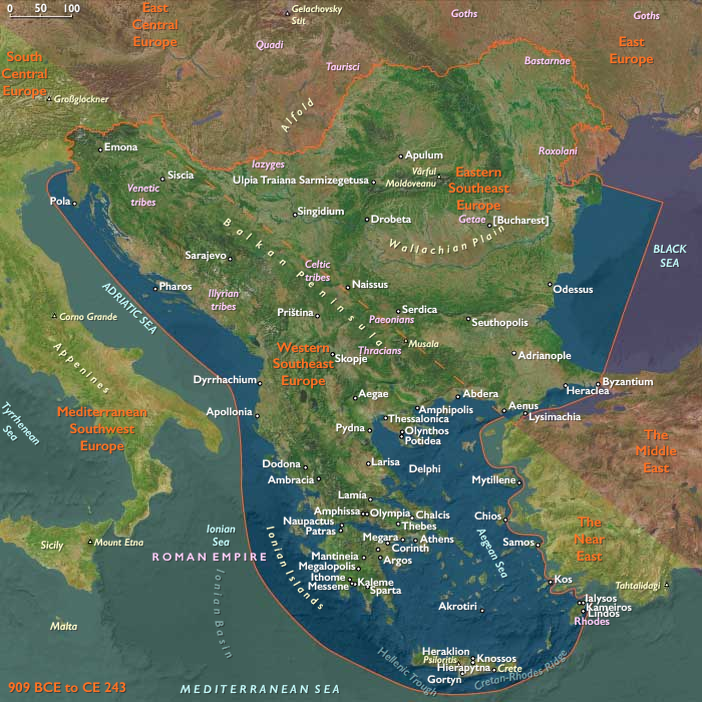
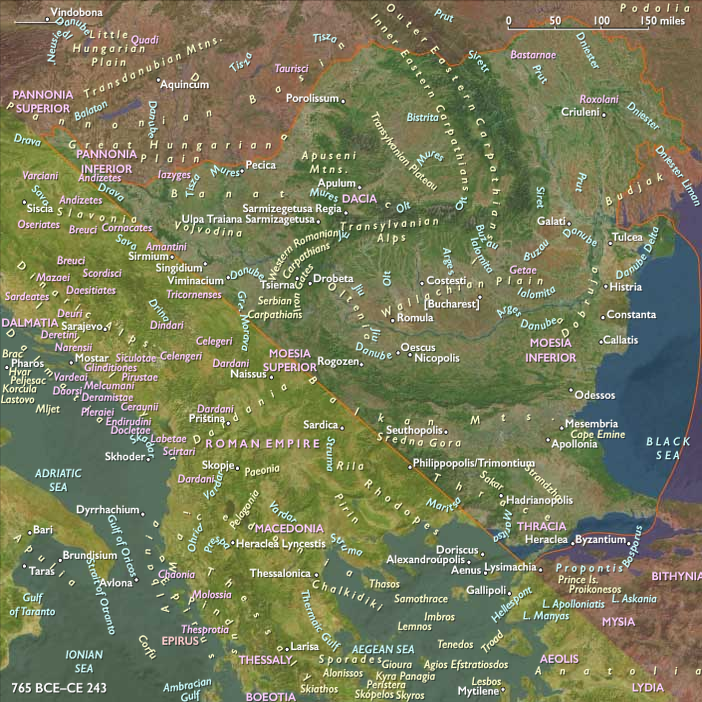
…Dacia Inferior is transformed into Dacia Malvensis (situated at Oltenia).
Romula is its capital (modern Reşca Dobrosloveni, Romania).
As per Hadrian's earlier reorganization, each zone is governed by equestrian procurators, and all are responsible to the senatorial governor in Apulensis.
Locations
People
Groups
Topics
Commodoties
Subjects
Regions
Subregions
Related Events
Filter results
Showing 10 events out of 61084 total
A Taoist movement, the Way of the Five Pecks of Rice, spreads rapidly throughout China.
An Shigao, a prince of Parthia, has renounced his claim to the royal throne of Parthia in order to serve as a Buddhist missionary monk.
Nicknamed the "Parthian Marquis", he arrives in China in 148 CE at the Han Dynasty capital of Luoyang, where he produces a substantial number of translations of Indian Buddhist texts and attracts a devoted community of followers.
More than a dozen works by An Shigao are currently extant, including texts dealing with meditation, abhidharma, and basic Buddhist doctrines.
An Shigao's corpus does not contain any Mahāyāna scriptures, though he himself is regularly referred to as a "bodhisattva" in early Chinese sources.
Scholarly studies of his translations have shown that they are most closely affiliated with the Sarvāstivāda school.
An Shigao is the first Buddhist translator to be named in Chinese sources.
East Central Europe (148–159 CE): Late Antonine Stability and Deepening Roman-Germanic Engagement
Between 148 and 159 CE, East Central Europe—covering Poland, Czechia, Slovakia, Hungary, and those portions of Germany and Austria lying east of 10°E and north of a line stretching from roughly 48.2°N at 10°E southeastward to the Austro-Slovenian border near 46.7°N, 15.4°E—continued to experience peaceful and prosperous conditions due to sustained Roman frontier policies. Emperor Antoninus Pius maintained stability, ensuring a secure and well-defended Danube frontier. Trade flourished, diplomatic ties became more sophisticated, and regional cultural integration deepened, further strengthening ties between Roman provinces (Pannonia Superior, Pannonia Inferior, and Noricum) and Germanic tribal societies.
Political and Military Developments
Continued Frontier Stability under Antoninus Pius
-
Emperor Antoninus Pius continued to reinforce and maintain frontier defenses along the Danube, safeguarding the Roman provinces of Pannonia Superior, Pannonia Inferior, and Noricum.
-
The Roman frontier remained secure, supported by a well-maintained network of legionary camps, forts, and watchtowers, allowing for sustained peace and diplomatic exchange.
Diplomatic Complexity with Germanic Tribes
-
Diplomatic interactions with the prominent Germanic tribes—particularly the Marcomanni and Quadi, occupying modern Czechia, Slovakia, and parts of southern Poland—became more nuanced, involving complex negotiations to maintain stability.
-
The Langobardi (Lombards) continued consolidating their position north and northeast of the frontier, increasingly interacting economically and diplomatically with Roman provincial authorities.
Economic and Technological Developments
Flourishing Cross-Border Trade
-
Economic prosperity continued to rise, supported by extensive and stable trade networks between Roman frontier settlements and Germanic tribes. Roman goods, including coins, pottery, glass, and textiles, exchanged extensively for local commodities such as amber, grain, iron tools, livestock, and fur.
-
Roman coinage facilitated widespread monetary transactions, promoting economic integration across the region.
Agricultural Innovations and Technological Exchange
-
Germanic communities continued adopting Roman agricultural techniques, increasing productivity, and stabilizing food supply and local economies.
-
Technological exchanges in ironworking, pottery, and craftsmanship advanced local industry, enhancing economic specialization within Germanic societies.
Cultural and Artistic Developments
Increasing Cultural Integration
-
Material culture from this era, including pottery, jewelry, and metalwork, reflected an intensified fusion of Roman artistic influences and Germanic traditional motifs, signaling deeper cultural integration across the frontier.
Artistic Refinement and Craftsmanship
-
Germanic artisans and craftsmen, benefiting from sustained economic interactions, produced increasingly sophisticated artifacts, combining local artistic traditions with Roman styles, materials, and techniques.
Settlement and Urban Development
Growth of Roman Frontier Towns
-
Roman settlements along the frontier—particularly Carnuntum, Vindobona, and Aquincum—continued thriving as administrative, economic, and cultural hubs, significantly influencing regional development.
Stability of Germanic Agricultural Communities
-
North of the Roman provinces, Germanic settlements continued to expand modestly, remaining stable agricultural villages characterized by communal farming practices, localized economies, and improved prosperity due to steady trade with Roman settlements.
Social and Religious Developments
Tribal Leadership Stability
-
Tribal social structures remained robust, led by warrior elites and chieftains whose political influence relied heavily on trade, military prowess, and diplomatic ties with Roman frontier authorities.
Persistent Religious Traditions and Syncretism
-
Traditional religious practices among Germanic tribes continued strongly, emphasizing ancestor worship, nature deities, and community rituals. Increased interactions with Romans brought about gradual cultural and religious syncretism.
Long-Term Consequences and Historical Significance
The era from 148 to 159 CE, marked by Emperor Antoninus Pius's sustained policies, reinforced frontier stability, enhanced regional prosperity, and deepened Roman-Germanic cultural and economic integration. Continued peaceful relations enabled productive trade, technological advancement, and cultural exchanges, reinforcing social structures within Germanic communities and laying solid foundations for further developments. These dynamics significantly influenced the subsequent historical trajectory of East Central Europe, shaping enduring political, economic, and cultural identities.
The accession of Antonius Pius has seen the arrival of an emperor who takes a cautious approach to the defense of the provinces.
The large amount of milestones dated to his reign demonstrates that he was particularly concerned with ensuring that the roads were in a constant state of repair.
Stamped tiles show that the amphitheater at Ulpia Traiana Sarmizegetusa, which had been built during the earliest years of the colonia, is repaired under his rule.
In addition, …
…given the exposed position of the larger of the Roman fortifications at Porolissum (near Moigrad, Romania), the camp is reconstructed using stone, and given sturdier walls for defensive purposes.
Antonius Pius undertakes another reorganization of the Dacian provinces following a revolt around 158.
Dacia Porolissensis (in what is now northern Transylvania), with Porolissum as its capital, remains as it is.
Dacia Superior is renamed Dacia Apulensis (in Banat and southern Transylvania), with Apulum as its capital, while …
The Middle East: 148–159 CE
Religious Movements and Growing Christianity
The period from 148 to 159 CE witnesses significant developments in religious thought and organization, particularly marked by the rise of the Montanist movement around the middle of the century. Originating in Phrygia (present-day central Turkey), Montanus, a charismatic convert to Christianity, claims to have received divine revelations shortly after his baptism in approximately 156 CE (though some sources suggest a later date of 172 CE). Montanus declares himself the chosen prophet of the Holy Spirit, tasked with leading Christianity into its ultimate, perfected state in preparation for imminent end times.
Montanism emphasizes spiritual fervor, ecstatic prophecy, asceticism, and rigorous moral discipline. Rejecting the hierarchical and institutional structures increasingly shaping the early Christian church, Montanus advocates for a return to a purer, more spontaneous form of Christianity characterized by personal spiritual revelation, charismatic leadership, and a rigorous lifestyle marked by isolation, prayer, fasting, and disdain for worldly attachments.
Though initially attractive to many Christians who feel alienated by growing ecclesiastical formality, Montanism soon sparks controversy and opposition from mainstream church leaders. The movement prompts intense theological debates regarding the nature of prophecy, the authority of church hierarchy, and the appropriate expression of spirituality. Despite—or perhaps because of—this controversy, Montanism quickly spreads beyond Phrygia, significantly impacting Christian communities throughout Asia Minor, the Near East, and even reaching as far as North Africa.
This era, therefore, marks a critical juncture in early Christian history, highlighting tensions between charismatic religious expression and structured ecclesiastical governance, setting patterns that will continue to shape religious discourse for centuries to come.

The Acts of the Apostles, purportedly written by the author of the Gospel according to Luke, recounts the early preaching about Jesus Christ, the growth of the primitive Christian community, and the spread of the Christian message.
Rome, in the wake of three Jewish-Roman Wars, states that while Judaism will not be recognized as an official religion, it must be tolerated.
Montanus, a Phrygian, claims to have received a revelation from the Holy Spirit, shortly after his baptism as a Christian in 156 or 172, to the effect that he, as representative prophet of the Spirit, is to lead the Christian church into its final stage.
He calls for less church hierarchy and more charismatic prophecy, regarding a life of seclusion and contempt of the world as the only true Christian ideal.