Cyrus leads a rebellion against his Medean …
Years: 561BCE - 550BCE
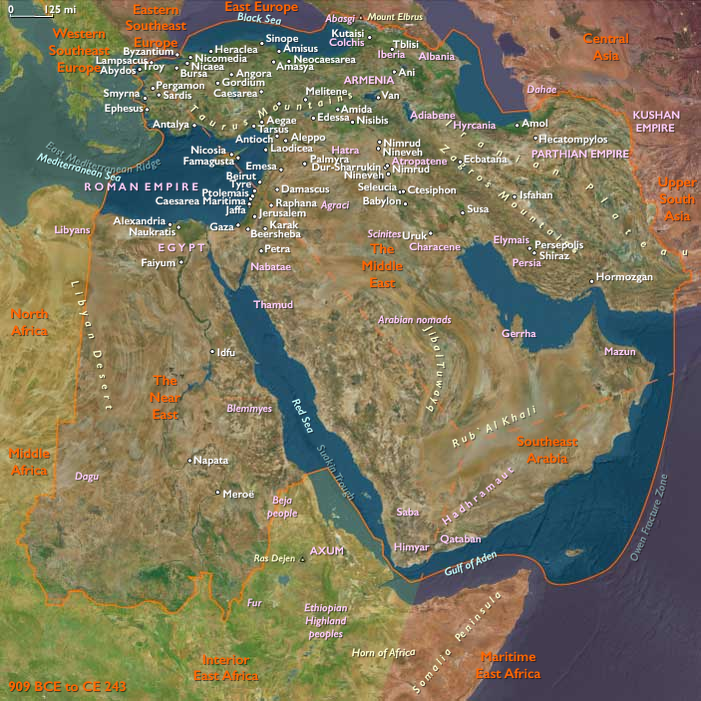
Cyrus leads a rebellion against his Medean overlords in 553, gathering to his cause Medians no longer willing to tolerate the continued harshness of the wildly unpopular Astyages.
Cyrus and his rebel army engage the Medes in a number of indecisive battles.
Taking advantage of an army mutiny, Cyrus enters the Median capital at Ecbatana without serious fighting to defeat Astyages in 549; sparing the king’s life, he removes his treasury to the Anshan capital at Susa.
Locations
People
Groups
Topics
- Younger Subboreal Period
- Iron Age, Near and Middle East
- Iron Age Cold Epoch
- Classical antiquity
- Persian Conquests of 559-509 BCE
- Persian Revolt
- Persian Border, Battle of the
Commodoties
Subjects
Regions
Subregions
Related Events
Filter results
Showing 10 events out of 65854 total
Greek colonies on the Aegean coast of Thrace include Aenus near Alexandroúpolis.
Formerly called Poltyobria (or Poltymbria), it is located near the mouth of the Hebrus River, not far from the Melas Gulf (modern Gulf of Saros), which is formed by the Thracian Chersonesus to the east.
The city was said to be founded (or at least settled) by Aeolian migrants from Lesbos.
The Middle East: 561–550 BCE
Colonization and Expansion in Anatolia
Around 560–558 BCE, Megarian colonists establish Heraclea Pontica (modern Ereğli) on the Black Sea coast, named after the legendary Greek hero Heracles. The colony quickly expands its influence, subjugating the indigenous Mariandynians, who become helot-like serfs with the protection of not being sold into foreign slavery. Benefiting from fertile lands and abundant fisheries, Heraclea Pontica grows prosperous, extending its territorial control eastward along the coast to Cytorus (near modern Cide).
Rise of Cyrus the Great
In 559 BCE, Cyrus, son of Cambyses, becomes ruler of the Persian district of Anshan under Median overlordship. Cyrus, reportedly a descendant of Median king Astyages through his mother, initially rules as a subordinate prince. The expansive Median Empire, under Astyages, encompasses vast territories from Anatolia to the Iranian plateau.
Dissatisfaction with Astyages’ rule motivates a revolt in 553 BCE, led by Cyrus with crucial support from the Median general Harpagus. Following several inconclusive battles, a pivotal mutiny within the Median forces facilitates Cyrus’ entry into the Median capital Ecbatana in 549 BCE. Astyages is captured, but spared, and Cyrus transfers the royal treasury to his capital at Susa. This victory effectively dismantles the Median Empire, marking the ascendance of Cyrus and the rise of the Achaemenid Persian Empire.
Developments in Babylon and Hebrew Literature
Babylon experiences internal shifts during this era. King Nabonidus, largely preoccupied with antiquarian and religious interests, becomes increasingly unpopular with the Babylonian priesthood. In response, Nabonidus elevates his son, Belshazzar, to the role of co-regent around 550 BCE. Meanwhile, in Judahite communities living in exile in Babylon, substantial religious and literary developments occur. Around 550 BCE, priestly sources contribute significantly to the final compilation of the Torah. Concurrently, key biblical texts, including the Book of Joshua and the Books of Kings, undergo editing and expansion.
Thus, this era witnesses transformative geopolitical shifts with the rise of Cyrus, significant colonial expansions in Anatolia, and crucial religious and literary developments among the exiled Judahite communities in Babylon, profoundly influencing the future political and cultural landscape of the Middle East.
A colony of Megarians establishes Heraclea Pontica (present-day Eregli on the Black Sea coast in about 560-558 BCE; they name it after Heracles, who the Greeks believed entered the underworld at a cave on the adjoining Archerusian promontory (Cape Baba).
The colonists soon subjugate the native Mariandynians but agree to terms that none of the latter, now helot-like serfs, be sold into slavery outside their homeland.
Prospering from the rich, fertile adjacent lands and the sea-fisheries of its natural harbor, the colony extends its control along the coast as far east as Cytorus (Gideros, near Cide).
Cyrus is reportedly the son of Cambyses, a prince in Persis (modern Fars province) and whose mother (according to Herodotus) is the daughter of Median king Astyages, who in 559 ruled the Persian district of Anshan. (The name Cyrus may simply mean simply "son" in a local dialect.)
Named as Astyages’ heir (though his father will live until 551 BCE) Cyrus succeeds to the throne of Anshan in 559 BCE; however, he is not yet an independent ruler.
Like his predecessors, Cyrus has to recognize Median overlordship.
During Astyages's reign, the Median Empire may have ruled over the majority of the Ancient Near East, from the Lydian frontier in the west to the Parthians and Persians in the east.
In Herodotus's version, Harpagus, seeking vengeance, persuades Cyrus to rally the Persian people to revolt against their feudal lords, the Medes.
However, it is likely that both Harpagus and Cyrus rebelled due to their dissatisfaction with Astyages's policies.
From the start of the revolt in summer 553 BCE, with his first battles taking place from early 552 BCE, Harpagus, with Cyrus, leads his armies against the Medes until the capture of Ecbatana in 549 BCE, effectively conquering the Median Empire.
Babylon’s king Nabonidus, more interested in antiquarian pursuits than in affairs of state and unpopular with the priests of Marduk, officially elevates his son Belshazzar, the crown prince, to coregent in 550 BCE, according to Babylonian sources. (Biblical sources, however, name Belshazzar as the son of Nebuchadnezzar, who was conquered by Darius the Mede).
A priestly source (P), some parts of which are very old, is added to the final edition of the Torah about 550, during the Jews’ Babylonian Captivity.
The “Book of Joshua” and the “Books of Kings “are updated and reedited around this time.
Maya, the wife of the monarch of a small kingdom spanning northern India and Nepal, dreams of a white elephant that enters her womb, according to traditions current during the reign of the Buddhist emperor Asoka around 300 BCE.
She gives birth after ten months to a son and dies seven days later.
A sage prophesies that the child will either become a great monarch or Buddha.
The child is known as Sakyamuni, which means "the silent sage of the Sakya tribe," and Gautama, his clan name.
He bears the personal name Siddhartha, "he who will accomplish.”
Near East (561–550 BCE): Wealth of Croesus and Ionian Intellectual Flourishing
Croesus and the Prosperity of Lydia
The wealthy Croesus, succeeding his father Alyattes as king of Lydia, rapidly becomes renowned for his extraordinary riches, derived chiefly from extensive trade networks. Croesus notably issues coins made from electrum—an alloy of gold and silver that the Greeks call "white gold" (today known as "green gold"). Although electrum coins had been minted previously, possibly beginning with King Gyges, Croesus refines the system significantly. His earliest coins bear distinctive motifs: facing heads of a lion and a bull, a design he later transfers to a groundbreaking bimetallic series featuring separate coins of pure gold and pure silver. Recent scholarship debates whether this pure-metal coinage was issued by Croesus himself or introduced later by his Persian successors. Nonetheless, Croesus' innovations deeply influence monetary systems in Greece, coinciding with the initial Greek production of silver coins.
Ephesus and the Temple of Artemis
During this period, Croesus asserts authority over the prominent Ionian city of Ephesus, which had previously been ruled by local tyrants allied by marriage to Lydia’s kings. His patronage significantly enhances Ephesus' religious and architectural status, especially through the lavish rebuilding of the Artemisium (Temple of Artemis), one of the ancient world’s architectural marvels. Following a destructive flood in the seventh century BCE, reconstruction under Croesus' sponsorship begins around 560 BCE, led by the acclaimed Cretan architect Chersiphron and his son Metagenes. The temple, reputedly the first Greek temple constructed entirely of marble, spans approximately 377 by 180 feet (115 by 55 meters), becoming the largest and most celebrated temple of its era. Decorated with detailed columns bearing reliefs of mythical figures and inscriptions commemorating Croesus’ donations, the Artemisium houses a revered archaic statue of Artemis. Its grandeur secures its place as one of the legendary Seven Wonders of the Ancient World. At this time, the Ephesians relocate their primary settlement onto the plain, prompting legal and civic reforms reportedly drafted by the Athenian lawgiver Aristarchus.
Intellectual Legacy of the Milesian Philosophers
In the nearby city of Miletus, significant philosophical advancements continue to shape early Western thought. The pioneering philosopher Thales of Miletus, renowned for his work on geometry, astronomy, and navigational methods, passes away around this time. Thales famously holds that water is the fundamental substance underlying all existence, asserting that the Earth itself floats upon water.
Thales’ student and intellectual heir, Anaximander of Miletus, also dies shortly after his teacher. Distinguished for challenging Thales' single-element theory, Anaximander introduces the concept of the apeiron ("boundless" or "indefinite"), an infinite and undefined principle from which all matter emerges and into which it eventually returns. Rejecting traditional mythology, Anaximander seeks rational explanations for cosmological phenomena, hypothesizing a cylindrical Earth and creating the first known map of the world, while also proposing early theories about marine life's origins.
Completing this lineage of Milesian philosophers, Anaximenes proposes yet another innovative cosmology, suggesting air (aer) as the foundational substance of all existence. According to Anaximenes, transformations among air, water, fire, and earth result from processes of condensation and rarefaction—thus offering early explanations for various natural phenomena, including celestial bodies and divine entities.
Legacy of the Era
The decade spanning 561 to 550 BCE is marked by extraordinary cultural and economic dynamism in the Near East. Lydia under Croesus achieves unmatched commercial prosperity and innovation in monetary systems, leaving a lasting economic legacy. Ephesus, benefiting from Lydian patronage, becomes architecturally iconic through the construction of the magnificent Artemisium. Concurrently, the Milesian philosophers—Thales, Anaximander, and Anaximenes—profoundly influence the intellectual landscape, laying foundational stones for Western philosophy and science through their rational, observational approaches to understanding nature.

Alyattes' son and successor, the wealthy Croesus of Lydia, has become famous for his great wealth gained by trade.
Croesus' earliest coins are of electrum (an alloy of gold and silver), which the Greeks call “white gold” (modern “green gold”). (The foundation deposit of the Artemisium at Ephesus shows that electrum coins were in production before Croesus, possibly under King Gyges.)
The coins attributed to Croesus are stamped on one side with the facing heads of a lion and a bull; this type is later transferred to his bimetallic series of pure gold and pure silver. (Some recent scholarship, however, suggests that this latter series had in fact been struck under Croesus' Persian successors.)
Croesus' relations with Greece are close, and his later bimetallic system of pure gold and pure silver coins may have owed something to the fact that Greece has itself now produced its first silver coins.
Tyrants ruled the city of Ephesus for part of the early sixth century.
Though allied by marriage to the kings of Lydia, its people cannot hold back Croesus, who asserts a general suzerainty over the city.
He does, however, present many columns and some golden cows for a new and splendid rebuilding of the Artemisium (Temple of Artemis).
The first sanctuary (temenos) of Artemis in Ephesus, dating to the Bronze Age, antedated the Ionic immigration by many years.
Callimachus, in his Hymn to Artemis, attributed it to the Amazons.
A flood had destroyed the old temple in the seventh century.
Its reconstruction began around 560 BCE, under the Cretan architect Chersiphron and his son Metagenes, at the expense of Croesus; the project takes ten years to complete.
The monumental Artemision, or Temple of Artemis, apparently inspired by the recently constructed temple of Hera at Samos, is reportedly the finest example of early Ionic architecture.
Supposedly the first Greek temple built of marble, its base measures three hundred and seventy-seven by one hundred and eighty feet (one hundred and fifteen by fifty-five meters), and the roofless, colonnaded interior houses a primitive statue of Artemis.
The columns of the porch feature reliefs of mythical characters and inscriptions recording donations by Croesus.
As the world’s largest and most complex temple, it becomes known as one of the seven wonders of the world.
The Ephesians begin to live in the plain at this time, according to Strabo; and to this period, too, should be allotted the redrafting of the laws, said to have been the work of an Athenian, Aristarchus.
Thales of Miletus, who has made detailed observations on triangulation navigation methods, dies holding the belief that the Earth floats on water; that all things come to be from water; and that all things somehow consist of water.
Thales’ pupil and successor Anaximander of Miletus, who wrote a comprehensive history of the universe that hypothesizes nonmythological explanations for the creation, dies only a year after his teacher.
Challenging Thales' position that a single element can be the origin of all, Anaximander argued that, because known elements are constantly opposing and changing into one another, something different from these elements must therefore underlie and cause changes, postulating the “apeiron” ("boundless," or "indefinite") as the originative and sustaining substance.
Anaximander, believing Earth to be cylindrically shaped, drew the first known world map; he also speculated about the origins of marine life.
Greek philosopher Anaximenes, the last of the Milesian school founded by Thales, maintains that the primary substance is air (Greek, “aer”); everything else in the world, including the gods, is no more than condensed or rarefied air: condensation transforms air into wind, water and earth; rarefaction heats air and transforms it into fire, in this way explaining the sun and other celestial bodies.
Years: 561BCE - 550BCE
Locations
People
Groups
Topics
- Younger Subboreal Period
- Iron Age, Near and Middle East
- Iron Age Cold Epoch
- Classical antiquity
- Persian Conquests of 559-509 BCE
- Persian Revolt
- Persian Border, Battle of the