
Cyaxares had eventually divided the former Assyrian …
Years: 597BCE - 586BCE
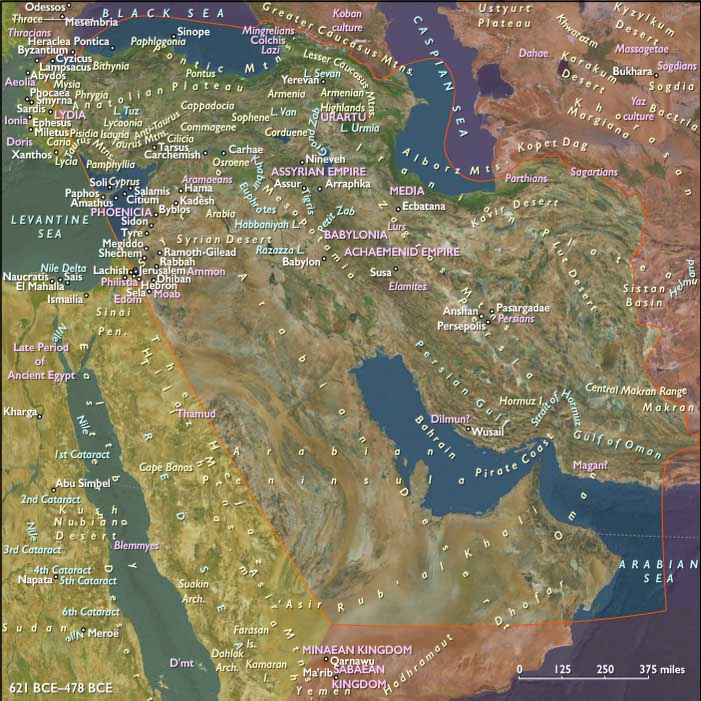
Cyaxares had eventually divided the former Assyrian Empire with Babylonia.
From his capital at Ecbatana (modern Hamadan), the King of the Medes rules an empire that includes western Iran, northern Mesopotamia, and part of Anatolia.
Locations
People
Groups
Topics
Subjects
Regions
Subregions
Related Events
Filter results
Showing 10 events out of 67 total
Sigismund (1387-1437), Louis's son-in-law, had won a bitter struggle for the throne after Louis died in 1382.
Under Sigismund, Hungary's fortunes had begun to decline.
Many Hungarian nobles despise Sigismund for his cruelty during the succession struggle, his long absences, and his costly foreign wars.
In 1401 disgruntled nobles temporarily imprison the king.
In 1403 another group crowns an anti-king, who fails to solidify his power but succeeds in selling Dalmatia to Venice.
Sigismund fails to reclaim the territory.
Sigismund becomes the Holy Roman Emperor in 1410 and king of Bohemia in 1419, thus requiring him to spend long periods abroad and enabling Hungary's magnates to acquire unprecedented power.
In response, Sigismund creates the office of palatine to rule the country in his stead.
Like earlier Hungarian kings, Sigismund elevates his supporters to magnate status and sell off crown lands to meet burgeoning expenses.
Although Hungary's economy continues to flourish, Sigismund's expenses outstrip his income.
He bolsters royal revenues by increasing the serfs' taxes and requiring cash payment.
Social turmoil erupts late in Sigismund's reign as a result of the heavier taxes and renewed magnate pressure on the lesser nobles.
Hungary's first peasant revolt erupts when a Transylvanian bishop orders peasants to pay tithes in coin rather than in kind.
The revolt is quickly checked, but it prompts Transylvania's Szekel, Magyar, and German nobles to form the Union of Three Nations, which is an effort to defend their privileges against any power except that of the king.
Additional turmoil erupts when the Ottoman Turks expand their empire into the Balkans.
They cross the Bosporus Straits in 1352, subdue Bulgaria in 1388, and defeat the Serbs at Kosovo Polje in 1389.
Sigismund leads a crusade against them in 1396, but the Ottomans rout his forces at Nicopolis, and he barely escapes with his life.
Tamerlane's invasion of Anatolia in 1402-03 slows the Turks' progress for several decades, but in 1437 Sultan Murad prepares to invade Hungary.
Sigismund dies the same year, and Hungary's next two kings, Albrecht V of Austria (1437-39) and Wladyslaw III of Poland (1439-44), who is known in Hungary as Ulaszlo I, both die during campaigns against the Turks.
After Ulaszlo, Hungary's nobles choose an infant king, Laszlo V, and a regent, Janos Hunyadi, to rule the country until Laszlo V comes of age.
The son of a lesser nobleman of the Vlach tribe, Hunyadi has risen to become a general, Transylvania's military governor, one of Hungary's largest landowners, and a war hero.
He uses his personal wealth and the support of the lesser nobles to win the regency and overcome the opposition of the magnates.
Hunyadi then establishes a mercenary army funded by the first tax ever imposed on Hungary's nobles.
He defeats the Ottoman forces in Transylvania in 1442 and breaks their hold on Serbia in 1443, only to be routed at Varna (where Laszlo V himself perishes) a year later.
In 1456, when the Turkish army besieges Belgrade, Hunyadi defeats it in his greatest and final victory.
Hunyadi dies of the plague soon after.
Some magnates had resented Hunyadi for his popularity as well as for the taxes he imposed, and they feared that his sons might seize the throne from Laszlo.
They coax the sons to return to Laszlo's court, where Hunyadi 's elder son is beheaded.
His younger son, Matyas, is imprisoned in Bohemia.
However, lesser nobles loyal to Matyas soon expel Laszlo.
After Laszlo' s death abroad, they pay ransom for Matyas, meet him on the frozen Danube River, and proclaim him king.
Known as Matyas Corvinus (1458-90), he is, with one possible exception (Janos Zapolyai), the last Hungarian king to rule the country.
Matyas's reforms do not survive the turbulent decades that follow his reign.
An oligarchy of quarrelsome magnates gains control of Hungary.
They crown a docile king, Vladislav Jagiello (the Jagiellonian king of Bohemia, who is known in Hungary as Ulaszlo II, 1490-1516), only on condition that he abolish the taxes that had supported Matyas's mercenary army.
As a result, the king's army disperses just as the Turks are threatening Hungary.
The magnates also dismantle Matyas's administration and antagonizes the lesser nobles.
In 1492 the Diet limits the serfs' freedom of movement and expands their obligations.
Rural discontent boils over in 1514 when well-armed peasants under Gyorgy Dozsa rise up and attack estates across Hungary.
United by a common threat, the magnates and lesser nobles eventually crush the rebels.
Dozsa and other rebel leaders are executed in a most brutal manner.
Matyas regularly convenes the Diet and expands the lesser nobles' powers in the counties, but he exercises absolute rule over Hungary by means of a secular bureaucracy.
He enlists thirty thousand foreign mercenaries in his standing army and builds a network of fortresses along Hungary's southern frontier, but he does not pursue his father's aggressive anti-Turkish policy.
Instead, Matyas launches unpopular attacks on Bohemia, Poland, and Austria, pursuing an ambition to become Holy Roman Emperor and arguing that he is trying to forge a unified Western alliance strong enough to expel the Turks from Europe.
He eliminates tax exemptions and raises the serfs' obligations to the crown to fund his court and the military.
The magnates complain that these measures reduce their incomes, but despite the stiffer obligations, the serfs consider Matyas a just ruler because he protects them from excessive demands and other abuses by the magnates.
He also reforms Hungary's legal system and promotes the growth of Hungary's towns.
Matyas is a true renaissance man and makes his court a center of humanist culture; under his rule, Hungary's first books are printed and its second university is established.
Matyas's library, the Corvina, is famous throughout Europe.
In his quest for the imperial throne, Matyas eventually moves to Vienna, where he dies in 1490.
When Ulaszlo II dies in 1516, his ten-year-old son Louis II (1516-26) becomes king, but a royal council appointed by the Diet rules the country.
Hungary is in a state of near anarchy under the magnates' rule.
The king's finances are a shambles; he borrows to meet his household expenses despite the fact that they total about one-third of the national income.
The country's defenses sag as border guards go unpaid, fortresses fall into disrepair, and initiatives to increase taxes to reinforce defenses are stifled.
In 1521 Sultan Suleiman the Magnificent recognizes Hungary's weakness and seizes Belgrade in preparation for an attack on Hungary.
In August 1526, he marches more than one hundred thousand troops into Hungary's heartland, and at Mohacs they cut down all but several hundred of the twenty-five thousand ill-equipped soldiers whom Louis II had been able to muster for the country's defense.
Louis himself dies, thrown from a horse into a bog.
The Diet of 1514, shocked by the peasant revolt, passes laws that condemn the serfs to eternal bondage and increase their work obligations.
Corporal punishment becomes widespread, and one noble even brands his serfs like livestock.
The legal scholar Stephen Werboczy includes the new laws in his Tripartitum of 1514, which will make make up Hungary's legal corpus until the revolution of 1848.
The Tripartitum give Hungary's king and nobles, or magnates, equal shares of power: the nobles recognize the king as superior, but in turn the nobles have the power to elect the king.
The Tripartitum also frees the nobles from taxation, obligates them to serve in the military only in a defensive war, and makes them immune from arbitrary arrest.
The new laws weaken Hungary by deepening the rift between the nobles and the peasantry just as the Turks prepare to invade the country.
New farming methods boost crop yields.
Craftsmen form guilds as artisanry flourishes; gold, silver, and salt mining expands; and money-based transactions replace barter.
Though townspeople are exempt from feudal obligations, feudalism expands and the nobles stiffen the serfs' obligations.
The serfs resent the higher payments; some flee the country, while others become outlaws.
In 1437 Romanian and Hungarian peasants rebel against their feudal masters.
The uprising gathers momentum before the Magyar, German, and Szekler nobles in Transylvania united forces and, with great effort, successfully quell the revolt.
Afterwards, the nobles form the Union of Three Nations, jointly pledging to defend their privileges against any power except that of Hungary's king.
The document declares the Magyars, Germans, and Szeklers the only recognized nationalities in Transylvania; henceforth, all other nationalities here, including the Romanians, are merely ''tolerated."
The nobles gradually impose even tougher terms on their serfs.
In 1437, for example, each serf has to work for his lord one day per year at harvest time without compensation; by 1514 serfs have to work for their lord one day per week using their own animals and tools.
Economic life in Transylvania had rebounded quickly after the Mongol invasion.
New farming methods have boosted crop yields.
Craftsmen have formed guilds as artisanry flourishes; gold, silver, and salt mining have expanded; and money-based transactions have replaced barter.
Though townspeople are exempt from feudal obligations, feudalism has expanded and the nobles have stiffened the serfs' obligations.
The serfs resent the higher payments; some have fled the country, while others have become outlaws.
In 1437, Romanian and Hungarian peasants rebel against their feudal masters.
The uprising gathers momentum before the Magyar, German, and Szekler nobles in Transylvania unite forces and, with great effort, successfully quell the revolt.
