
Cro-Magnons, the earliest modern humans in Europe, …
Years: 40653BCE - 38926BCE
Cro-Magnons, the earliest modern humans in Europe, enter the continent (including France) around forty thousand years ago during a long interglacial period of particularly mild climate, when Europe was relatively warm, and food was plentiful.
When they arrive in Europe, they bring with them sculpture, engraving, painting, body ornamentation, music and the painstaking decoration of utilitarian objects.
The recently discovered Denisova hominin, based on bone fragments of a juvenile that lived about forty-one thousand years ago found in Denisova Cave (Altai Krai, Russia), a region also inhabited at about the same time by Neanderthals and modern humans, shares a common origin with the Neanderthals and interbred with the ancestors of modern Melanesians.
The mtDNA of the Denisova hominin is distinct from the mtDNAs of Neanderthals and modern humans.
Genetic studies link approximately four percent of non-African modern human DNA to Neanderthals.
In addition, tests comparing the Denisova hominin genome with those of six modern humans whose genome has been sequenced—a Kung from South Africa, a Nigerian, a French person, a Papua New Guinean, a Bougainville Islander and a Han Chinese—showed that between four percent and six percent of the genome of Melanesians (represented by the Papua New Guinean and Bougainville Islander) derives from a Denisovan population.
This was possibly introduced during the early migration of the ancestors of Melanesians into Southeast Asia.
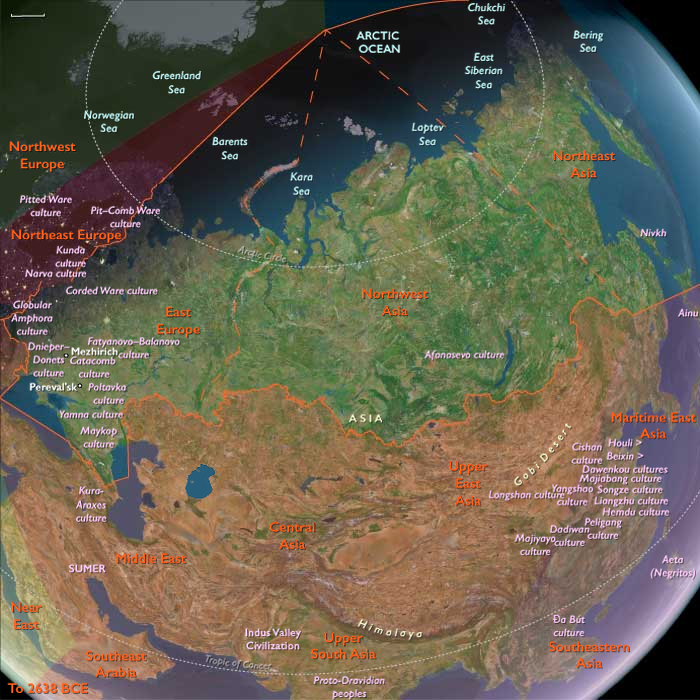
This history of interaction suggests that Denisovans once ranged widely over eastern Asia.
Locations
Groups
Topics
Subjects
Regions
Subregions
Years: 40653BCE - 38926BCE
Locations
Groups
Topics
Subjects
Regions
Subregions