
Cretan Neolithic culture gives way to the …
Years: 2637BCE - 2494BCE
Cretan Neolithic culture gives way to the bronze-based Minoan culture during a period of great unrest.
Crete begins to become an important center of civilization, possibly fueled by the introduction of the working of copper and bronze by emigrants from Anatolia or Syria.
The Minoan culture begins producing sculpture and pottery in approximately 2600 BCE, inaugurating what is known as the prepalatial (early Minoan) period.
The civilization is marked by the extensive use of sealstones and the development of writing.
The term "Minoan" was coined by the British archaeologist Sir Arthur Evans after the mythic "king" Minos, who, along with his twin brother, Rhadamanthus, is the son of Europa, who had been impregnated by Zeus in the guise of a white bull.
After becoming ruler of Crete with the help of Poseidon, Minos built a powerful navy and used it to control an extensive Aegean empire, colonizing many of the islands and ridding the sea of pirates.
He married Pasiphae, the daughter of Helios, who bore him, among others, Androgeos, Ariadne, and Phaedra, and who was the mother of the Minotaur.
Minos was associated in Greek myth with the labyrinth, which Evans identified as the site at Knossos.
Minos successfully warred against Athens and Megara to obtain redress after his son Androgeos was killed by the Athenians.
In Athenian drama and legend, Minos became the tyrannical exactor of the tribute of children to feed the Minotaur.
The daughters of King Cocalus killed Minos in Sicily by pouring boiling water over him as he was taking a bath.
After his death, he became a judge in Hades.
Although Athens preserved a hostile tradition, the general account shows Minos as a powerful, just ruler, very closely associated with religion and ritual.
In light of excavations in Crete, many scholars consider that Minos was a royal or dynastic title for the priestly rulers of Bronze Age, or Minoan, Knossos.
What the Minoans called themselves is unknown.
It has sometimes been argued that the Egyptian placename "Keftiu" and the Semitic "Kaftor" or "Caphtor" and "Kaptara" in the Mari archives apparently refer to the Cretan capital.
Minoan society perpetuates women's preponderant influence in religion and social life and accords them equal political authority with men.
In sharp contrast with Sumerian women, Minoan women, members of a trading rather than a warrior society, draw strength both from their membership in corporate kinship groups and from their institutionalized ties with other women.
Locations
Groups
Topics
Commodoties
Subjects
- Commerce
- Symbols
- Writing
- Watercraft
- Sculpture
- Environment
- Government
- Custom and Law
- Technology
- Metallurgy
- Mythology
- Anthropology
- Archaeology
- Piracy
Regions
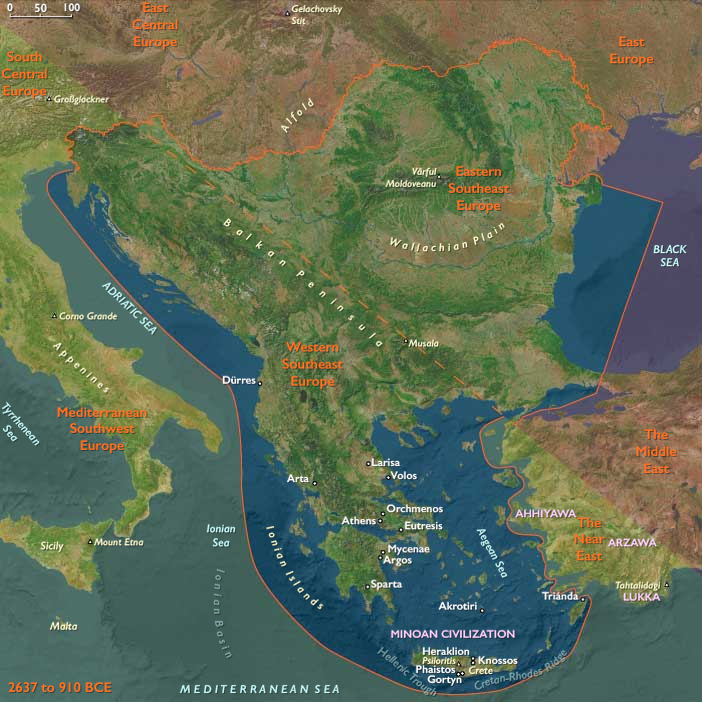
Subregions
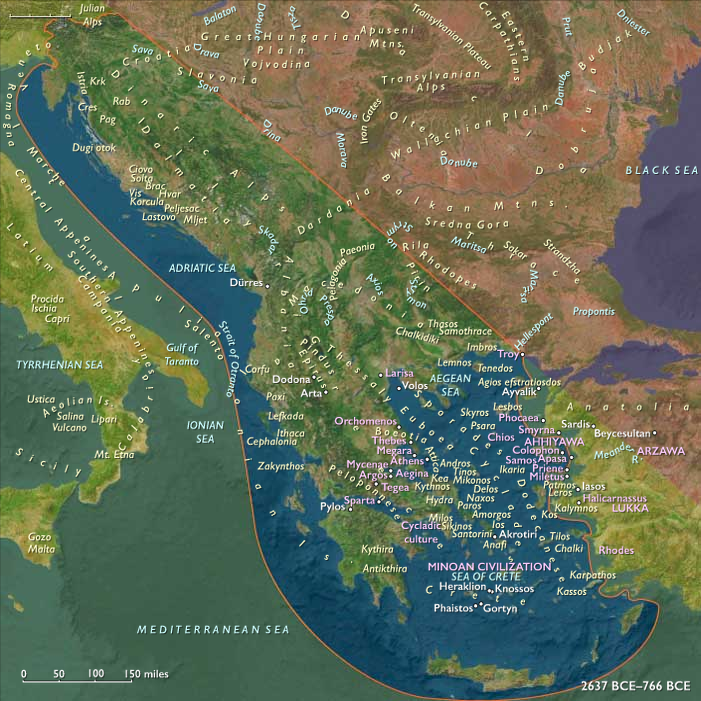
Related Events
Showing 10 events out of 68553 total
Years: 2637BCE - 2494BCE
Locations
Groups
Topics
Commodoties
Subjects
- Commerce
- Symbols
- Writing
- Watercraft
- Sculpture
- Environment
- Government
- Custom and Law
- Technology
- Metallurgy
- Mythology
- Anthropology
- Archaeology
- Piracy
Regions
Subregions