
Contractors working for New York City—"Ring …
Years: 1870 - 1870
December
Contractors working for New York City—"Ring favorites, most of them – were told to multiply the amount of each bill by five, or ten, or a hundred, after which, with Mayor Hall's 'O.K.' and Connolly's endorsement, it was paid ... through a go-between, who cashed the check, settled the original bill and divided the remainder ... between Tweed, Sweeny, Connolly and Hall". (Paine, p. 144)
For example, the construction cost of the New York County Courthouse, begun in 1861, has grown to nearly thirteen million dollars—about one hundred and seventy-eight million in 2012 dollars , and nearly twice the cost of the Alaska Purchase in 1867.
Tweed and his friends also garner huge profits from the development of the Upper East Side, especially Yorkville and Harlem.
They buy up undeveloped property, then use the resources of the city to improve the area—for instance by installing pipes to bring in water from the Croton Aqueduct—thus increasing the value of the land, after which they sell and take their profits.
The focus on the east side also slows down the development of the west side, the topography of which makes it more expensive to improve.
The ring also take their usual percentage of padded contracts, as well as raking off money from property taxes.
Despite the corruption of Tweed and Tammany Hall, they do accomplish the development of upper Manhattan, though at the cost of tripling the city's bond debt to almost ninety million dollars.
During the Tweed era, the proposal to build a suspension bridge between New York and Brooklyn, at this time an independent city, is floated by Brooklyn-boosters, who see the ferry connections as a bottleneck to Brooklyn's further development.
In order to ensure that the Brooklyn Bridge project will go forward, State Senator Henry Cruse Murphy approaches Tweed to find out whether New York's aldermen would approve the proposal.
Tweed's response is that sixty thousand dollars for the aldermen will close the deal, and contractor William C. Kingsley puts up the cash, which is delivered in a carpet bag.
Tweed and two others from Tammany also receive over half the private stock of the Bridge Company, the charter of which specifies that only private stockholders have voting rights, so that even though the cities of Brooklyn and Manhattan put up most of the money, they essentially have no control over the project.
Tweed buys a mansion on Fifth Avenue and 43rd Street, and stables his horses, carriages and sleighs on 40th Street.
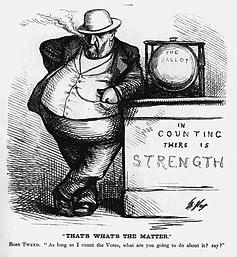
Thomas Nast shows Tweed's source of power: control of the ballot box. "As long as I count the Votes, what are you going to do about it?"
Locations
People
Groups
Topics
Subjects
Regions

Subregions
Related Events
Showing 10 events out of 12847 total
Years: 1870 - 1870
December
Thomas Nast shows Tweed's source of power: control of the ballot box. "As long as I count the Votes, what are you going to do about it?"
Locations
People
Groups
Topics
Subjects
Regions
Subregions