
South America Major (1828–1971 CE) Republics, …
Years: 1828 - 1971
South America Major (1828–1971 CE)
Republics, Frontiers, and Modern Transformations
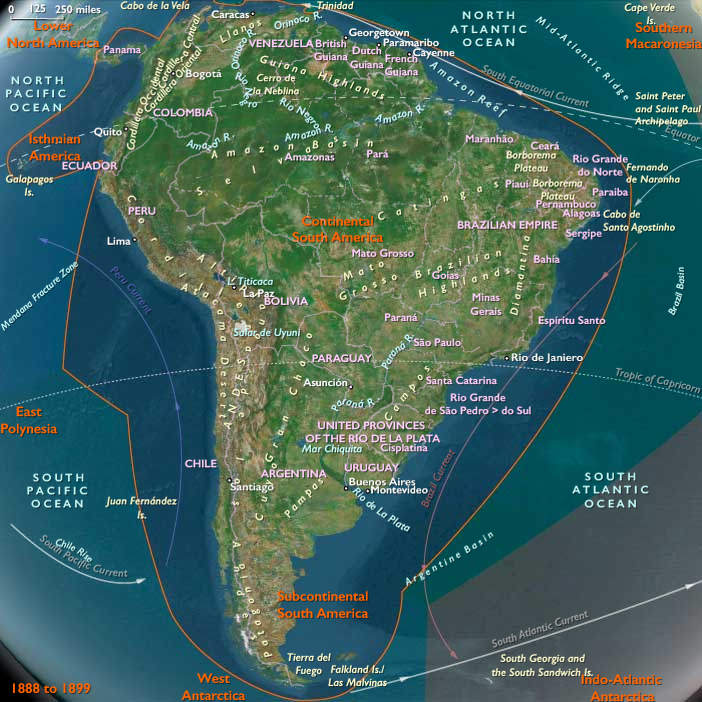
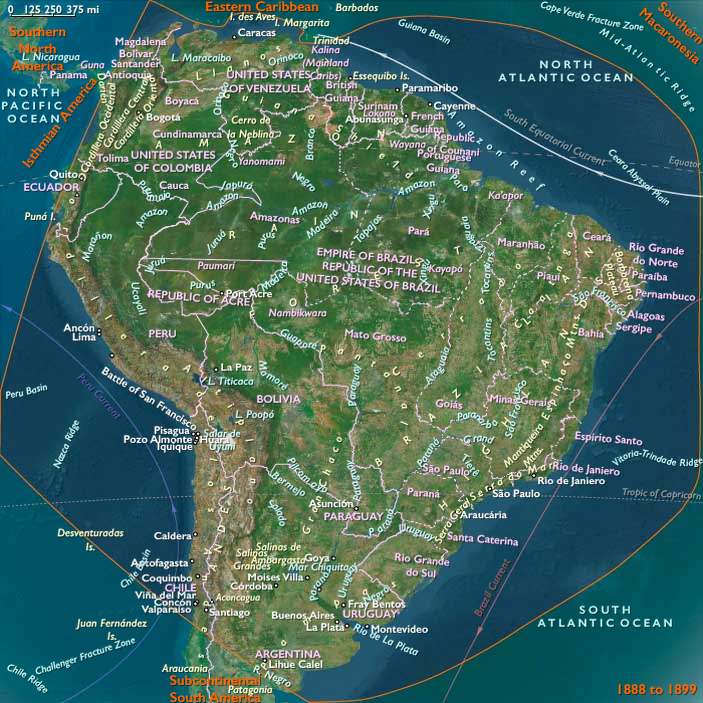
Geographic Definition of South America Major
The subregion of South America Major encompasses all lands north of the Río Negro, extending across the full continental span of Brazil, Uruguay, Paraguay, northern Argentina and northern Chile, Bolivia, Peru, Ecuador(excluding the Cape lands at the Isthmian boundary), Colombia (excluding the Darién region, which belongs to Isthmian America), Venezuela, Guyana, Suriname, and French Guiana.
Anchors include the Andes cordillera and Altiplano, the Amazon basin, the Orinoco and Magdalena river systems, the Venezuelan Llanos, the Gran Chaco, the Uruguayan Pampas, and the Guiana Shield.
Bounded by Isthmian America to the north and Subcontinental South America to the south, this subregion forms the continental heartland of South America—linking the Pacific and Atlantic worlds through its intertwined highlands, forests, plains, and river systems.
Geography and Political Frontiers
Between 1828 and 1971, South America Major evolved from newly independent republics into a mosaic of modern nations. The Andes continued to define borders and identity; the Amazon, Gran Chaco, and Pampas became frontiers of settlement, extraction, and nation-building. The century and a half after independence saw shifting alliances, wars over territory, and the gradual incorporation of frontier zones into national economies.
The Pacific coast urbanized through ports like Lima, Guayaquil, and Valparaíso; Atlantic Brazil expanded through coffee and industry; and inland Bolivia, Paraguay, and Uruguay became landlocked crossroads of diplomacy and struggle. The Guianas remained colonial or semi-colonial enclaves until mid-century decolonization.
Climate and Environmental Shifts
The retreat of the Little Ice Age brought modest warming and rainfall fluctuations:
-
Andes and Altiplano: Melting glaciers improved water availability for valleys but also triggered landslides and floods.
-
Amazon basin: Rainfall cycles alternated between flood and drought decades, with deforestation beginning to affect local climates by the 20th century.
-
Gran Chaco and Pampas: Droughts and locust plagues recurred through the 19th century; by the 20th, cattle ranching and grain cultivation transformed the landscape.
-
Guiana forests and Llanos: Continued to alternate between wet and dry extremes, sustaining biodiversity yet increasingly opened by logging, mining, and plantations.
Environmental volatility shaped settlement patterns but also spurred innovation—irrigation in Andean valleys, drainage of pampas wetlands, and hydroelectric development along major rivers.
Subsistence and Settlement
Post-independence economies remained agrarian but diversified steadily:
-
Andean republics (Peru, Bolivia, Ecuador, Colombia): Highland peasants maintained terraced maize–potato rotations; haciendas and plantations expanded in valleys. Mining revived—silver and tin in Bolivia, guano and nitrate in Peru, oil in Ecuador and Colombia.
-
Brazil: Transitioned from sugar and gold to coffee (São Paulo, Rio de Janeiro), rubber (Amazon), and later industrial production (Belo Horizonte, São Paulo, Rio Grande do Sul).
-
River Plate region (Argentina, Uruguay, Paraguay): Cattle and sheep ranching dominated, later joined by grain exports. Paraguay remained rural after devastating wars; Uruguay balanced pastoral exports and political stability.
-
Venezuela and Colombia: Coffee, cocoa, and oil reshaped economies; ranching persisted in the Llanos.
-
Guianas: Plantation agriculture (sugar, rice) persisted under British, French, and Dutch control, worked by Afro-descended and Indo-Asian laborers.
Urbanization accelerated: Buenos Aires, Rio de Janeiro, Lima, Santiago, Bogotá, Quito, and Caracas became political and economic capitals, concentrating power and population.
Technology and Material Culture
Railways, telegraphs, and steamships integrated fragmented landscapes.
In the 19th century, rail lines climbed the Andes (e.g., Oroya Railway, Quito–Guayaquil) and linked interior ranches and mines to ports. Steam navigation on the Amazon and Paraná–Paraguay rivers expanded trade and migration.
European architectural styles—neoclassical capitals, baroque churches, and eclectic civic buildings—symbolized modernization.
Local crafts persisted: Andean textiles, Amazonian ceramics, Guaraní carvings, and Afro-Brazilian percussion instruments. By the 20th century, industrialization brought steelworks (São Paulo, Caracas), automobiles (Buenos Aires), and aviation links across the continent.
Movement and Interaction Corridors
Continental circulation intensified:
-
River systems: The Amazon, Orinoco, Paraná–Paraguay, and Magdalena became arteries of commerce and colonization.
-
Rail networks: Linked mines and ranches to ports, knitting national markets.
-
Migration: Italian, German, Spanish, and Japanese immigrants settled Brazil, Argentina, Uruguay, and Paraguay, transforming agriculture and culture.
-
Slave emancipation and internal migration: Brazil abolished slavery in 1888, and freed populations moved into cities and frontiers.
-
Oil routes: Pipelines and refineries in Venezuela, Colombia, and Ecuador shifted economies toward energy export.
Regional trade blocs, from early customs unions to mid-20th-century cooperation schemes, sought continental integration, while European and North American investment reshaped industrial growth.
Cultural and Symbolic Expressions
National identities crystallized from colonial legacies.
Romantic nationalism and liberal reform inspired literature, painting, and architecture celebrating Indigenous and creole heritage: Bolívarian epics, José Hernández’s Martín Fierro, Machado de Assis, Rubén Darío, and Andean costumbrismo.
In the 20th century, modernismo, muralism (led by Diego Rivera and Cándido Portinari), and revolutionary art redefined visual culture.
Catholicism remained pervasive but adapted: popular pilgrimages (e.g., Virgen de Copacabana, Círio de Nazaré) coexisted with secular nationalism and Protestant missions.
Afro-descended and Indigenous cultural forms—candomblé, samba, marimba, and Andean panpipe music—entered national consciousness as emblems of authenticity.
Environmental Adaptation and Resilience
Peasant and Indigenous communities maintained ecological knowledge despite land concentration:
-
Highland terraces and irrigation persisted for local autonomy.
-
Amazonian forest management—rubber tapping, shifting gardens, and agroforestry—balanced extraction with sustainability until industrial overreach in the mid-20th century.
-
Ranching and agriculture expanded dramatically across the Pampas and cerrado, transforming ecosystems.
-
Dams and deforestation along the Amazon and Paraná altered river regimes by the 1960s, initiating modern environmental debates.
Throughout, traditional practices—from Andean vertical exchange to Guaraní collective farming—anchored cultural and ecological continuity.
Technology and Power Shifts (Conflict Dynamics)
Wars and revolutions marked the region’s political evolution:
-
Post-independence conflicts: Civil wars, caudillo rivalries, and frontier disputes shaped early republics.
-
Major wars: War of the Triple Alliance (1864–1870) decimated Paraguay; War of the Pacific (1879–1883) redrew borders between Chile, Peru, and Bolivia.
-
Reforms and revolutions: Abolition of slavery (Brazil 1888), republican overthrow of the monarchy (Brazil 1889), and land reforms in Mexico and Bolivia signaled social transformation.
-
20th-century shifts: Populist regimes (Vargas in Brazil, Perón in Argentina), revolutions (Bolivia 1952, Cuba 1959), and guerrilla movements (Colombia, Venezuela) redefined state–society relations.
-
External influences: The Good Neighbor Policy and Cold War interventions tied the region to U.S. geopolitical strategies, particularly during the 1960s and early 1970s.
Technological modernization—railways, telephones, automobiles, oil drilling, and aviation—interwove with social upheaval and uneven industrialization.
Transition (to 1971 CE)
By 1971, South America Major had completed its passage from colonial dependency to diverse modernity.
The region’s republics faced contrasts: booming urban economies alongside rural poverty, democratic aspirations shadowed by coups and authoritarianism.
The Andes still bore terraces and mines older than empire; the Amazon and Guianas remained ecological frontiers; and the Pampas and Llanos powered global agriculture.
From liberation heroes to modern reformers, the quest for sovereignty, equity, and identity defined this long age.
Despite enduring inequality and deforestation, South America Major emerged as a continent of resilience—its highlands, forests, plains, and coasts still bound by the enduring geography that had shaped all its worlds.
Groups
- Mapuche (Amerind tribe)
- Christians, Roman Catholic
- Chile, Republic of
- Paraguay, Republic of
- Colombia, Republic of (Gran Colombia)
- Peru, Republic of
- Brazilian Empire
- Bolivia, Republic of
- Uruguay, Eastern Republic of
- Venezuela, Bolivarian Republic of
- Ecuador, Republic of
- Argentine Confederation
- Chile, (Conservative) Republic of
- Peru-Bolivian Confederation
- Bolivia, Republic of
- Peru, Republic of
- Buenos Aires, State of
- Argentina (Argentine Republic)
- Chile, (Liberal) Republic of
- Colombia, United States of
- Colombia, Republic of
- Brazil, Federative Republic of
- Chile, (Parliamentary) Republic of
- Panama, Republic of
- Chile, (Presidential) Republic of
Topics
- Atlantic slave trade
- Araucanía, Occupation of
- Paraguayan War (López War or War of the Triple Alliance)
- Conquest of the Desert
- Chaco War
- Cold War
Commodoties
- Gem materials
- Domestic animals
- Grains and produce
- Fibers
- Strategic metals
- Slaves
- Sweeteners
- Industrial chemicals
- Stimulants
- Rubber
- Telecommunications
Subjects
Regions
Subregions
Related Events
Showing 10 events out of 19829 total
Years: 1828 - 1971
Groups
- Mapuche (Amerind tribe)
- Christians, Roman Catholic
- Chile, Republic of
- Paraguay, Republic of
- Colombia, Republic of (Gran Colombia)
- Peru, Republic of
- Brazilian Empire
- Bolivia, Republic of
- Uruguay, Eastern Republic of
- Venezuela, Bolivarian Republic of
- Ecuador, Republic of
- Argentine Confederation
- Chile, (Conservative) Republic of
- Peru-Bolivian Confederation
- Bolivia, Republic of
- Peru, Republic of
- Buenos Aires, State of
- Argentina (Argentine Republic)
- Chile, (Liberal) Republic of
- Colombia, United States of
- Colombia, Republic of
- Brazil, Federative Republic of
- Chile, (Parliamentary) Republic of
- Panama, Republic of
- Chile, (Presidential) Republic of
Topics
- Atlantic slave trade
- Araucanía, Occupation of
- Paraguayan War (López War or War of the Triple Alliance)
- Conquest of the Desert
- Chaco War
- Cold War
Commodoties
- Gem materials
- Domestic animals
- Grains and produce
- Fibers
- Strategic metals
- Slaves
- Sweeteners
- Industrial chemicals
- Stimulants
- Rubber
- Telecommunications
Subjects
Regions
Subregions