
South America Major (1684–1827 CE) Revolts, …
Years: 1684 - 1827
South America Major (1684–1827 CE)
Revolts, Reforms, and the Birth of Independence
Geographic Definition of South America Major
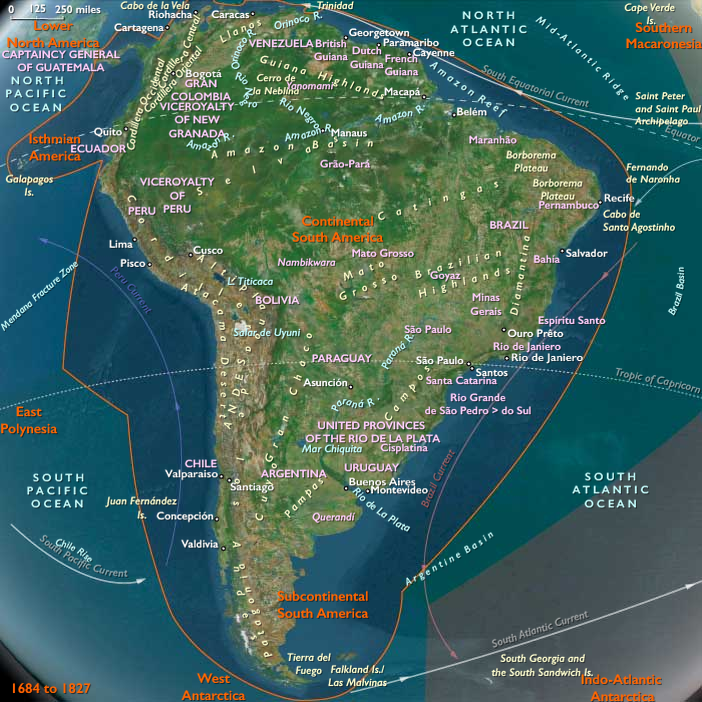
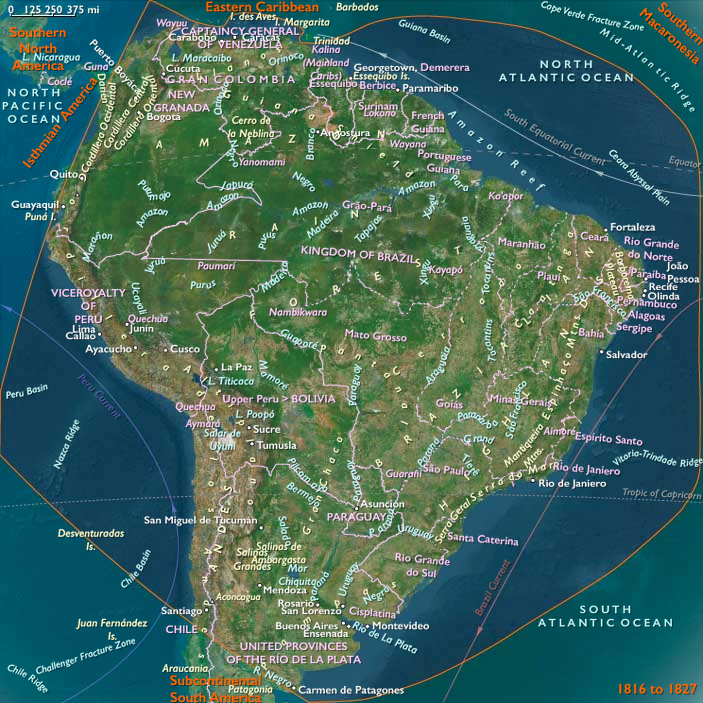
The subregion of South America Major encompasses all lands north of the Río Negro, extending across the full continental span of Brazil, Uruguay, Paraguay, northern Argentina and northern Chile, Bolivia, Peru, Ecuador(excluding the Cape lands at the Isthmian boundary), Colombia (excluding the Darién region, which belongs to Isthmian America), Venezuela, Guyana, Suriname, and French Guiana.
Anchors include the Andes cordillera and Altiplano, the Amazon basin, the Orinoco and Magdalena river systems, the Venezuelan Llanos, the Gran Chaco, the Uruguayan Pampas, and the Guiana Shield.
Bounded by Isthmian America to the north and Subcontinental South America to the south, this subregion forms the continental heartland of South America—linking the Pacific and Atlantic worlds through its intertwined highlands, forests, plains, and river systems.
Geography and Imperial Frontiers
Between 1684 and 1827, South America Major transformed from a colonial realm into a constellation of independent nations. The Andes still anchored Spanish power, while the Amazon basin, the Guiana forests, and the southern plains remained vast, contested frontiers. The Portuguese advanced deep into Brazil’s interior, expanding beyond the Tordesillas meridian through mining and ranching; Spain struggled to govern its mountainous viceroyalties from distant Lima and Bogotá. The region’s geography—its cordilleras, rivers, and forests—both connected and divided peoples, shaping the uneven course of empire and revolution.
Climate and Environmental Shifts
The late Little Ice Age brought alternating droughts and floods, influencing agriculture and settlement.
In the Andes, glaciers advanced slightly, shortening growing seasons and threatening terraced crops.
Across Brazil’s cerrado and the Guiana forests, rainfall swings altered river regimes and harvests, while El Niño events disrupted Pacific fisheries and Peruvian coastal farming.
The Llanos and Pampas alternated between lush pastures and parched plains.
Environmental volatility spurred adaptation—new crops, irrigation, and migration—within both colonial estates and Indigenous territories.
Subsistence and Settlement
By the 18th century, the subregion was a patchwork of imperial economies and Indigenous persistence:
-
Andean highlands: Mining towns like Potosí, Oruro, and Huancavelica remained economic cores. Encomienda and mita labor systems evolved into wage and debt peonage, sustaining silver and mercury production. Highland farmers grew maize, potatoes, and quinoa; imported wheat spread in valleys.
-
Coastal Peru and Ecuador: Plantation agriculture expanded around sugar, cotton, and vineyards; coastal ports like Lima, Guayaquil, and Callao handled global trade.
-
Brazilian interior: Gold and diamond booms in Minas Gerais (1690s onward) transformed Brazil’s economy, drawing settlers inland. Cattle ranching and sugar plantations flourished in Bahia, Pernambuco, and the Recôncavo, while the Amazon sustained missions and extractive trade in cacao, dyes, and forest goods.
-
Paraguay and Uruguay: Yerba mate, hides, and cattle became major exports; Jesuit reductions integrated Guaraní communities into mission economies until their expulsion in 1767.
-
Venezuela and Colombia: The Llanos supported cattle ranching and cocoa cultivation; the Magdalena and Orinoco rivers formed transport arteries between highlands and coasts.
-
Guianas: French, Dutch, and British outposts extracted sugar and timber, relying heavily on enslaved African labor.
Despite growing European control, Indigenous and Afro-descended communities remained central to labor, knowledge, and resistance across every ecological zone.
Technology and Material Culture
Mining innovations—mercury amalgamation and mule-driven mills—deepened dependence on Indigenous and enslaved workers.
In Brazil, smelting, waterwheels, and canalized sluices spread through mining districts; in Andean Peru, silver-processing patios reshaped entire valleys.
Agricultural technologies mixed Iberian plows and presses with Indigenous irrigation and terracing.
Architecture fused baroque cathedrals and mission churches with local materials—adobe, stone, and timber.
Textiles, pottery, and metalwork blended European and Indigenous forms: the Cusco School of painting, Jesuit mission music, and Afro-Brazilian festivals reflected a growing creole aesthetic.
Movement and Interaction Corridors
Continental networks intensified:
-
Silver highways: From Potosí to Lima, mule trains and caravans linked mines, ports, and European markets.
-
Brazilian gold routes: Trails from Minas Gerais and Goiás led to Salvador and Rio de Janeiro, shifting Brazil’s economic center southward.
-
Amazon and Orinoco rivers: Served both Indigenous canoe trade and Portuguese mission expansion.
-
Atlantic slave routes: Enslaved Africans arrived at Bahia, Cartagena, and the Guianas, embedding African culture into creole societies.
-
Mission networks: Jesuit and Franciscan roads connected Paraguay’s reductions, Amazon missions, and Andean highlands.
-
Trade corridors: Buenos Aires rose as a smuggling hub, connecting the Rio de la Plata with Potosí’s silver traffic, despite royal prohibitions.
By the 18th century, contraband trade and overland communication tied the continent together as never before.
Cultural and Symbolic Expressions
Baroque Catholicism dominated urban and rural life. Churches, processions, and festivals blended European theology with Indigenous ritual and African devotion. Saints’ cults and pilgrimages mapped sacred geography across the Andes and coasts.
In the Amazon and Paraguay, missions combined Gregorian chant and local music.
Creole intellectuals and clergy began articulating local pride—Garcilaso de la Vega, Sor Juana Inés de la Cruz, and Jesuit scholars in Lima and Quito bridged colonial scholasticism and early Enlightenment.
Indigenous and Afro-descended populations kept older spiritual systems alive beneath Catholic veneers: Andean huaca worship, Guaraní dances, and Afro-Brazilian congado and candomblé merged cosmologies into living syncretism.
Environmental Adaptation and Resilience
Agricultural and ecological ingenuity persisted across regions:
-
Terracing and crop rotation sustained Andean villages under frost and drought.
-
Irrigation canals and sugar mills stabilized coastal economies.
-
Amazonian peoples used shifting cultivation and forest-garden mosaics to preserve fertility.
-
Cattle and sheep grazing expanded across the Llanos, Chaco, and Pampas, reshaping ecosystems into ranching frontiers.
-
Urban centers managed periodic famine with granaries, trade, and church relief.
Even under imperial extraction, local adaptation ensured survival and continuity.
Technology and Power Shifts (Conflict Dynamics)
By the 18th century, reform and resistance redefined empire:
-
Spanish Bourbon Reforms (from 1700): Centralized administration, curbed local autonomy, and taxed trade and mining; these policies fueled unrest among criollo elites.
-
Brazil under Pombal (1750s–1770s): The Marquis of Pombal reorganized administration, expelled Jesuits (1759), and encouraged secular colonization in Amazon and frontier zones.
-
Indigenous and popular uprisings: The Comunero Revolts in New Granada (1781) and Túpac Amaru II’s Rebellion in Peru (1780–81) blended anti-tax grievances with calls for justice and autonomy.
-
Slave resistance: Palmares in Brazil’s northeast and smaller maroon communities across Suriname, the Guianas, and Venezuela embodied defiance and survival.
-
Foreign wars: Spain’s and Portugal’s European conflicts—War of the Spanish Succession (1701–1714) and Napoleonic invasions (1807–1808)—weakened colonial control.
Transition (to 1827 CE)
By 1827, South America Major was no longer colonial. Revolutions ignited by Simón Bolívar, José de San Martín, José Artigas, and others swept through Andes and plains.
From Caracas to Buenos Aires, new republics—Colombia, Venezuela, Peru, Chile, Argentina, Paraguay, Uruguay, and Brazil’s empire—emerged from the ruins of Iberian dominion.
Mines and missions, ranches and plantations, cities and forests—each bore the marks of both conquest and continuity.
The subregion entered the modern age through conflict and transformation: Indigenous persistence, African cultural legacies, and creole aspirations forged a South America no longer imperial, but still profoundly shaped by its colonial past.
People
- Antonio José de Sucre
- José Gaspar Rodríguez de Francia
- José Gervasio Artigas
- José de San Martín
- Pedro I of Brazil
- Simón Bolívar
- Túpac Amaru II
Groups
- Mapuche (Amerind tribe)
- Guaraní (Amerind tribe)
- Christians, Roman Catholic
- Portuguese Empire
- Inca Empire
- Spanish Empire
- Spaniards (Latins)
- Jesuits, or Order of the Society of Jesus
- Chile (Spanish colony)
- Peru, Viceroyalty of
- Venezuela Province
- Spain, Bourbon Kingdom of
- Venezuela, Captaincy General of
- Chile, Republic of
- Paraguay, Republic of
- Venezuela, Second Republic of
- Colombia, Republic of (Gran Colombia)
- Peru, Republic of
- Bolivia, Republic of
Topics
- Age of Discovery
- Atlantic slave trade
- Colonization of the Americas, Portuguese
- Colonization of the Americas, Spanish
- Jesuits, Political Suppression of the
- Jesuits, Papal Suppression of the
- French Revolution
- Haitian Revolution
- Argentine War of Independence
- Spanish American wars of independence
- Chilean War of Independence
- Colombian War of Independence
- Argentine War of Independence
- Paraguayan War of Independence
- Chilean Revolt
- Bolivar's War
- Venezuelan War of Independence
- Bolivar in Venezuela
- Boyacá, Battle of
- Carabobo, Battle of
- Junín, Battle of
- Ayacucho, Battle of
Commodoties
Subjects
Regions
Subregions
Years: 1684 - 1827
People
- Antonio José de Sucre
- José Gaspar Rodríguez de Francia
- José Gervasio Artigas
- José de San Martín
- Pedro I of Brazil
- Simón Bolívar
- Túpac Amaru II
Groups
- Mapuche (Amerind tribe)
- Guaraní (Amerind tribe)
- Christians, Roman Catholic
- Portuguese Empire
- Inca Empire
- Spanish Empire
- Spaniards (Latins)
- Jesuits, or Order of the Society of Jesus
- Chile (Spanish colony)
- Peru, Viceroyalty of
- Venezuela Province
- Spain, Bourbon Kingdom of
- Venezuela, Captaincy General of
- Chile, Republic of
- Paraguay, Republic of
- Venezuela, Second Republic of
- Colombia, Republic of (Gran Colombia)
- Peru, Republic of
- Bolivia, Republic of
Topics
- Age of Discovery
- Atlantic slave trade
- Colonization of the Americas, Portuguese
- Colonization of the Americas, Spanish
- Jesuits, Political Suppression of the
- Jesuits, Papal Suppression of the
- French Revolution
- Haitian Revolution
- Argentine War of Independence
- Spanish American wars of independence
- Chilean War of Independence
- Colombian War of Independence
- Argentine War of Independence
- Paraguayan War of Independence
- Chilean Revolt
- Bolivar's War
- Venezuelan War of Independence
- Bolivar in Venezuela
- Boyacá, Battle of
- Carabobo, Battle of
- Junín, Battle of
- Ayacucho, Battle of
Commodoties
Subjects
Regions
Subregions