
South America Major (1816–1827 CE): Decisive Independence, …
Years: 1816 - 1827
South America Major (1816–1827 CE): Decisive Independence, Collapse of Colonial Rule, and Birth of New Nations
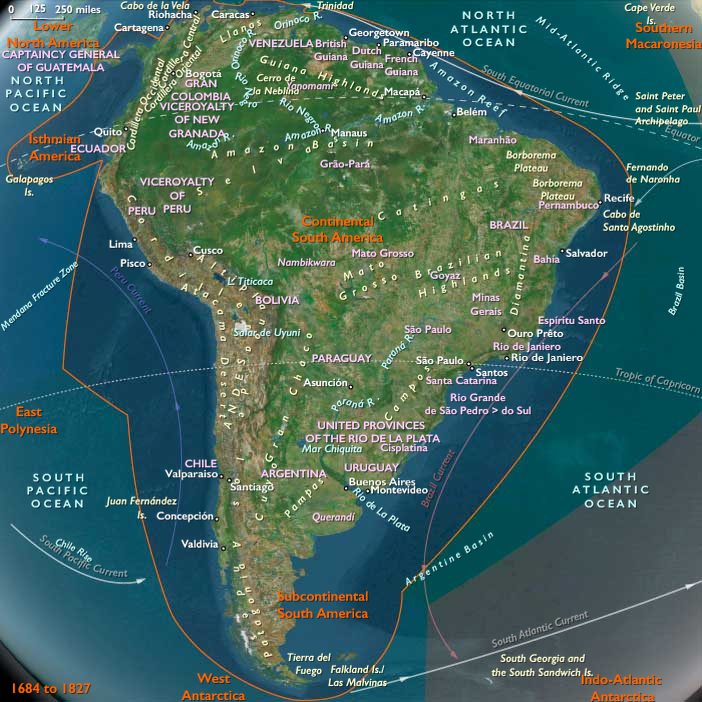
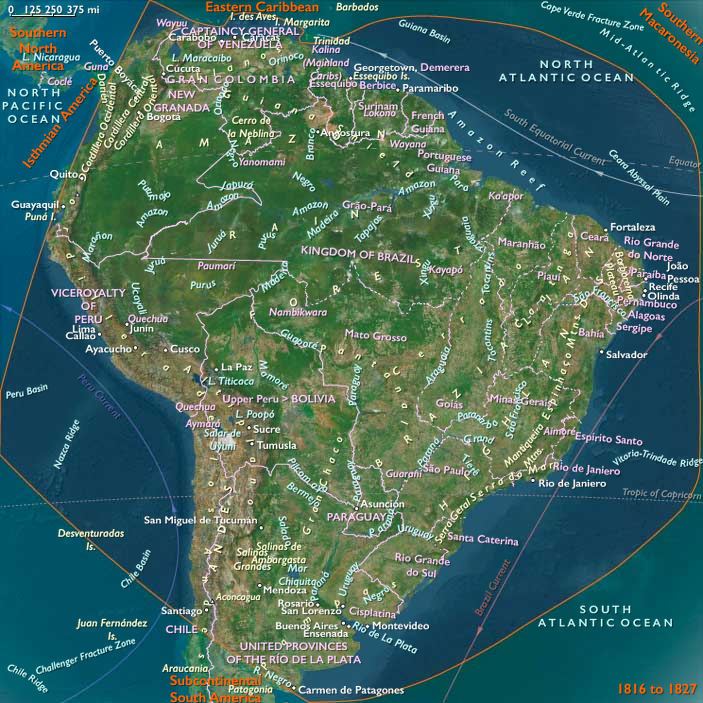
Between 1816 and 1827 CE, South America Major—encompassing all lands north of the Río Negro, extending across the full continental span of Brazil, Uruguay, Paraguay, northern Argentina and northern Chile, Bolivia, Peru, Ecuador (excluding the Cape lands at the Isthmian boundary), Colombia (excluding the Darién region, which belongs to Isthmian America), Venezuela, Guyana, Suriname, and French Guiana—experienced revolutionary climax and the definitive collapse of Spanish colonial control. Led by key revolutionary figures, this period saw the establishment of independent republics, profound social reconfiguration, and foundational shifts toward national sovereignty and identity.
Political Developments
Definitive Victories for Independence
Major revolutionary leaders such as Simón Bolívar and José de San Martín secured decisive victories:
-
Argentina: Consolidation of independence after the Congress of Tucumán (1816).
-
Chile: José de San Martín and Bernardo O’Higgins achieved decisive victories, ensuring independence by 1818.
-
Gran Colombia (Colombia, Venezuela, Ecuador): Bolívar secured significant victories (Battle of Boyacá, 1819; Battle of Carabobo, 1821), liberating northern territories from Spanish control
-
Paraguay: Under the decisive and isolationist leadership of José Gaspar Rodríguez de Francia (from 1814 onward), Paraguay established one of the continent’s most distinctive post-colonial regimes. Francia’s policy of strict isolation, economic autarky, and political authoritarianism sharply contrasted with the republican and liberal trends in neighboring countries, setting Paraguay on an entirely separate trajectory for decades.
-
Peru and Bolivia: Battles of Junín and Ayacucho (1824) marked decisive defeats of Spanish forces, establishing independence for both nations.
Brazilian Independence (1822)
Brazil uniquely achieved independence under the Portuguese royal family itself. In 1822, Prince Dom Pedro I declared Brazil independent from Portugal, becoming its first emperor—establishing a monarchy rather than a republic, contrasting with Spanish America.
Creation of New Republics
Throughout the continent, new republican governments emerged from former colonial territories. Constitutions were drafted, republican ideals articulated, and political institutions gradually took shape, though often amid instability.
Economic Developments
Post-Independence Economic Reorganization
The economies, previously reliant on colonial extraction (gold, silver, emeralds) and plantation agriculture, faced significant disruptions and restructuring. Newly independent nations struggled economically due to war destruction, disrupted trade, and depleted resources.
Continued Reliance on Plantation Agriculture and Slavery
In Brazil and regions like Venezuela and Colombia, plantation agriculture—sugar, coffee, cocoa—continued strongly, still heavily reliant on enslaved labor. The independence period intensified debates about slavery, but abolition remained incomplete and contentious.
Decline of Colonial Mining Economies
Gold mining in Brazil’s Minas Gerais, silver in Potosí, and emerald mining in Colombia all continued to decline significantly, accelerating economic shifts toward agriculture, ranching, and early industrial ventures.
Cultural and Technological Developments
Rise of National Identities and Cultural Expression
Newly independent republics actively promoted national identity through literature, arts, architecture, and public rituals. Revolutionary and nationalist symbols emerged strongly, marking a cultural shift away from colonial traditions toward distinct national identities.
Urban Transformation
Major cities—Buenos Aires, Rio de Janeiro, Lima, Bogotá, Caracas—experienced transformations driven by independence and nationalism. Public spaces, monuments, universities, and infrastructure developments began reflecting republican ideals and national pride.
Social and Religious Developments
Social Transformation and Class Realignment
Social structures shifted significantly as independence movements offered greater participation to mestizos, creoles, and some indigenous and enslaved communities. However, traditional inequalities and hierarchies persisted, producing ongoing tensions, notably regarding indigenous land rights and slavery.
Catholic Church in Independent Societies
The Catholic Church navigated a challenging transition. While remaining influential socially and culturally, its political and institutional role shifted as new republics introduced varying degrees of secularization and challenged traditional Church privileges.
Indigenous Resistance and Frontier Dynamics
Indigenous communities remained active in shaping post-independence dynamics. Many participated actively in revolutionary struggles, seeking improved rights and recognition. Nonetheless, frontier regions like Mapuche territory in Chile and indigenous lands in the Amazon continued to experience conflict, resistance, and colonial-style encroachments by newly formed states.
Long-Term Consequences and Historical Significance
The era from 1816 to 1827 CE represented a definitive conclusion to colonial rule in South America Major, leading to profound transformations politically, economically, and socially. The birth of independent republics fundamentally reshaped the continent’s trajectory, laying essential foundations—albeit amidst instability and persistent inequality—that would determine future political, social, and economic developments. The legacies of independence movements, debates over slavery, indigenous rights, and national identity established during this critical era would resonate throughout the continent’s subsequent history.
People
Groups
- Mapuche (Amerind tribe)
- Guaraní (Amerind tribe)
- Christians, Roman Catholic
- Portuguese Empire
- Inca Empire
- Spanish Empire
- Spaniards (Latins)
- Chile (Spanish colony)
- Jesuits, or Order of the Society of Jesus
- Peru, Viceroyalty of
- Venezuela Province
- Portugal, Bragança Kingdom of
- Spain, Bourbon Kingdom of
- Venezuela, Captaincy General of
- Chile, Republic of
- Venezuela, Second Republic of
Topics
- Age of Discovery
- Atlantic slave trade
- Colonization of the Americas, Portuguese
- Colonization of the Americas, Spanish
- French Revolution
- Haitian Revolution
- Argentine War of Independence
- Spanish American wars of independence
- Paraguayan War of Independence
- Chilean War of Independence
- Colombian War of Independence
- Argentine War of Independence
- Chilean Revolt
- Venezuelan War of Independence
- Bolivar's War
- Bolivar in Venezuela
Commodoties
Subjects
Regions
Subregions
Years: 1816 - 1827
People
Groups
- Mapuche (Amerind tribe)
- Guaraní (Amerind tribe)
- Christians, Roman Catholic
- Portuguese Empire
- Inca Empire
- Spanish Empire
- Spaniards (Latins)
- Chile (Spanish colony)
- Jesuits, or Order of the Society of Jesus
- Peru, Viceroyalty of
- Venezuela Province
- Portugal, Bragança Kingdom of
- Spain, Bourbon Kingdom of
- Venezuela, Captaincy General of
- Chile, Republic of
- Venezuela, Second Republic of
Topics
- Age of Discovery
- Atlantic slave trade
- Colonization of the Americas, Portuguese
- Colonization of the Americas, Spanish
- French Revolution
- Haitian Revolution
- Argentine War of Independence
- Spanish American wars of independence
- Paraguayan War of Independence
- Chilean War of Independence
- Colombian War of Independence
- Argentine War of Independence
- Chilean Revolt
- Venezuelan War of Independence
- Bolivar's War
- Bolivar in Venezuela
Commodoties
Subjects
Regions
Subregions