
South America Major (1828–1839 CE): Early Republican …
Years: 1828 - 1839
South America Major (1828–1839 CE): Early Republican Consolidation, Political Instability, and Nation-Building
Between 1828 and 1839 CE, South America Major—encompassing Peru, Bolivia, Paraguay, Uruguay, Brazil, northern Argentina, northern and central Chile, Colombia (excluding Darién) and Ecuador (excluding the Ecuadoran capelands), Venezuela, Suriname, Guyana, and French Guiana—embarked on the complex task of building stable nations after achieving independence. This era was characterized by significant political instability, early republican experiments, ongoing economic challenges, and profound cultural and social redefinitions as newly independent states struggled to find cohesive national identities.
Political Developments
Fragile Republican Governments
The new South American republics faced immediate political instability:
-
Gran Colombia, the ambitious union of Venezuela, Colombia, Ecuador, and Panama under Simón Bolívar, fragmented definitively by 1830 into separate republics.
-
Peru and Bolivia struggled with factional rivalries, frequent coups, and short-lived governments.
-
Chile and Argentina faced internal conflicts and political competition between centralized authority and regional interests.
Brazil’s Unique Monarchic Path
Brazil maintained a relatively stable monarchy under Emperor Pedro I until his abdication in 1831. His successor, the child emperor Pedro II, assumed the throne under a regency marked by considerable instability and regional revolts (notably the Cabanagem and Farroupilha rebellions).
Paraguay’s Isolation and Stability
Paraguay continued its exceptional trajectory under dictator José Gaspar Rodríguez de Francia (until 1840). Francia’s policy of political isolation, autarky, and strict authoritarianism sharply distinguished Paraguay’s stability from regional turmoil.
Economic Developments
Economic Reconstruction and Early Struggles
Economic recovery from revolutionary destruction remained slow and challenging. Mining activities (silver in Bolivia, gold in Brazil, emeralds in Colombia) further declined, prompting economic diversification attempts into agriculture, ranching, trade, and small-scale manufacturing.
Export Economies and Dependency
Newly independent republics increasingly relied on agricultural exports—coffee in Brazil and Venezuela, sugar and cattle ranching in Argentina, Paraguay, and Uruguay. However, reliance on European markets perpetuated economic dependency, limiting long-term development.
Continued Dependence on Slave Labor
Brazil maintained extensive slave-based agriculture, particularly in coffee and sugar production. Despite independence, slavery remained entrenched, continuing to provoke deepening ethical debates and social tensions.
Cultural and Technological Developments
Forming National Identities
New nations vigorously promoted cultural projects fostering national identities, histories, and symbols. Education, literature, and art flourished as vehicles for defining distinct national characters separate from colonial traditions.
Urban Renewal and Development
Urban centers—Lima, Quito, Bogotá, Buenos Aires, Rio de Janeiro—began reorienting toward independent republican identities. Public buildings, plazas, universities, and national theaters symbolized new ideals of citizenship and national unity.
Social and Religious Developments
Social Reorganization and Ongoing Inequalities
Post-independence societies underwent gradual reorganization, with creole elites assuming power while indigenous populations, mestizos, and enslaved Africans continued to face marginalization. Social hierarchies, though challenged by independence, remained largely intact.
Catholic Church's Changing Role
The Catholic Church navigated complex adjustments, balancing traditional colonial influence with emerging republican demands for secularism and educational reforms. The Church continued as a vital cultural institution but faced increasing pressures toward reform and reduced privilege.
Indigenous Resistance and Frontier Dynamics
Indigenous communities continued to negotiate their roles within the new republics. Frontier tensions persisted, notably among the Mapuche in Chile and indigenous groups in Amazonian and Andean territories, influencing national policies and military strategies.
Long-Term Consequences and Historical Significance
The era from 1828 to 1839 CE marked critical formative years for South America's independent republics. Political instability, economic restructuring, ongoing inequalities, and profound cultural redefinitions underscored the challenges of nation-building. Despite internal divisions and regional differences—highlighted by Paraguay’s distinctive isolationism and Brazil’s unique monarchy—the era laid foundational patterns and tensions that defined subsequent political, social, and economic trajectories throughout the continent.
People
Groups
- Mapuche (Amerind tribe)
- Christians, Roman Catholic
- Portuguese Empire
- Spanish Empire
- Spaniards (Latins)
- Jesuits, or Order of the Society of Jesus
- Venezuela, Captaincy General of
- Chile, Republic of
- Paraguay, Republic of
- Spain, Bourbon Kingdom (first restoration) of
- Venezuela, Second Republic of
- Colombia, Republic of (Gran Colombia)
- Peru, Republic of
- Bolivia, Republic of
- Uruguay, Eastern Republic of
- Ecuador, Republic of
- Venezuela, Bolivarian Republic of
- Peru-Bolivian Confederation
- Bolivia, Republic of
- Peru, Republic of
Topics
- Age of Discovery
- Atlantic slave trade
- Colonization of the Americas, Portuguese
- Colonization of the Americas, Spanish
- French Revolution
- Haitian Revolution
- Argentine War of Independence
- Spanish American wars of independence
- Paraguayan War of Independence
- Chilean War of Independence
- Colombian War of Independence
- Argentine War of Independence
- Chilean Revolt
- Venezuelan War of Independence
- Bolivar's War
- Bolivar in Venezuela
- Cabanagem
- Ragamuffin War
Commodoties
Subjects
Regions
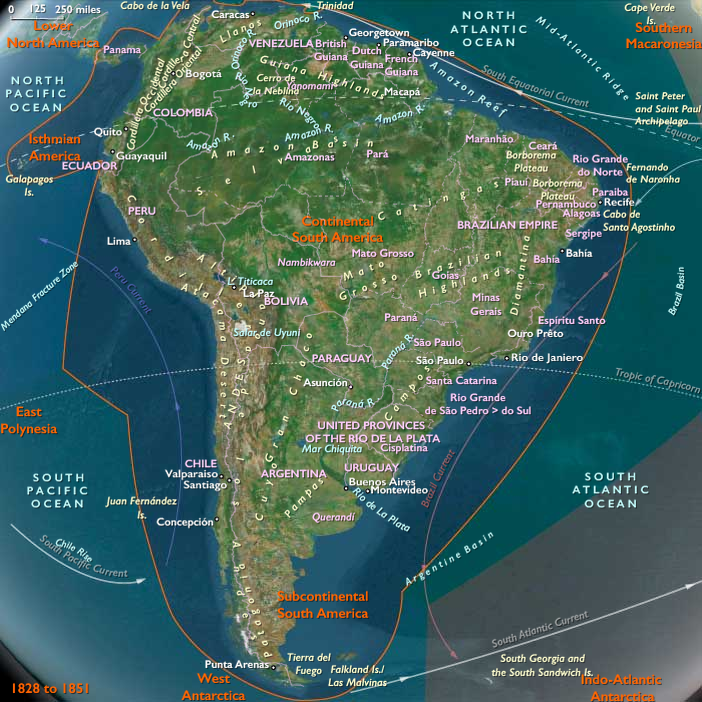
Subregions
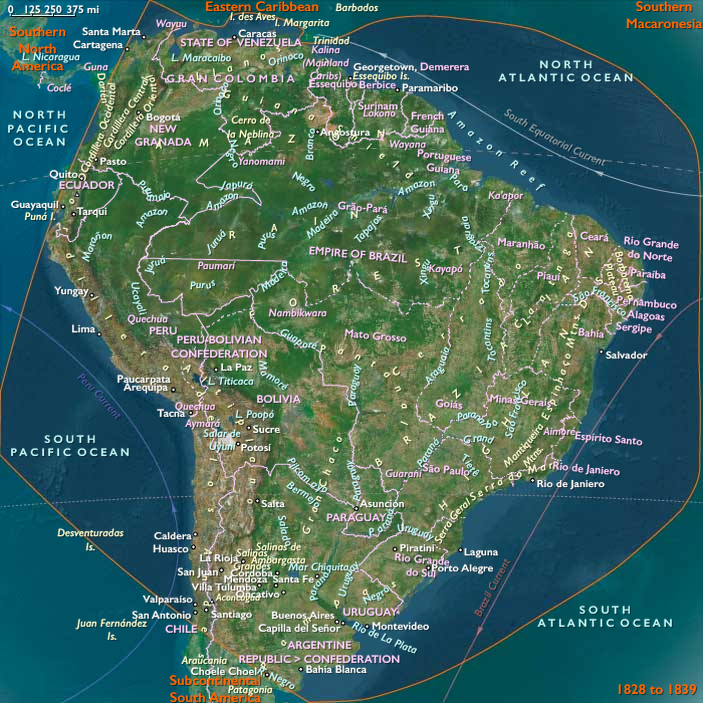
Years: 1828 - 1839
People
Groups
- Mapuche (Amerind tribe)
- Christians, Roman Catholic
- Portuguese Empire
- Spanish Empire
- Spaniards (Latins)
- Jesuits, or Order of the Society of Jesus
- Venezuela, Captaincy General of
- Chile, Republic of
- Paraguay, Republic of
- Spain, Bourbon Kingdom (first restoration) of
- Venezuela, Second Republic of
- Colombia, Republic of (Gran Colombia)
- Peru, Republic of
- Bolivia, Republic of
- Uruguay, Eastern Republic of
- Ecuador, Republic of
- Venezuela, Bolivarian Republic of
- Peru-Bolivian Confederation
- Bolivia, Republic of
- Peru, Republic of
Topics
- Age of Discovery
- Atlantic slave trade
- Colonization of the Americas, Portuguese
- Colonization of the Americas, Spanish
- French Revolution
- Haitian Revolution
- Argentine War of Independence
- Spanish American wars of independence
- Paraguayan War of Independence
- Chilean War of Independence
- Colombian War of Independence
- Argentine War of Independence
- Chilean Revolt
- Venezuelan War of Independence
- Bolivar's War
- Bolivar in Venezuela
- Cabanagem
- Ragamuffin War
Commodoties
Subjects
Regions
Subregions