
South America Major (1804–1815 CE): Independence Movements, …
Years: 1804 - 1815
South America Major (1804–1815 CE): Independence Movements, Revolutionary Conflict, and Colonial Breakdown
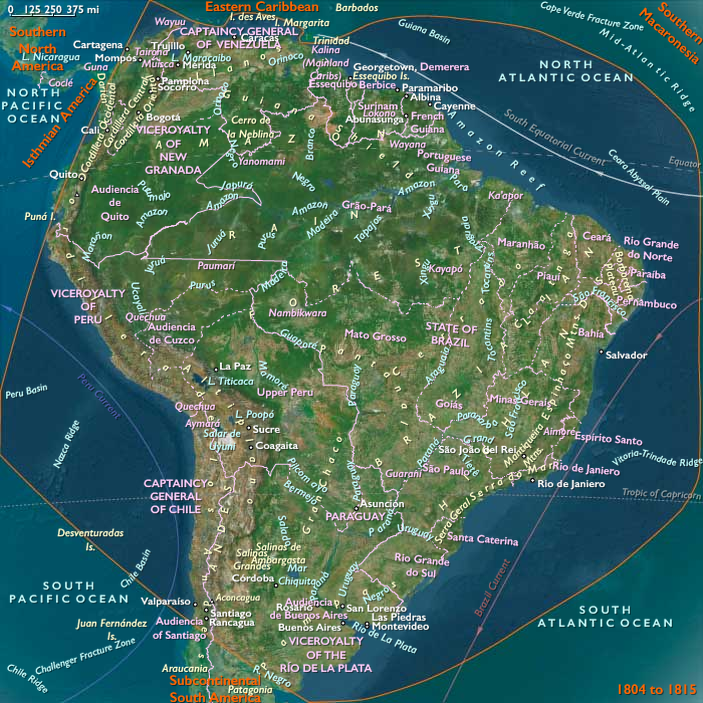
Between 1804 and 1815 CE, South America Major—covering all lands north of the Río Negro, extending across the full continental span of Brazil, Uruguay, Paraguay, northern Argentina and northern Chile, Bolivia, Peru, Ecuador (excluding the Cape lands at the Isthmian boundary), Colombia (excluding the Darién region, which belongs to Isthmian America), Venezuela, Guyana, Suriname, and French Guiana—underwent dramatic upheaval characterized by revolutionary movements, widespread colonial breakdown, and early stages of independence. Fueled by external revolutionary precedents, notably the success of the Haitian Revolution (1804), these years marked profound transformations in political structures, social hierarchies, and economic systems across the continent.
Political Developments
Revolutionary Impact and Haitian Influence
The successful Haitian Revolution (1791–1804)—the first successful slave rebellion establishing an independent nation—deeply impacted South American elites, colonial authorities, and enslaved populations. The precedent of successful resistance dramatically inspired independence efforts and intensified colonial anxieties.
Outbreak of Independence Wars
Widespread independence movements erupted, notably:
-
Venezuela: Francisco de Miranda (1806) and Simón Bolívar initiated revolutionary movements, officially declaring independence in 1811.
-
Argentina: The May Revolution of 1810 marked Buenos Aires’s break from Spanish rule.
-
Chile: Early independence attempts emerged in 1810, beginning a prolonged struggle against Spanish authority.
-
Colombia and Ecuador: Experienced initial independence revolts beginning around 1809–1810.
-
Paraguay: In 1811, Paraguay achieved an unusually peaceful independence from Spanish rule, distinguishing itself from prolonged conflicts elsewhere. Led initially by local elites seeking autonomy from Buenos Aires as well as Madrid, Paraguay swiftly established a self-contained government under an emerging authoritarian political structure.
Portuguese Monarchy Relocation to Brazil
Portuguese political dynamics dramatically shifted in 1808 when the Portuguese royal court, fleeing Napoleon’s invasions, relocated to Rio de Janeiro, significantly altering Brazil’s political status and setting the stage for Brazil's later independence.
Economic Developments
Economic Disruption Amid Revolutionary Conflict
Mining economies in Brazil (Minas Gerais) and Bolivia (Potosí) continued, though increasingly disrupted by revolutionary conflicts and resource depletion. Trade patterns and economies destabilized as warfare spread, leading to severe economic fluctuations.
Plantation Economies Under Pressure
Plantation agriculture and enslavement continued, but the revolutionary atmosphere—fueled by Haitian precedents—increased tensions, fear of slave revolts, and demands for abolitionist reform, especially in Brazil.
Emerald and Resource Extraction Decline
Emerald mining in Colombia continued under strained conditions due to revolutionary disruptions, military conflict, and declining colonial oversight, weakening extractive economies.
Cultural and Technological Developments
Revolutionary Ideals and Intellectual Transformation
Enlightenment-inspired ideals of liberty, republicanism, and equality spread vigorously through urban centers—Lima, Quito, Bogotá, Caracas, Rio de Janeiro, and Buenos Aires—energizing revolutionary thought and prompting dramatic shifts in political and intellectual life.
Urban Cultural and Architectural Impact
Major cities, though politically turbulent, continued to serve as cultural and intellectual hubs. Revolutionary conflicts reshaped urban life, turning cities into centers of ideological debate, political mobilization, and cultural shifts toward nationalist identity formation.
Social and Religious Developments
Social Upheaval and Class Reconfiguration
Social hierarchies were challenged dramatically amid revolutionary upheaval. Indigenous peoples, enslaved populations, mestizos, and creoles actively participated in revolutionary movements, destabilizing rigid colonial social structures and creating opportunities for societal reconfiguration.
Catholic Church Amid Revolutionary Change
The Catholic Church confronted unprecedented pressures amid revolutionary transformations. Often aligned with traditional colonial power structures, the Church faced tensions as revolutionary leaders advocated secular reforms, challenging Church authority and provoking internal divisions.
Indigenous Resistance and Frontier Dynamics
Persistent indigenous resistance significantly influenced revolutionary conflicts, as indigenous communities navigated alliances and resistances to colonial and revolutionary factions alike. Frontier regions, notably in Chile (Mapuche territories), Andean communities, and Amazonian groups, experienced ongoing conflict and territorial disruption.
Long-Term Consequences and Historical Significance
The era from 1804 to 1815 CE represented a decisive turning point, initiating South America Major's sustained revolutionary upheaval and struggle for independence. Driven by external revolutionary precedents, intense ideological currents, widespread social upheaval, and weakening colonial governance, these years profoundly reshaped the continent’s political, social, and economic landscapes. The movements and conflicts of this era established irreversible momentum toward full independence, profoundly influencing South America’s subsequent historical trajectory.
People
Groups
- Mapuche (Amerind tribe)
- Guaraní (Amerind tribe)
- Christians, Roman Catholic
- Portuguese Empire
- Inca Empire
- Spanish Empire
- Spaniards (Latins)
- Chile (Spanish colony)
- Jesuits, or Order of the Society of Jesus
- Peru, Viceroyalty of
- Venezuela Province
- Portugal, Bragança Kingdom of
- Spain, Bourbon Kingdom of
- Venezuela, Captaincy General of
- Chile, Republic of
- Venezuela, Second Republic of
Topics
- Age of Discovery
- Atlantic slave trade
- Colonization of the Americas, Portuguese
- Colonization of the Americas, Spanish
- French Revolution
- Haitian Revolution
- Argentine War of Independence
- Spanish American wars of independence
- Paraguayan War of Independence
- Chilean War of Independence
- Colombian War of Independence
- Argentine War of Independence
- Chilean Revolt
- Venezuelan War of Independence
- Bolivar's War
- Bolivar in Venezuela
Commodoties
Subjects
Regions

Subregions
Years: 1804 - 1815
People
Groups
- Mapuche (Amerind tribe)
- Guaraní (Amerind tribe)
- Christians, Roman Catholic
- Portuguese Empire
- Inca Empire
- Spanish Empire
- Spaniards (Latins)
- Chile (Spanish colony)
- Jesuits, or Order of the Society of Jesus
- Peru, Viceroyalty of
- Venezuela Province
- Portugal, Bragança Kingdom of
- Spain, Bourbon Kingdom of
- Venezuela, Captaincy General of
- Chile, Republic of
- Venezuela, Second Republic of
Topics
- Age of Discovery
- Atlantic slave trade
- Colonization of the Americas, Portuguese
- Colonization of the Americas, Spanish
- French Revolution
- Haitian Revolution
- Argentine War of Independence
- Spanish American wars of independence
- Paraguayan War of Independence
- Chilean War of Independence
- Colombian War of Independence
- Argentine War of Independence
- Chilean Revolt
- Venezuelan War of Independence
- Bolivar's War
- Bolivar in Venezuela
Commodoties
Subjects
Regions
Subregions