Contemporary historians are silent on the early …
Years: 49BCE - 49BCE
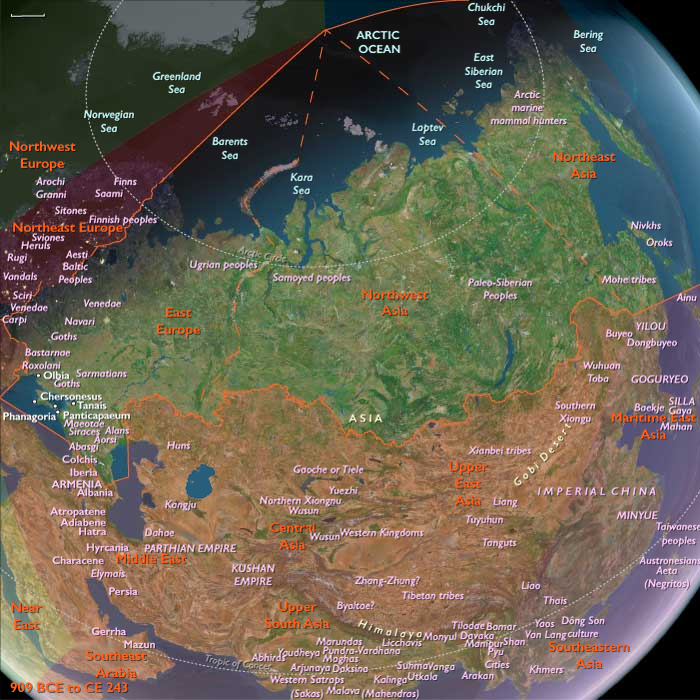
Contemporary historians are silent on the early reign of Pharnaces II, but eventually, on viewing the increasing power struggles between the Romans, and with an eye to recreating the kingdom of his father, he had attacked and subjugated the free Greek city of Phanagoria, violating one of his agreements with Pompey.
Locations
People
Groups
- Scythians, or Sakas
- Roman Republic
- Bosporan Kingdom
- Sarmatians
- Greeks, Hellenistic
- Pontus, Kingdom of
Topics
- Classical antiquity
- Roman Age Optimum
- Roman Republic, Crisis of the
- Roman Civil War, Great, or Caesar's Civil War
Commodoties
Subjects
Regions
Subregions
Related Events
Filter results
Showing 10 events out of 12 total
East Europe (1684–1695 CE): Expansion, Westernization, and Military Reforms
Political and Military Developments
Rise of Peter the Great
Between 1684 and 1695 CE, Muscovy witnessed the ascent of Tsar Peter I (Peter the Great), marking a pivotal era of substantial reforms, modernization, and ambitious territorial expansion aimed at transforming Russia into a major European power.
Territorial Ambitions and Military Campaigns
Peter the Great initiated significant military campaigns, including early attempts to secure access to the Black Sea. His administration emphasized strategic military planning and aggressive diplomacy to expand Muscovy’s geopolitical influence.
Diplomatic and Strategic Realignment
Diplomatic relationships with European powers, notably Sweden, Poland-Lithuania, and the Ottoman Empire, became increasingly strategic. Peter actively sought alliances to strengthen Muscovy’s international position and enhance military preparedness.
Economic and Technological Developments
Economic Modernization
Economic policies began shifting towards modernization and increased integration with European markets. Efforts included the establishment of new industries, improvements in trade practices, and strategic economic reforms aimed at bolstering Muscovy’s economic resilience.
Military and Infrastructure Innovations
Under Peter, significant advancements in military organization and technology were initiated, notably the modernization of naval forces and improvement of fortification techniques. These changes were critical for achieving his strategic military objectives.
Cultural and Artistic Developments
Introduction of Western Influences
Peter's reign marked the introduction of Western European influences into Muscovite culture. Architectural styles, artistic expressions, and educational practices began incorporating Western elements, reshaping cultural identities.
Intellectual Growth and Literary Activity
Intellectual endeavors expanded significantly, reflecting increased contact with European scholarship. Literary production began to evolve, incorporating new forms and themes reflecting Western influences and broader intellectual currents.
Settlement Patterns and Urban Development
Urban Modernization
Cities, particularly Moscow, began modernizing with new urban planning methods, infrastructure improvements, and expanded administrative capacities. These developments supported increased population growth and urban efficiency.
Enhanced Fortifications
Significant improvements in urban and territorial fortifications enhanced Muscovy’s defensive capabilities, reflecting a strategic focus on military preparedness and security.
Social and Religious Developments
Social Reforms and Integration
Social structures began reflecting Peter’s reforms aimed at Westernization, impacting traditional societal frameworks. Integration efforts continued, focusing on accommodating diverse ethnic populations within a modernizing state.
Orthodox Church and State Relations
Relations between the Orthodox Church and state authorities evolved, influenced by Peter’s reforms. Efforts were made to align the church more closely with state objectives, adjusting its role in education, community life, and social governance.
Long-Term Consequences and Historical Significance
The period from 1684 to 1695 CE represented the initial stages of Peter the Great’s transformative influence on Muscovy. These reforms set critical foundations for Russia’s emergence as a significant European power, initiating profound changes in political structure, economic practices, cultural identity, and military strength.

Eastern Southeast Europe (1684–1695 CE): The Holy League and Ottoman Retrenchment
Settlement and Migration Patterns
Serbian Migration and the Great Exodus
From 1684 to 1695 CE, Christian offensives against Ottoman territories triggered significant demographic shifts. Serbian populations, fearing Ottoman reprisals after failed rebellions, experienced substantial migrations. In 1690, Serbian Patriarch Arsenije III Čarnojević led an exodus of approximately thirty-six thousand Serbian families into Austrian-held southern Hungary, notably into what would become known as Vojvodina. The Austrian emperor offered religious freedom, autonomous governance, and military oversight to these refugees, laying the foundation for Serbian cultural and political identity in the region.
Political Dynamics and Regional Conflicts
The Holy League's Offensive
This era marked a significant military effort by Christian European powers—Austria, Poland, Venice, and Russia—to drive the Ottoman Empire out of Southeast Europe following the decisive relief of Vienna in 1683 by Polish forces under King Jan Sobieski. From 1687 to 1690, the Holy League successfully expelled Ottoman forces from significant portions of southern Hungary, including Transylvania, temporarily capturing Belgrade and large parts of Serbia.
Ottoman Retrenchment and Reprisals
Despite initial successes by the Holy League, Ottoman forces regrouped and recaptured territories, notably retaking Belgrade. The failure of the Serbian rebellions in Ottoman-controlled territories led to severe reprisals and a reinforced Ottoman presence south of the Sava River. Simultaneously, the Albanian Catholic revolt against Ottoman rule ended tragically, resulting in forced conversions to Islam and intensified Ottoman control.
Austro-Habsburg Dominance in Transylvania
In 1688, the Transylvanian Diet formally renounced Ottoman suzerainty and accepted Habsburg protection. By 1699, the Porte officially recognized Austrian control over Transylvania. Although local privileges of the nobility and the rights of "recognized" religions (Roman Catholicism, Lutheranism, Calvinism, and Unitarianism) were confirmed, direct Austrian administrative control significantly altered the region's political landscape.
Economic and Social Developments
Intensified Serfdom and Religious Oppression
Under Austrian authority, Transylvania’s Romanian majority faced extreme hardship. Romanians were systematically excluded from political participation, tightly bound by serfdom restrictions, and economically exploited. Orthodox Romanians suffered additional religious oppression, compelled to pay tithes to either Roman Catholic or Protestant institutions, causing widespread impoverishment among Orthodox clergy.
Cultural and Religious Dynamics
Serbian Cultural Resilience
The Serbian migration to Vojvodina led to the establishment of new monasteries, which rapidly became significant centers for Serbian cultural and religious preservation. These institutions not only reinforced Serbian Orthodox identity but also became centers for education and literature, profoundly influencing Serbian national consciousness.
Albanian and Bulgarian Resistance
The period saw desperate revolts by Albanian Catholics and Bulgarian Christians against Ottoman oppression. Despite their failure and the harsh repercussions, these revolts underscored enduring resistance and dissatisfaction with Ottoman rule, setting the stage for future nationalist sentiments.
Key Historical Events and Developments
-
1687-1690: Holy League's counteroffensive against the Ottoman Empire.
-
1690: Serbian Patriarch Arsenije III Čarnojević leads mass migration to Austrian-held territories.
-
1688: Transylvanian Diet accepts Austrian protection, formally breaking from Ottoman suzerainty.
-
1689: Temporary Austrian capture and subsequent Ottoman recapture of Belgrade, inciting reprisals.
-
1695: Russian assault on the Ottoman-held fortress city of Azov, signaling a broader regional struggle for control of strategic Black Sea access.
Long-Term Consequences and Historical Significance
The era from 1684 to 1695 CE dramatically reshaped Eastern Southeast Europe's political, cultural, and demographic landscapes. The Holy League's initial successes and subsequent setbacks highlighted the complex power dynamics between Ottoman resilience and European ambitions. Serbian migration, Austrian control of Transylvania, and regional revolts laid essential foundations for future nationalist movements and cultural resilience against external dominance.
Russia, at the beginning of the reign of Tsar Peter in 1692 is a huge territorial power, but with no access to the Black Sea, the Caspian, or to the Baltic, and to win such an outlet has become the main goal of Peter's foreign policy.
The first steps taken in this direction is the campaign of 1695 to capture Azov from the Crimean Tatar vassals of Turkey.
On the one hand, the Azov campaign can be seen as fulfilling Russia's commitments, undertaken during Sophia's regency, to the anti-Turkish “Holy League” of 1684 (Austria, Poland, and Venice); on the other they are intended to secure the southern frontier against Tatar raids, as well as to approach the Black Sea.
Peter orders an assault on the Turkish-held city-fortress of Azov at the Don River delta.
The first Azov campaign begins in the spring of 1695, when Peter orders his army (thirty-one thousand men and one hundred and seventy guns) to advance towards Azov.
The army, comprising crack regiments and the Don Cossacks, is divided into three units under the command of Franz Lefort, Patrick Gordon and Avtonom Golovin.
Supplies are shipped down the Don from Voronezh.
The Russians block Azov from land between June 27 and July 5, but because Russia has no navy they cannot control the river and prevent resupply.
After two unsuccessful attacks on August 5 and September 25 with the Russians suffering heavy casualties, the siege is lifted on October 1.
Another Russian army (one hundred and twenty thousand men, mostly cavalrymen, Streltsy, Ukrainian Cossacks and Kalmyks) under the command of Boris Sheremetev had set out for the lower reaches of the Dnieper to take the Ottoman forts there.
The main fort at Kazy-Kerman is taken when its powder magazine blows up, but the Russians are not able to hold the area and withdraw most of their forces.
War dominates much of Peter's reign.
At first Peter attempts to secure the principality's southern borders against the Tatars and the Ottoman Turks.
His campaign against a fort on the Sea of Azov fails initially, but after he creates Russia's first navy, Peter is able to take the port of Azov in 1696.
To continue the war with the Ottoman Empire, Peter travels to Europe to seek allies.
The first tsar to make such a trip, Peter visits Brandenburg, Holland, England, and the Holy Roman Empire during his so-called Grand Embassy.
Peter learns a great deal and enlists into his service hundreds of West European technical specialists.
The embassy is cut short by the attempt to place Sofia on the throne instead of Peter, a revolt that is crushed by Peter's followers.
As a result, Peter has hundreds of the participants tortured and killed, and he publicly displays their bodies as a warning to others.
Eastern Southeast Europe (1696–1707 CE): Religious Tensions and Emerging Russian Influence
Settlement and Migration Patterns
Consolidation Under Habsburg Rule
Between 1696 and 1707, the Habsburg monarchy intensified efforts to consolidate its rule in Transylvania, imposing tighter administrative control. This included demographic policies aimed at strengthening the position of Roman Catholic settlers while marginalizing Protestant and Orthodox populations, contributing to internal tensions and demographic shifts.
Economic and Technological Developments
Economic Stability Under Habsburg Administration
Habsburg rule brought relative economic stability to regions like Transylvania, though rural populations—particularly Orthodox Romanians—continued to suffer under heavy feudal obligations and restricted freedoms. Trade networks with Central Europe strengthened, facilitated by imperial infrastructure projects and administrative integration.
Cultural and Artistic Developments
Baroque Influence and Catholic Cultural Expansion
The period saw an increase in Catholic cultural and artistic patronage under Habsburg influence. In Transylvania, baroque architecture flourished, visible in churches and public buildings newly acquired by Catholic authorities, often appropriated from Protestant communities.
Social and Religious Developments
Forced Catholicization and the Uniate Church
The Habsburgs aggressively promoted Catholicism in predominantly Protestant and Orthodox regions of Transylvania, forcibly transferring many Protestant churches to Catholic authorities. A campaign emerged to establish the Uniate Church, which maintained Orthodox rituals but recognized papal authority. Emperor Leopold I issued decrees in 1699 and 1701, officially merging Transylvania's Orthodox Church into the Catholic fold. Despite material incentives and promises of improved social standing offered by Jesuit missionaries, widespread resistance persisted among Orthodox clergy and laypeople, creating lasting religious divisions.
Orthodox Resistance and Persistence
Despite official decrees and some Orthodox clergy accepting the union, the broader Orthodox community strongly resisted incorporation into the Catholic hierarchy. This resistance reinforced religious identity among Orthodox Romanians, laying the groundwork for future national consciousness and opposition to Habsburg religious policy.
Political Dynamics and Regional Rivalries
Rising Russian Influence
This period marked the emergence of Russia as a significant power in Eastern Europe, eclipsing Polish influence and increasingly shaping events in the Ottoman Balkans. Tsar Peter I (Peter the Great) articulated a policy of supporting fellow Orthodox Christians living under Ottoman rule, making Russia an attractive ally for Romanian leaders in Wallachia and Moldavia, who sought Russian assistance to resist Ottoman domination.
Habsburg-Ottoman-Russian Rivalries
Intensified rivalries emerged between the Ottoman Empire, the Habsburg monarchy, and an increasingly assertive Russian Empire. Romanian principalities found themselves at the intersection of these great-power ambitions, carefully navigating alliances to protect their autonomy and exploit these rivalries.
Key Historical Events and Developments
-
1699, 1701: Emperor Leopold I issues decrees mandating the union of Transylvania's Orthodox Church with the Roman Catholic Church, sparking resistance.
-
1700s: Tsar Peter the Great declares official support for Orthodox communities under Ottoman rule, marking the start of increased Russian involvement in Wallachia and Moldavia.
Long-Term Consequences and Historical Significance
The years 1696–1707 CE significantly altered the religious landscape of Eastern Southeast Europe, intensifying Catholic-Orthodox tensions within Habsburg territories and introducing the Russian Empire as a critical external influence. These developments had lasting implications for regional identity, religious practices, and political alignments, shaping the region’s trajectory into the modern era.
Russia’s Tsar Peter, undissuaded by his failure to invest the Turkish-held city-fortress of Azov, builds a fleet at Voronezh at the urging of his Swiss-Scottish friend Franz Lefort (1656-99), an officer in the Russian service.
Peter’s new fleet, sailing down the Don River, blockades Azov in 1696 and captures it in July of this year at a cost of over thirty thousand Russian lives.
Years: 49BCE - 49BCE
Locations
People
Groups
- Scythians, or Sakas
- Roman Republic
- Bosporan Kingdom
- Sarmatians
- Greeks, Hellenistic
- Pontus, Kingdom of
Topics
- Classical antiquity
- Roman Age Optimum
- Roman Republic, Crisis of the
- Roman Civil War, Great, or Caesar's Civil War