
Construction of the Buddhist cave shrines known …
Years: 366 - 366
Construction of the Buddhist cave shrines known today as the Mogao Caves, or Mogao Grottoes, also known as the Caves of the Thousand Buddhas and Dunhuang Caves, begins in 366 as a places to store scriptures and art.
According to local legend, a Buddhist monk, Lè Zūn, had a vision of "golden rays of light shining down on one thousand Buddhas" and inspired the excavation of the caves he had envisioned.
The number of temples will eventually grow to more than a thousand.
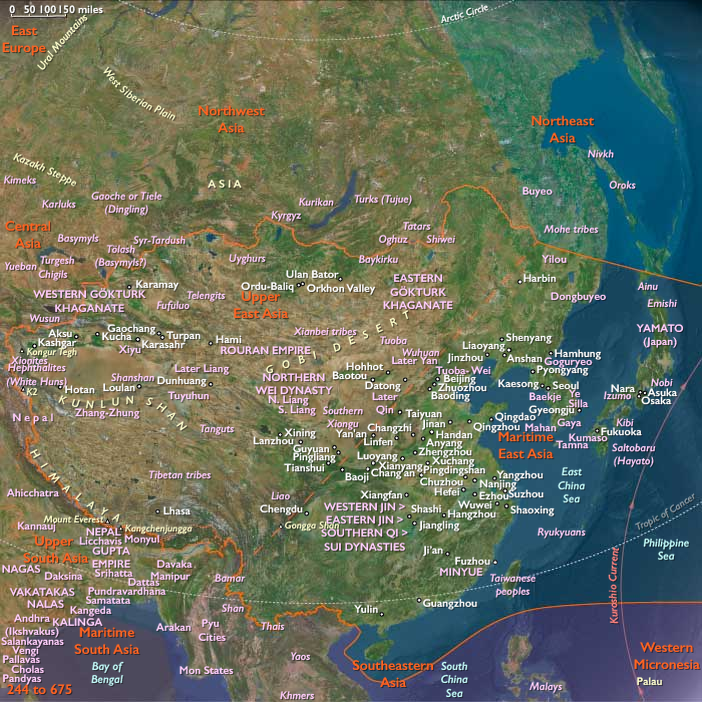
When completed, the caves will form a system of four hundred and ninety two temples, twenty-five kilometers (fifteen and a half miles) southeast of the center of Dunhuang, an oasis strategically located at a religious and cultural crossroads on the Silk Road, in Gansu province, China.
The caves contain some of the finest examples of Buddhist art spanning a period of one thousand years.
Locations
Groups
Topics
Subjects
Regions
Subregions

Related Events
Filter results
Showing 10 events out of 59671 total
Geunchogo, the second son of Biryu, the eleventh king of Baekje, had become king in 346 upon the death of the twelfth king, Gye.
His reign seems to have marked the permanent ascendancy of the descendants of the fifth king Chogo (reflected in Geunchogo's name) over those of the eighth king, Goi, and ended the alternating kingship of the two lines.
Having set set out to solidify the royal power within the Baekje state upon ascending the throne, he has reduced the power of the aristocracy and set up a system of local government with regional heads appointed by the court.
He has married a wife from the Jin clan, setting a precedent for his successors, and he has moved the capital to Hansan, today's southeast Seoul.
The first Korean envoy to Japan, an emissary of the government of Baekje, reportedly arrives in 366.
In this year, Geunchogo allies with Silla, which borders Baekje on the east, maintaining a rough balance of power among the Three Kingdoms.
Valens has finally assembled enough troops to deal effectively with the usurper Procopius in the spring of 366.
Marching out from Ancyra through Pessinus, Valens proceeds into Phrygia, where he defeats Procopius's general Gomoarius at the Battle of Thyatira.
The defeat of Gomoarius decreases the hopes of Procopius, so that, when Valens reaches Procopius and his troops at Nacoleia, the troops of the usurper desert their commander, and Procopius is on May 27 executed by the army, most of which have remained faithful to Valens, and his head sent to Valentinian in Trier for inspection.
Jovian had surrendered Rome's much disputed claim to control over Armenia in 363, and Shapur II, being eager to make good on this new opportunity, had begun enticing Armenian lords over to his camp, eventually forcing the defection of the Arsacid Armenian king, Arshak II, whom he had quickly arrested and incarcerated.
Shapur had then sent an invasion force to seize Caucasian Iberia and a second to besiege Arshak's son, Pap, in the fortress of Artogerassa, probably in 367.
By the following spring, Pap has engineered his escape from the fortress and flight to Valens, whom he seems to have met at Marcianople, Valens’s winter quarters, while campaigning against the Goths.
A Danube flood in spring 368 prevents Valens from crossing; instead the emperor occupies his troops with the construction of fortifications.
Valens next wages war on the Thervings, now settled agriculturists in Dacia, who had aided Procopius and are threatening to invade Thrace.
The Tervingi, at this time under the leadership of Athanaric, had apparently remained peaceful since their defeat under Constantine in 332.
The Emperor, furious at their support of the late would-be usurper, crosses the Danube in May 367 and devastates the Gothic territories in modern Romania.
The Thervings flee into the Carpathian Mountains, and elude Valens' advance, forcing him to return later in the summer.
Julian had recalled Aëtius of Antioch from exile, bestowed upon him an estate in Lesbos, and retained him for a time at his court in Constantinople.
Having been consecrated as a bishop, Aëtius had used his office in the interests of Arianism by creating other bishops of that party.
At the accession of Valens in 364, Aëtius had retired to his estate at Lesbos, but soon returned to Constantinople, where he dies in 367.
Eunomius of Cyzicus, deposed from his bishopric by Constantius for his extreme Arianist views, had resided in Constantinople during the reigns of Julian and Jovian, in close intercourse with his mentor Aëtius, consolidating an heretical party and consecrating schismatical bishops.
He had then gone to live at Chalcedon, whence in 367 he is banished to Mauretania for harboring the rebel Procopius.
He is recalled, however, before he reaches his destination.
Valentinian I at Ambiani (Amiens) and Roman Britain’s Defense (367 CE)
In 367 CE, Emperor Valentinian I moved his imperial residence to Ambiani (modern Amiens, France) to better coordinate military operations with his general, Theodosius (father of the future Emperor Theodosius I). Theodosius was leading Roman efforts to defend Britain, which was under siege from multiple barbarian groups, including the Saxons, Picts, and Scots.
1. The Strategic Importance of Ambiani
- Ambiani was closer to the northern coast of Gaul, allowing for better communication and rapid troop movement between the continent and Britain.
- From this position, Valentinian could:
- Monitor and reinforce the Rhine frontier against Alemanni incursions.
- Oversee naval operations supporting Theodosius’ campaign in Britain.
- Strengthen Roman defenses along the North Sea and English Channel, both vulnerable to Saxon piracy.
2. Roman Amiens: A Major Urban and Military Center
- Recent excavations near the city hall and the Palace of Justice have revealed the remains of:
- A large forum, indicating significant civic and administrative activity.
- Thermal baths, suggesting a well-developed Romanized urban culture.
- An amphitheater, built for a larger population than Londinium (London) or Lutetia (Paris) at the time.
- These findings suggest that Ambiani was a more important city in Roman Gaul than previously thought, serving as a regional economic and strategic hub.
3. Theodosius’ Defense of Britain and the Great Conspiracy
- Theodosius was in Britain responding to what Roman historians later called the Great Conspiracy (367 CE)—a coordinated invasion of Roman Britain by:
- The Picts from Scotland.
- The Scots from Ireland.
- The Saxons from northern Germany and Denmark.
- Roman control in Britain had weakened due to prior imperial instability, and Valentinian’s decision to prioritize the island’s defense reflected its importance to the empire.
4. Valentinian’s Legacy and Military Reforms
- Valentinian’s decision to relocate to Ambiani showed his hands-on approach to military strategy.
- His reign was marked by:
- Massive frontier fortifications, reinforcing Rome’s defenses along the Rhine, the Danube, and Britain.
- Supporting competent generals like Theodosius, ensuring that the empire’s provinces remained protected from external threats.
5. Conclusion: The Strengthening of Rome’s Northwestern Provinces
- Valentinian’s presence in Ambiani reinforced Rome’s position in northern Gaul, allowing him to effectively manage both the Rhine and British frontiers.
- The archaeological findings confirm that Amiens was one of the largest and most developed cities in Roman Gaul, comparable in size to London and Paris at the time.
- His efforts in military defense and urban development helped stabilize the western provinces, delaying the collapse of Roman Britain and Gaul for several more decades.
Through his strategic relocation, military focus, and urban investment, Valentinian I demonstrated his commitment to protecting the empire’s northern frontiers, reinforcing his legacy as one of Rome’s last great military emperors.
Valentinian I Strengthens the Line of Succession: The Proclamation of Gratian as Co-Emperor (367 CE)
In an effort to secure the imperial succession, Emperor Valentinian I proclaimed his eight-year-old son, Gratian, as co-emperor (Augustus) on August 24, 367 CE. This move was intended to reinforce dynastic stability, ensuring that Valentinian’s family retained control over the Western Roman Empire.
1. The Political and Military Context
- By 367 CE, Valentinian had successfully defended Gaul and Britain from barbarian incursions, but he remained concerned about the long-term stability of the empire.
- The empire was already divided into East and West, with his brother Valens ruling the Eastern Empire.
- By elevating Gratian, Valentinian established a direct hereditary succession, reducing the risk of civil war upon his death.
2. The Education of Gratian and the Role of Ausonius
- Recognizing the importance of a well-educated emperor, Valentinian entrusted Gratian’s education to Decimus Magnus Ausonius, a renowned poet, scholar, and teacher from Burdigala (modern Bordeaux).
- Ausonius was an esteemed rhetorician and grammarian, who taught in the famous schools of Bordeaux, making him one of the most respected intellectuals of his time.
- Valentinian appointed Ausonius as Praetorian Prefect, giving him significant political influence in the imperial administration.
3. Implications of Gratian’s Appointment
- Legitimacy: Proclaiming a young co-emperor signaled dynastic continuity, reinforcing the Valentinian dynasty’s claim to power.
- Stability: By securing an heir early, Valentinian hoped to prevent succession disputes and potential usurpations.
- Eastern Relations: The move likely reassured Valens, his co-emperor in the East, that the Western Empire would remain in family hands.
4. The Legacy of Gratian’s Rule
- When Valentinian died unexpectedly in 375 CE, Gratian succeeded him as Emperor of the West, ruling alongside his younger half-brother, Valentinian II.
- Gratian’s reign (367–383 CE) was marked by:
- Religious reforms favoring Christianity over pagan traditions.
- Continued struggles against barbarian threats, particularly the Goths and Alemanni.
- His eventual downfall in 383 CE, when he was overthrown by the usurper Magnus Maximus.
5. Conclusion: Valentinian’s Attempt to Secure the Dynasty
By elevating Gratian as co-emperor in 367 CE, Valentinian hoped to ensure the continuity of his dynasty, but the political realities of the late Roman Empire made stability difficult to maintain. Despite Gratian’s formal succession, the Western Empire soon faced internal struggles and external threats, demonstrating the challenges of dynastic rule in the later Roman world.
Valentinian takes up residence at Augusta Trevorum, (present Trier, now in Germany) in late September 367.
The Roman garrison on Hadrian's Wall rebels in the winter of 367, and allows Picts from Caledonia to enter Britannia.
Simultaneously, Attacotti, Scotti from Hibernia, and Saxons from Germania, land in coordinated and pre-arranged waves on the island's midwestern and southeastern borders, respectively.
Franks and Saxons also land in northern Gaul.
These warbands manage to overwhelm nearly all of the loyal Roman outposts and settlements.
The entire western and northern areas of Britannia are overwhelmed, the cities sacked and the civilian Romano-British murdered, raped, or enslaved.
Nectaridus, the Count of the Saxon Shore, is killed and the dux britanniarum, Fullofaudes, is either besieged or captured, the remaining loyal army units staying garrisoned inside southeastern cities.
The areani or local agents whom the Romans pay to provide intelligence on barbarian movements seem to have betrayed their paymasters for bribes, making the attacks completely unexpected.
Deserting soldiers and escaped slaves roam the countryside and turn to robbery to support themselves.
Although the chaos is widespread and initially concerted, the aims of the rebels are simply personal enrichment and they work as small bands rather than larger armies.
Emperor Valentinian, campaigning against the Alamanni at the time, is unable to respond personally.
A series of commanders to act in his stead are chosen but swiftly recalled.
The first was Severus, the emperor's comes domesticorum, soon replaced by Jovinus, the magister equitum; rumors of disasters dog them, however, and almost fifteen months before a capable replacement is sent.
