
Construction had begun on Santa Maria della …
Years: 1633 - 1633
Construction had begun on Santa Maria della Salute in 1631.
Substantially complete by 1633, the Salute is a vast, octagonal building with two domes and a pair of picturesque bell-towers at the back.
Built on a platform made of one hundred thousand wooden piles, it is constructed of Istrian stone and marmorino (brick covered with marble dust).
At the apex of the pediment stands a statue of the Virgin Mary who presides over the church erected in her honor.
The façade is decorated with figures of Saint George, Saint Theodore, the Evangelists, the Prophets, Judith with the head of Holofernes.
While its external decoration and location capture the eye, the internal design itself is quite remarkable.
The octagonal church, while ringed by a classic vocabulary, hearkens to Byzantine designs such as the Basilica of San Vitale.
The interior has its architectural elements demarcated by the coloration of the material, and the central nave with its ring of saints atop a balustrade is a novel design.
It is full of Marian symbolism -– the great dome represents her crown, the cavernous interior her womb, the eight sides the eight points on her symbolic star.
An important addition to the Venice skyline, the church has a large influence on contemporary architects immediately after its completion, and will soon became emblematic of the city.
The main entrance, modeled on the Roman triumphal arch, will later be copied in successive churches and cathedrals, in Venice and elsewhere.
Today, this two-domed church on the peninsula between the Grand Canal and the Zattere is one of the city's best-known landmarks.
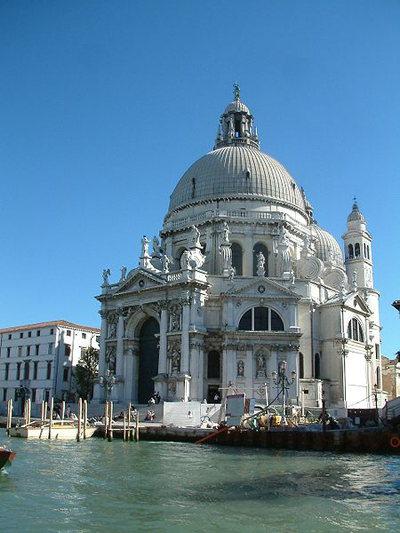
Basilica di Santa Maria della Salute (Basilica of St. Mary of Health), Venice (Photo by Radomil, 2005)
Locations
Groups
Topics
Subjects
Regions
Subregions
Years: 1633 - 1633
Basilica di Santa Maria della Salute (Basilica of St. Mary of Health), Venice (Photo by Radomil, 2005)
Locations
Groups
Topics
Subjects
Regions
Subregions