
Filters:
Fibonacci’s Liber Abaci and the …
Years: 1192 - 1203
Fibonacci’s Liber Abaci and the Introduction of Hindu-Arabic Numerals to the Latin West (1202 CE)
The cumbersome mathematics of the Latin West, which relied on Roman numerals and inefficient counting methods, underwent a revolutionary transformation with the introduction of the Hindu-Arabic numeral system and the place-value decimal system. This transformation was formalized in 1202 by the Italian mathematician Leonardo of Pisa, better known as Fibonacci, in his groundbreaking mathematical treatise, Liber Abaci (Book of the Abacus).
The Significance of Liber Abaci
- Fibonacci’s Liber Abaci introduced the modern Hindu-Arabic numeral system, which uses ten symbols (0–9) and a place-value system to perform arithmetic operations more efficiently.
- The Arabic decimal system, which had been transmitted through Islamic scholars, replaced the Roman numeral system, which lacked a positional structure and was difficult for performing calculations.
- Fibonacci demonstrated how merchants and scholars could use the new numerals for commercial arithmetic, weights and measures, interest calculations, and algebraic equations.
Impact on European Mathematics
-
Simplified Arithmetic
- The introduction of zero (0) and positional notation allowed for more efficient calculations.
- Addition, subtraction, multiplication, and division became far easier than with Roman numerals, which required cumbersome abacus-based calculations.
-
Commercial Applications
- Fibonacci emphasized the benefits of the new system for trade, accounting, and finance.
- The new numerals facilitated bookkeeping, helping merchants across Italy and beyond.
-
Foundation for Algebraic Development
- Liber Abaci also introduced basic algebraic techniques, building on Arabic and Indian mathematical traditions.
- It laid the groundwork for later advancements in algebra and number theory in Renaissance Europe.
The Slow but Lasting Adoption of Hindu-Arabic Numerals
- Initially, medieval scholars and officials resisted adopting the new system, as Roman numerals were deeply ingrained in Western tradition.
- However, over time, Italian merchants and bankers recognized its practical superiority.
- By the 15th century, Hindu-Arabic numerals had become standard across Europe, replacing the older Roman system in scholarly, commercial, and financial contexts.
Fibonacci’s Liber Abaci was a turning point in Western mathematics, ushering in a new era of numerical efficiencythat would eventually pave the way for modern arithmetic and algebra.
People
Groups
Topics
Subjects
Regions



Subregions
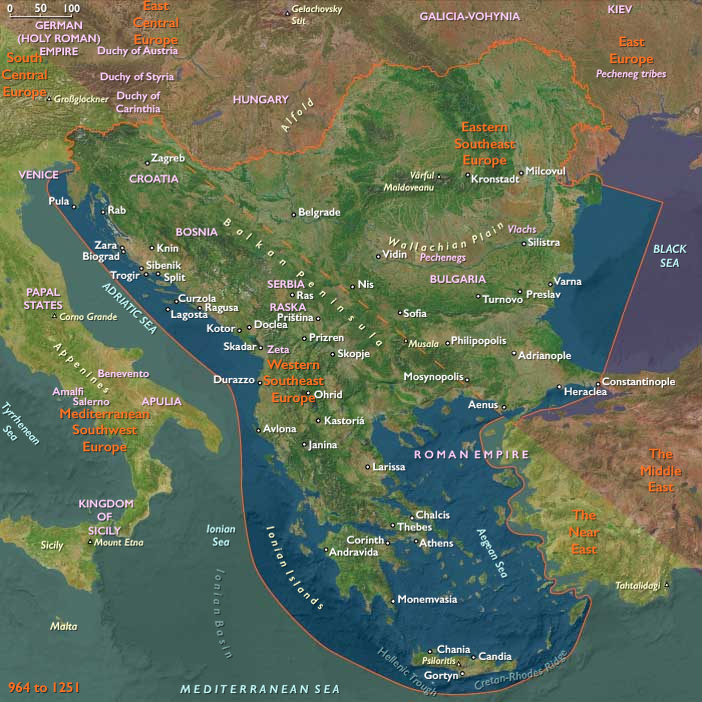
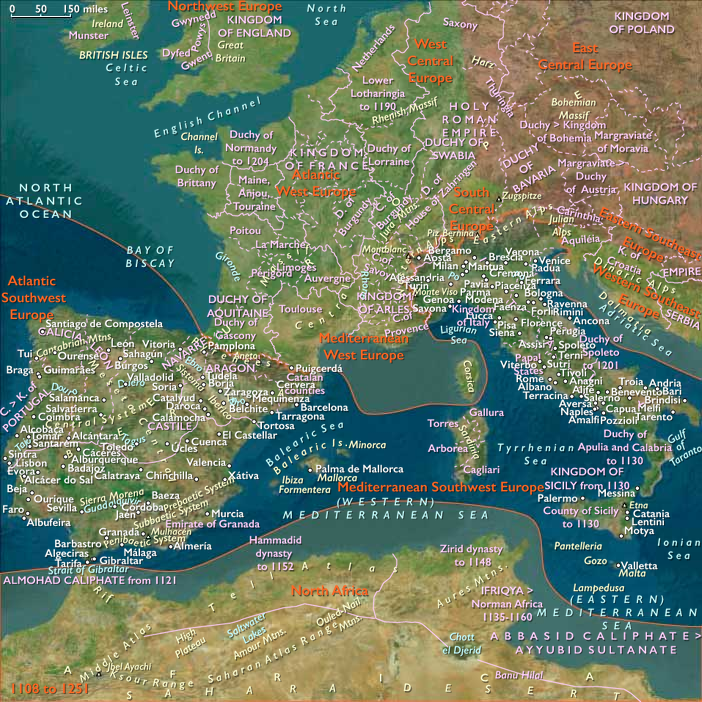
- Northeast Europe
- East Central Europe
- Western Southeast Europe
- South Central Europe
- Mediterranean West Europe
- Mediterranean Southwest Europe
- Atlantic West Europe
- West Central Europe
- Northwest Europe








Years: 1192 - 1203
People
Groups
Topics
Subjects
Regions
Subregions
- Northeast Europe
- East Central Europe
- Western Southeast Europe
- South Central Europe
- Mediterranean West Europe
- Mediterranean Southwest Europe
- Atlantic West Europe
- West Central Europe
- Northwest Europe