
Constantinople’s ascendant orthodox establishment relieves the Arian …
Years: 380 - 380
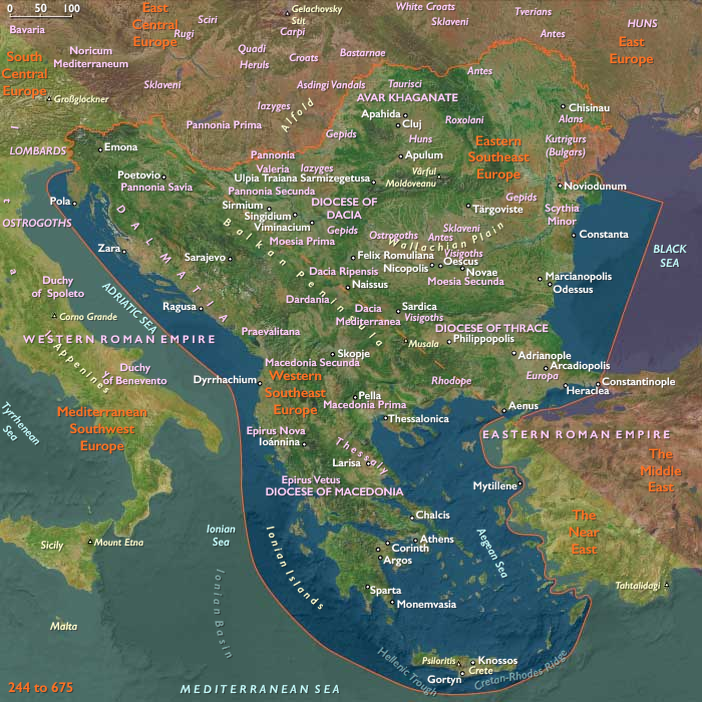
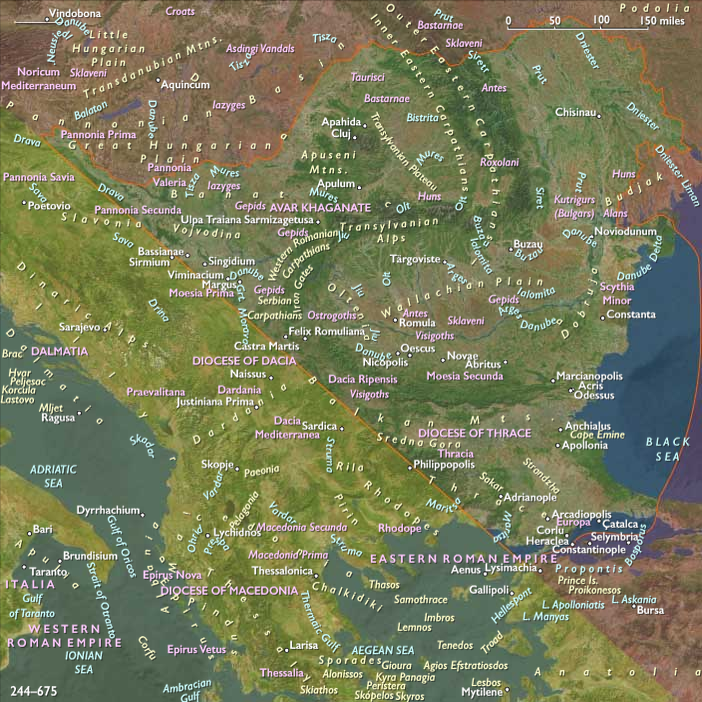
Constantinople’s ascendant orthodox establishment relieves the Arian faction of its churches here in 380.
Locations
People
Groups
- Christianity, Arian
- Thrace, Diocese of
- Christianity, Nicene
- East, or Oriens, Praetorian prefecture of
- Roman Empire: Valentinian dynasty (Rome)
- Roman Empire: Theodosian dynasty (Constantinople)
Topics
- Roman Age Optimum
- Late Antiquity
- Migration Period
- Arian controversy
- Fall of the Western Roman Empire
Subjects
Regions
Subregions
Related Events
Filter results
Showing 10 events out of 59577 total
The Goths, who by 380 can no longer be driven from the empire, divide into Therving and Greuthung armies, in part because of the difficulty of keeping such a large number supplied.
The Greuthungs move north into Pannonia, where Gratian in 380 agrees with a cluster of three tribal armies to settle them on vacant lands as a unit under their own chiefs.
The Thervings under Fritigern move south and east to Macedonia, where they take "protection money" from towns and cities rather than sacking them outright.
The Christian Church has become synonymous with the Roman Empire by about 380 , but Theodosius finds his realm divided between rival orthodox and Arian Christian groups.
Propelled by political as well as religious motives, he energetically undertakes to bring about unity of faith within the empire.
Soon dominating his weak colleague, Theodosius enters the battle on the side of orthodoxy, becoming the first emperor who does not assume the title of pontifex maximus (supreme guardian of the old Roman cults).
His position has been improved by the fact that during 379 the followers of the Nicene Creed had gained ground, whereupon Theodosius, without consulting the ecclesiastical authorities, issues an edict on February 28, 380, prescribing a creed that is to be binding on all subjects.
Only persons who believe in the consubstantiality of God the Father, Son, and Holy Spirit are henceforth to be considered Catholic Christians, a designation that here appears for the first time in a document.
Although Theodosius’ belief in the Nicene Creed is apparently genuine, he submits to baptism in the fall of 380 only after a serious illness.
Ambrose, in confronting the Arians, seeks to theologically refute their propositions, considered as heretical.
The Arians appeal to many high level leaders and clergy in both the Western and Eastern empires.
Although the western Emperor Gratian holds orthodox belief in the Nicene creed, the younger Valentinian II, his colleague in the empire, adheres to the Arian creed.
Ambrose has not swayed the young prince's position.
In the East, Emperor Theodosius likewise professed the Nicene creed; but there are many adherents of Arianism throughout his dominions, especially among the higher clergy.
In this contested state of religious opinion, two leaders of the Arians, bishops Palladius of Ratiaria and Secundianus of Singidunum, confident of numbers, prevail upon Gratian to call a general council from all parts of the empire.
This request appears so equitable that he complies without hesitation.
However, Ambrose fears the consequences and prevails upon the emperor to have the matter determined by a council of the Western bishops.
Gratian applies the settlement policy also to the Salian Franks in Germany.
King Naemul of Silla is the first king to appear by name in Chinese records.
It appears that there was a great influx of Chinese culture into Silla in his period, and that the widespread use of Chinese characters begins in his time.
In 381, Silla sends emissaries to China and establishes relations with Goguryeo.
The Nicene Creed prescribed in 380 is again defined at the beginning of 381 and ecclesiastically sanctioned, as it were, in the summer of this year by a church council summoned to Constantinople by Theodosius, chiefly to confront Arianism.
Meletius of Antioch presides but dies during the Council; Gregory of Nyssa, whose brother Basil had died early in 379, delivers Meletius’s funeral oration.
The Council, attended by more than 150 bishops, all from the Eastern portion of the empire, reaffirms the Nicene Creed, firmly rejecting Arianism, as well as Modalism and Monarchianism.
Apollinarianism, which had been opposed by Basil, together with Gregory of Nyssa, Gregory of Nazianzus, and Athanasius because of the doctrine’s implication that Christ was not fully human, is also condemned, as are the Eunomians, as the followers of Eunomius’s extreme brand of Arianism have become known.
In formulating the doctrine of the Holy Spirit, the Council defines the position of the Holy Spirit within the Trinity, describing the Holy Spirit as proceeding from God the Father.
It follows Athanasius in affirming the equality of the Father, Son, and Holy Spirit, declaring them separate persons but coequal and of one substance.
The council’s canons establish the authority of the metropolitan bishops over their dioceses and give the bishop of the capital a primacy similar to that of the bishop of Rome.
It also deposes Constantinople’s Arian bishop, Maximus.
Gregory of Nazianzus, who has influenced Jerome during the three years he has spent in Constantinople, plays a leading role at the council, but opposition to his claim to the Maximus’ vacated bishopric makes him decide to return to Nazianzus.
The gathering, considered the second ecumenical council, universally imposes the Nicaean faith: Christianity as preached by Peter is to be the sole official religion of the Roman Empire; orthodoxy is defined as the doctrines proclaimed by the bishops of Rome and Alexandria.
The Council’s new theological formulas persuade most Arians to convert to orthodoxy.
A church council held in Aquiléia in September 381, summoned by Gratian explicitly to "solve the contradictions of discordant teaching", has in fact been organized by Ambrose, though it is presided over by Valerian, Bishop of Aquileia.
The council, attended by thirty-two bishops of the West, from Italy, Africa, Gaul, and Illyria, deposes from their offices two bishops of the Eastern province of Dacia as partisans of Arius.
One of these, Palladius, had applied to the Emperor of the East for an opportunity to clear himself before a general council of these charges concerning the nature of Christ.
He had been unwilling to submit to a council of the Western bishops only, for Ambrose had previously assured the Emperor of the West that such a matter as the soundness or heresy of just two bishops might be settled by a council simply consisting of the bishops of the Diocese of Italy alone.
Palladius refused to admit the legitimacy of the proceedings, but the bishops unanimously pronounce anathema on all counts, and the matter is settled.
The council also requests the Emperors Theodosius and Gratian to convene at Alexandria a general council of all bishops in order to put an end to the Meletian schism at Antioch that has been ongoing since 362.
Theodosius seeks new possibilities for coexistence, recognizing after a series of costly and inconclusive campaigns that the barbarians can no longer be expelled from the provinces by force and that he can count on Gratian for only limited assistance.
This had resulted in the friendly reception, in 381, of Therving chieftain Athanaric (who died at Constantinople a fortnight after his arrival) and the conclusion of an unprecedented treaty of alliance, or foedus, with the main body of the Thervings in the fall of 382.
Pledging themselves to lending military assistance, the Goths are assigned territory for settlement between the lower Danube and the Balkan mountains.
Under this novel arrangement, an entire people is to be settled on imperial soil while retaining its autonomy.
Theodosius may hope that these Goths will become integrated, as had a group of Goths who in around 350 had settled near Nicopolis in Moesia; their leader, Bishop Ulfilas, undertakes missionary work among the parties to the foedus of 382.
Priscillian, a rigorous Spanish Christian ascetic apparently influenced by gnosticism and Manichaean dualism, espouses an unorthodox doctrine similar to both in its dualistic belief that matter is evil and the spirit good.
He teaches that angels and human souls emanate from the Godhead, that bodies are creations of the devil, and that human souls are joined to bodies as a punishment for sins.
Leading his followers in a quasi-secret society that aims for higher perfection through ascetic practices and proscribes all sensual pleasure, marriage, and the consumption of wine and meat, his movement, called Priscillianism, spreads throughout western and southern Spain and in southern Gaul.
Despite his unorthodox views, Priscillian had become bishop of Ávila in 380.
The Spanish church, led by bishops Hyginus of Mérida and Ithacius of Ossonoba, had soon opposed the movement.
A council of Spanish and Aquitanian bishops had adopted at Saragossa eight canons bearing more or less directly on the prevalent heresy of Priscillianism.
Priscillian’s enemies now persuade the devoutly Christian Gratian to exile the bishop and his primary disciples to Italy.
Years: 380 - 380
Locations
People
Groups
- Christianity, Arian
- Thrace, Diocese of
- Christianity, Nicene
- East, or Oriens, Praetorian prefecture of
- Roman Empire: Valentinian dynasty (Rome)
- Roman Empire: Theodosian dynasty (Constantinople)
Topics
- Roman Age Optimum
- Late Antiquity
- Migration Period
- Arian controversy
- Fall of the Western Roman Empire
