
Constantinople becomes the world's largest city in …
Years: 1650 - 1650
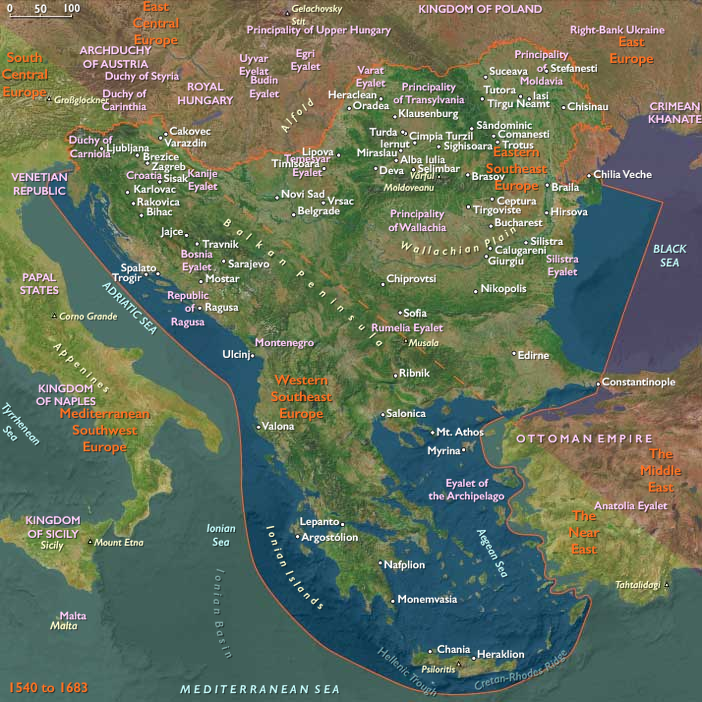
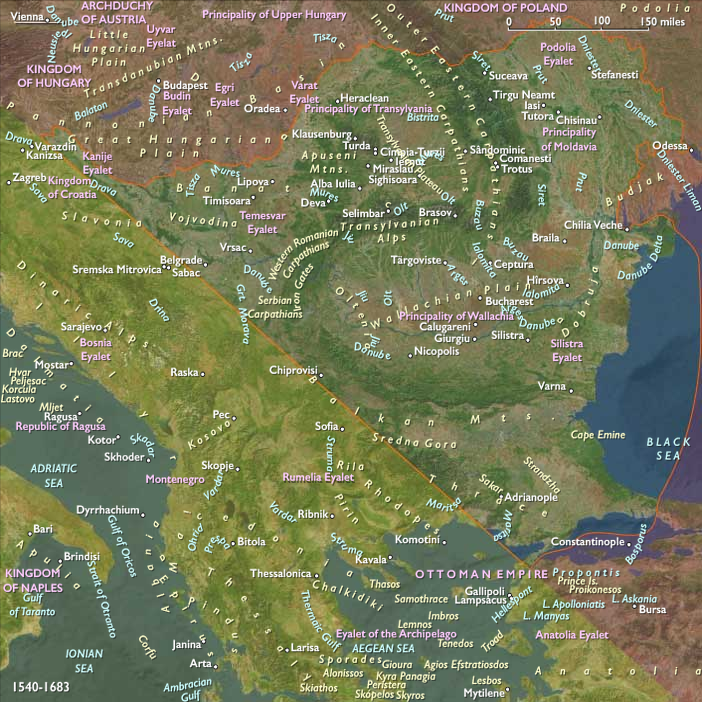
Constantinople becomes the world's largest city in 1650, taking the lead from Beijing.
Locations
Groups
Subjects
Regions
Subregions
Related Events
Filter results
Showing 10 events out of 31777 total
Örgöö (also spelled Urga), founded in 1639 as an initially nomadic yurt-based Buddhist monastic center, is first located in what is now Övörkhangai, around two hundred and fifty kilometers from the present site of Ulan Bator, (the capital of present Mongolia) is mainly intended to be the seat of the first Jebtsundamba Khutughtu, Zanabazar.
The five-year-old Zanabazar, the son of the Tüsheet Khan Gombodorj, ruler of central Khalkha Mongolia and at this time one of the three Khans in Khalkha, had been identified in 1640 as the reincarnation of the scholar Taranatha of the Jonang school of Tibetan Buddhism.
Recognized by the Panchen Lama and the Dalai Lama as being a "Living Buddha", Zanabazar had received his seat at Örgöö as spiritual head of the Gelug lineage of Tibetan Buddhism in Mongolia.
Miraculous occurrences had allegedly taken place during his youth, and in 1647, at the age of twelve, he had founded the Shankh Monastery.
The Rise of Cafés in Europe (c. 1650 Onward)
By 1650, cafés began to emerge as popular social and intellectual hubs in Europe, fueled by the increasing availability of coffee from the Ottoman Empire, the Middle East, and European colonies. Over the following decades, coffeehouses spread rapidly, becoming centers of conversation, commerce, and cultural exchange.
Origins and Spread of Cafés in Europe
-
Introduction of Coffee to Europe
- Coffee was first introduced to Venice in the early 1600s, brought by Ottoman and Middle Eastern traders.
- By the mid-17th century, coffee had spread through Italy, France, England, and the Netherlands, leading to the establishment of dedicated coffeehouses.
-
The First European Cafés (c. 1650–1700)
- 1650 – The first recorded café in England was opened in Oxford, possibly by a Lebanese or Jewish merchant named Jacob.
- 1652 – London’s first coffeehouse, Pasqua Rosée's, opened near the Royal Exchange.
- 1675 – The first French café was established in Marseille; by 1686, the Café Procope in Paris had become a famous meeting place for intellectuals.
- 1683 – After the Battle of Vienna, coffee spread further into Central Europe, particularly in Austria, where Café Frauenhuber and other coffeehouses became part of Viennese culture.
The Role of Cafés in European Society
-
Centers of Intellectual Debate
- Coffeehouses became meeting places for scholars, writers, and merchants, fostering discussions in philosophy, politics, and science.
- In London, cafés were known as “penny universities” because for the price of a coffee, one could engage in intellectual discourse.
-
Business and Finance Hubs
- Some of London’s earliest stock and insurance markets were formed in coffeehouses.
- Lloyd’s of London, the famous insurance market, originated from Edward Lloyd’s Coffeehouse (1686).
-
Cultural and Literary Influence
- Parisian cafés hosted Enlightenment figures such as Voltaire, Diderot, and Rousseau.
- In Austria, cafés became part of Vienna’s artistic and musical life, frequented by composers such as Mozart and Beethoven.
Conclusion: The Birth of European Coffeehouse Culture
By 1650, cafés were becoming popular across Europe, evolving into important social and intellectual institutions. Over time, they became central to cultural movements, economic developments, and political revolutions, laying the foundation for the vibrant coffeehouse culture that persists today.
Van Der Neer's favorite subjects are the rivers and watercourses of his native country either at sunset or after dark.
His peculiar skill is shown in realizing transparency that allows objects even distant to appear in the darkness with varieties of warm brown and steel grays.
Bartholomeus van der Helst, born in Haarlem to an innkeeper, had moved to Amsterdam some time before 1636, for he had been married here in that year.
His first dated picture, a group portrait of the regents of the Walloon Orphanage (currently the location of Maison Descartes in Amsterdam), dates from 1637.
It is unknown from whom he had earned to paint, but in Haarlem he must have at least known the work of Frans Hals, who like him, never traveled to Italy and specialized in portraiture.
Hals refused even to travel to Amsterdam to paint the lucrative schuttersstukken, or city militia, and a few years after the trekschuit (a horse-drawn tugboat specific to the Netherlands) made commuting to Amsterdam possible in 1632, he had attempted this in 1636 with the De Magere Compagnie, but gave it up and let Pieter Codde finish it.
As the son of an innkeeper with ever-increasing trekschuit patrons, van der Helst would have seen immediately the importance of this and the relative value of Amsterdam above Haarlem.
In any case, he had moved to Amsterdam and in 1639 won his own schutterstuk commission, The company of Captain Roelof Bicker and Lieutenant Jan Michielsz Blaeuw.
In Amsterdam he may well have trained with Nicolaes Eliaszoon Pickenoy.
A contemporary of Rembrandt, van der Helst had soon become the most popular painter of portraits in this city, his flattering portrayals in the style of Anthony van Dyck being more immediately appealing than Rembrandt's dark and introspective later work.
Some of Rembrandt's pupils, including Ferdinand Bol and Govaert Flinck, adopt Van Helst's style instead of their master's.
His large group portrait, Banquet of the Amsterdam Civic Guard in Celebration of the Peace of Münster, is painted in 1648, and exhibited to popular acclaim.
French missionaries first encounter the Miami in the mid-seventeenth century, noting many linguistic and cultural similarities between the Miami bands and the Illiniwek.
The Miami, thought by anthropologists to be one of the cultural descendants of the Mississippian culture, are characterized by maize-based agriculture (they seem also to have enjoyed hunting), chiefdom-level social organization, extensive regional trade networks, hierarchical settlement patterns, and other factors.
The name 'Miami' derives from the tribe's name for themselves in their own language, Myaamia (plural Myaamiaki).
(Some sources say that the Miami called themselves the Twightwee (also spelled Twatwa), an onomatopeic reference to their sacred bird, the crane.
However, "Twightwee" appears to in fact be a Delaware name for the Miamis, and some Miamis have stated that this was only a name used by other tribes for the Miamis, and not a name the Miamis used for themselves.
Another common usage was Mihtohseeniaki, "the people.")
The Iroquois begin to attack the French in the early 1650s.
Some of the Iroquois Nations, notably the Oneida and Onondaga, have peaceful relations with the French but are under control of the Mohawk.
The latter are the strongest nation in the Confederacy and are hostile to the French presence.
After a failed peace treaty negotiated by Chief Canaqueese, Iroquois war parties move north into New France along Lake Champlain and the Richelieu River.
They attack and blockade Montreal.
A raid on an isolated farm or settlement typically consists of a war party moving swiftly and silently through the woods, swooping down suddenly, and wielding a tomahawk and a scalping knife to attack the inhabitants.
Prisoners, especially women and children, are in many cases brought back to the Iroquois homelands and are adopted into the nations.
Abraham Wood, sometimes referred to as "General" or "Colonel" Wood, an English fur trader (specifically the beaver and deerskin trades) and explorer of Virginia, is based at Fort Henry at the falls of the Appomattox in present-day Petersburg.
Built in 1646 to mark the legal frontier between the white settlers and the natives, Fort Henry is near the Appomattoc tribe with whom Abraham Wood trades.
From the fort’s inception, and for the next forty-five years or so, it is the only point in Virginia at which natives can be authorized to cross eastward into white territory, or whites westward into native territory.
All natives are at first required to display a badge made of striped cloth while in white territory, or they could be murdered on the spot.
This circumstance gives Wood, who commands the fort and privately owns the adjoining lands, a considerable advantage over his competitors in the "Indian trade".
Several exploration parties are dispatched from Fort Henry by Wood during these years, including one undertaken by Wood himself in 1650, which explores the upper reaches of the James River and Roanoke River.
The prehistoric origins of the Shawnees are uncertain.
The other Algonquian nations regard the Shawnee as their southernmost branch.
Algonquian languages have words similar to the archaic shawano (now: shaawanwa) meaning "south".
However, the stem shaawa- does not mean "south" in Shawnee, but "moderate, warm (of weather)".
In one Shawnee tale, Shaawaki is the deity of the south.
Some scholars have speculated that the Shawnee are descendants of the people of the prehistoric Fort Ancient culture of the Ohio country; other scholars disagree.
No definitive proof has been established.
Europeans report encountering Shawnee over a widespread geographic area.
The earliest mention of the Shawnee may be a 1614 Dutch map showing the Sawwanew just east of the Delaware River.
Later seventeenth-century Dutch sources also place them in this general location.
Accounts by French explorers in this same century usually located the Shawnee along the Ohio River.
According to one legend, the Shawnee are descended from a party sent by Chief Opechancanough, ruler of the Powhatan Confederacy 1618-1644, to settle in the Shenandoah Valley, and led by his son, Sheewa-a-nee, for whom they are named.
Edward Bland, an explorer who accompanies Abraham Wood's expedition in 1650 and writes The Discoverie of New Brittaine, notes that in Opechancanough's day there had been a falling-out between the "Chawan" chief and the weroance of the Powhatan proper (also a relative of Opechancanough's family), and that the latter had murdered the former.
Historian Alan Gallay speculates that the Shawnee migrations of the middle to late seventeenth century were probably driven by the Iroquois Wars that began in the 1640s.
The Shawnee become known for their widespread settlements and migrations, and their frequent long-distance visits to other native groups.
Their language is to become a lingua franca among numerous tribes.
Together with their experience, this will help make them leaders in initiating and sustaining pan-native resistance to European and American expansion.
The Iroquois engage in a wide-ranging campaign of conquest that is unmatched in Native American history.
As they attack northward, they also begin a major expansion to the west along the Great Lakes.
The powerful Neutral nation, numerically equal to the Iroquois but lacking European firearms, inhabit a territory in present southern Ontario ranging from the present-day Niagara Peninsula, westward to the Grand River valley.
The Iroquois, led by the Senecas, launch a strategy of stealth attacks on the Neutrals in 1650.
Cotton has become a commercial slave plantation crop in the West Indies so that by the 1650’s Barbados has become the first British West Indian colony to export cotton.
Years: 1650 - 1650
Locations
Groups
Subjects
Regions
Subregions