Constantine proclaims his fourth (or fifth) son …
Years: 333 - 333
Constantine proclaims his fourth (or fifth) son Constans a caesar in 333.
Locations
People
Groups
Topics
Subjects
Regions
Subregions
Related Events
Filter results
Showing 10 events out of 59871 total
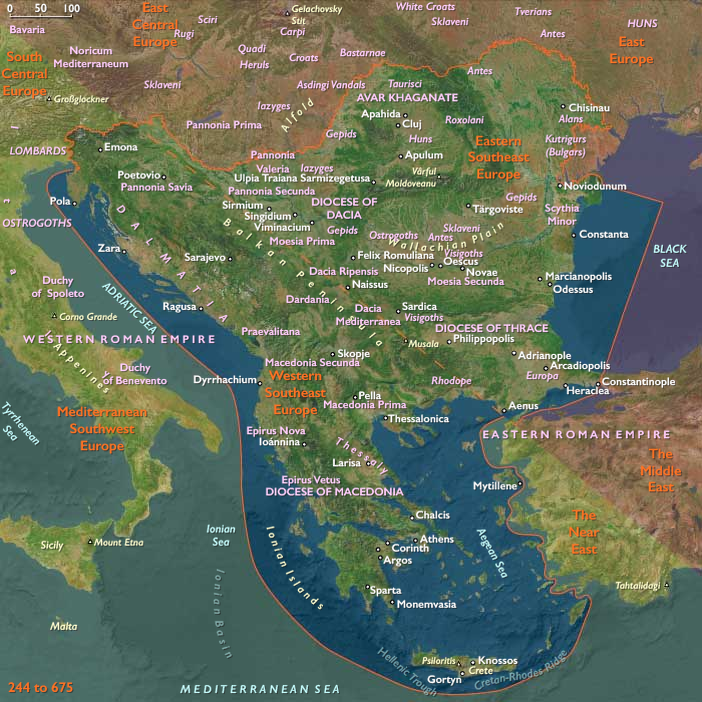
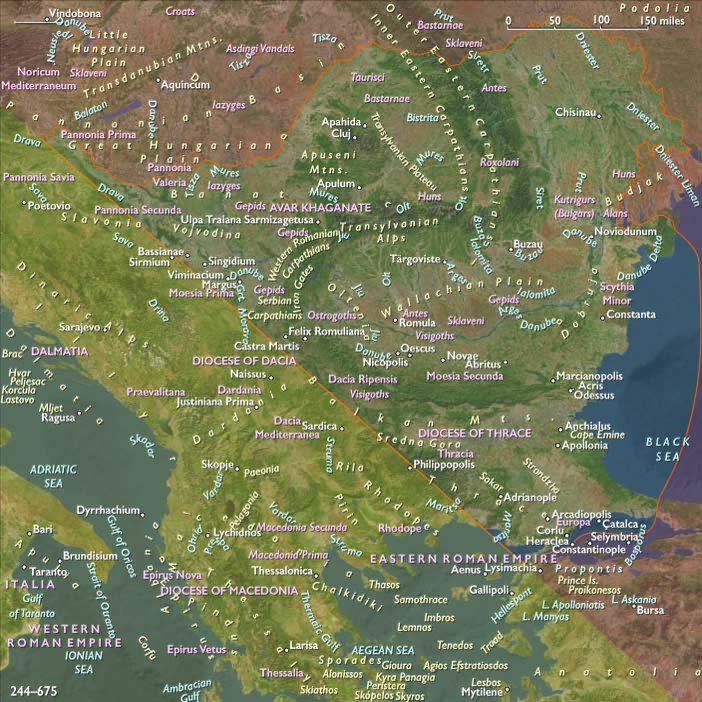
The Sarmatians, having settled in Dacia, find themselves increasingly pressured by Gothic intruders and other tribes.
Answering their appeal for help, Emperor Constantine dispatches his eldest son at the head of a force that crosses the Danube and joins the Sarmatians to rout the Goths and their allies in 332—33.
The ungrateful Sarmatians, having used Rome to dispatch the Goths, begin to raid across the border into the Roman Empire.
Constantine, therefore, encourages the Goths to crush the Sarmatians, doing nothing this time to aid them.
After the Goths overwhelm the Sarmatians, who, he allows about three hundred thousand survivors to settle within the empire.
The Vatican Hill’s huge Basilica of Saint Peter, dedicated by Constantine in about 333, is the first church designed expressly for the Christian liturgical emphasis on the altar as the site for the Christian sacrifice (communion).
Christian Basilicas of the period, closely modeled after the Roman basilica, or civil assembly hall, are typically fronted by a square atrium, or forecourt (reserved for penitents prohibited from entering the church itself) and a narthex (porch) leading to the nave, crossed by a transept (transverse aisle) that separated the nave from the apse, wherein lies the sanctuary.
The semicircular apse of Saint Peter’s Basilica marks the tomb of Peter, over which rises the high altar.
The basilicas’ cruciform plan provides for the worshiper a powerful longitudinal perspective focused on the altar, reinforced by rows of aisle columns.
Sylvester, pope from 314 to 335, is held by Christian tradition to have established the first schola cantorum (literally, "choir school") in Rome; among the first Christian chants are the psalms used in worship, sung in response as two choirs, or as a priest and congregation sing alternate verses.
Shi Hu moves the capital of Later Zhao to Yecheng (in modern Handan, Hebei) in 335.
Here it will remain for the rest of the state's history (except for Shi Zhi's brief attempt to revive the state at Xiangguo).
Both parties meet Constantine at Constantinople at the end of 355.
Athanasius is accused of threatening to interfere with the grain supply from Egypt, and without any formal trial Constantine exiles him to the Rhineland.
At the same synod, another opponent is successfully attacked: Marcellus of Ancyra had long opposed the Eusebians and had protested against the reinstitution of Arius.
Accused of Sabellianism, he will be deposed in 336.
Flavius Dalmatius, the son of Constantius Chlorus and Flavia Maximiana Theodora, and thus half-brother of the Emperor Constantine I, had spent his youth in the Gallic Tolosa.
It is probable that his two sons, Dalmatius and Hannibalianus, were born there.
During the mid-320s, Flavius Dalmatius had returned to Constantinople, to the court of his half-brother, and been appointed consul and censor in 333.
In Antioch, Flavius is responsible for the security of the eastern borders of the realm.
During this period, he examines the case of bishop Athanasius of Alexandria, the important opponent of Arianism, who is accused of murder.
In 334, Flavius had suppressed the revolt of Calocaerus, who had proclaimed himself emperor in Cyprus.
In the following year he sends some soldiers to the council of Tyros to save the life of Athanasius.
The Eusebians, now that Eustathius has been removed, proceed against Athanasius, a much more dangerous opponent.
Athanasius has devoted the first years of his episcopate to visitation of his extensive patriarchate, which includes all of Egypt and Libya.
During this time, …
…Athanasius has established important contacts with the Coptic monks of Upper Egypt and their leader Pachomius.
Soon began the struggle with imperialist and Arian churchmen that will occupy much of his life.
Athanasius is in 334 summoned before a synod in Caesarea; he does not attend.
He uses political influence against the Meletians, followers of the schismatic bishop Meletius of Lycopolis, who have gone back on the plans made at Nicaea for their reunion with the church; but …
…he refutes specific charges of mistreatment of Arians and Meletians before a hostile gathering of bishops, over which Eusebius of Caesarea presides, at Tyre (in modern Lebanon) in 335, which Athanasius refuses to recognize as a general council of the church.
Foreseeing the result, he goes to Constantinople to bring his cause before the emperor.
Murong Huang and his son Murong Jun, who initially claim the Jin Dynasty-created title "Prince of Yan," establish Former Yan, a state of Xianbei ethnicity, in 337.
The Arian leaders, exiled after the Council of Nicaea, have from 325 to the death of Constantine in 337 tried by intrigue to return to their churches and sees and to banish their enemies.
They have been partly successful.
After some months of confusion, the emperor's three surviving sons each adopt the title of Augustus on September 9 and divide the empire among themselves.
Constantius II takes the eastern provinces (Thrace, Macedonia, Greece, Asia, and Egypt) for himself.
Simultaneously, the troops massacre many of his relatives, including Constantine's half-brother, Julius Constantius, consul in 335 and father of the future caesar Gallus and the six-year-old future emperor Julian, who is exiled with the rest of his family to Cappadocia.
(In Julian's 361 Letter to the Athenians, he will openly accuse Constantius of murdering his father.
The historian Eutropius felt the new emperor had “permitted but not ordered” the killings.)
Constantius expands Roman anti-Jewish legislation; Jews are labeled “a pernicious sect”.