Constantine had been preparing to go to …
Years: 338 - 338
Constantine had been preparing to go to war against the Persians at the time of his death in 337.
This legacy weighs heavily on the shoulders of Constantius, a military incompetent when compared to the energetic Shapur, with whom Constantius in 338 becomes engaged in what will prove to be a dozen years of inconclusive but extremely bloody warfare.
The Emperor's death in 337 had allowed Athanasius to return to Alexandria, but Constantius renews the order of banishment in 338.
Locations
People
Groups
- Persian people
- Armenia, Kingdom of
- Persian Empire, Sassanid, or Sasanid
- Christianity, Arian
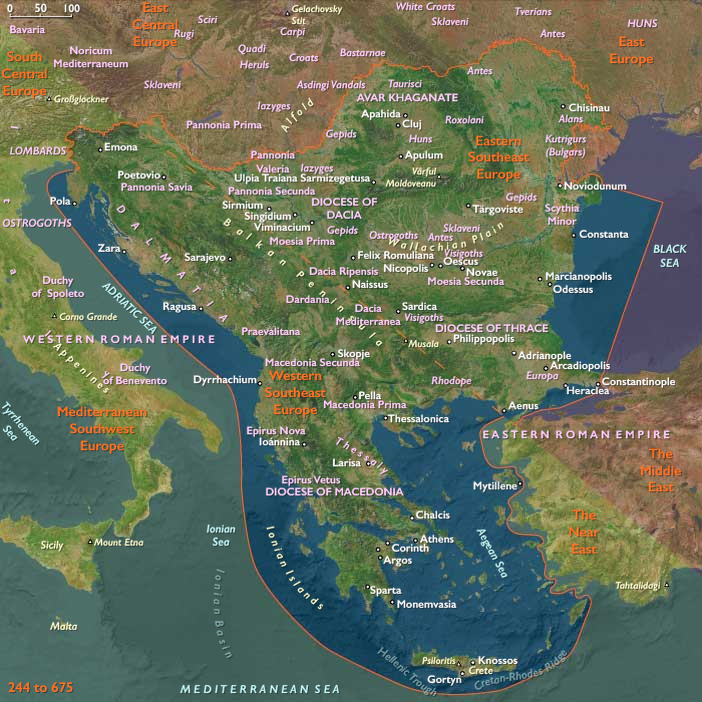
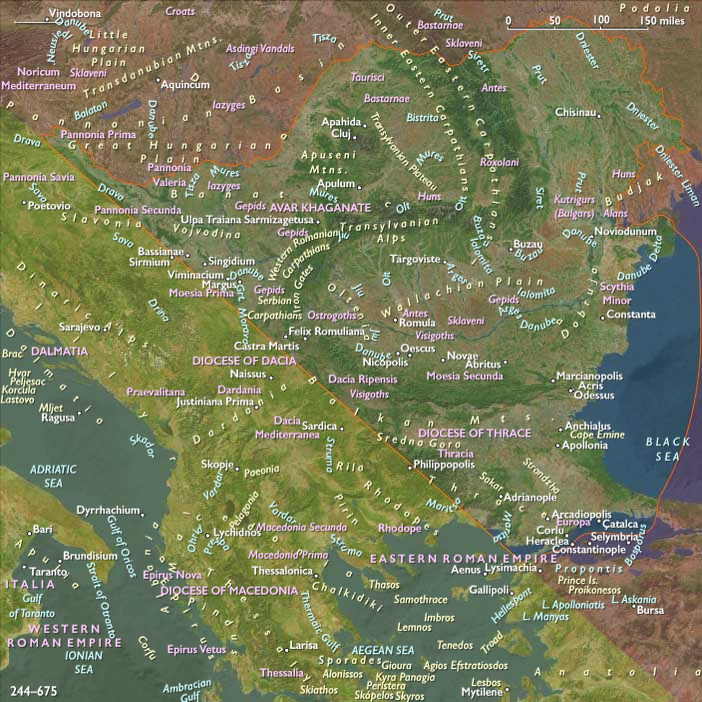
- Thrace, Diocese of
- Christianity, Nicene
- Roman Empire: Constantinian dynasty (Constantinople)
Topics
Commodoties
Subjects
Regions
Subregions
Related Events
Filter results
Showing 10 events out of 59853 total
Li Shou, cousin to Cheng Han's founding emperor Li Xiong, overthrows Li Xiong's son Li Qi in 338, disassociates himself from Li Xiong's regime by renaming the state from Cheng to Han, and sets up a different imperial ancestral temple.
(Traditional historians did not consider his regime a separate state, however, and treated the succession from Li Xiong to Li Shou's son Li Shi as a single Cheng Han state.)
Eusebius of Nicomedia, formerly bishop of Berytus, had been bishop of the seat of the imperial court under Constantine.
(A leading exponent of Arianism, Eusebius was likely a fellow disciple, with Arius, of Lucian of Antioch.)
Although Eusebius signed the formula approved at the Nicaean council declaring the full divinity and equality of Christ with the Father, he had soon begun advocating Arianism with renewed zeal.
This resulted in his banishment by Constantine, but the favor of the empress restored him to his post.
He had employed his growing political and ecclesiastical power to obtain the banishment of Athanasius, in 335.
In 338, Eusebius, who had baptized Constantine as the first Christian emperor shortly before his death, becomes bishop of Constantinople.
Constantius, a weak emperor who relies on his Church advisors, begins a series of anti-Jewish decrees protecting Jewish converts to Christianity, banning Jewish pilgrimages to Jerusalem, and forbidding “on pain of death” Christian intermarriage between Jewish men and Christian women and the circumcision of pagan or Christian slaves.
Constantius also does away with the right of Jews to possess slaves.
This prohibition to trade in and to keep slaves at a time when slave labor is common is not merely an attempt to arrest conversion to Judaism; it is also a blow at the economic life of the Jew, placing Jews at a disadvantage with Christian competitors with whom this economic privilege is assured.
Pachomius sometimes acts as lector for nearby shepherds, but neither he nor any of his monks become priests.
Athanasius of Alexandria had visited in 333 and wished to ordain him, but Pachomius had fled from him.
Athanasius' visit was probably a result of Pachomius' zealous defense of orthodoxy against Arianism.
From his initial monastery, demand has quickly grown and, Pachomius has come to build six or seven more monasteries and a nunnery.
He has from 336 spent most of his time at his Pabau monastery.
The exiled Athanasius has meanwhile made his way to Rome, taking refuge here under the protection of Constans.
Tensions are high in China following the fall of the ethnically Jie Later Zhao regime in 350 by the Chinese state of Ran Wei.
The Jie people, who had formed the Later Zhao Dynasty, do not accept Ran Min's rule and rise against him, and are joined in this by many other Wu Hu nations.
The resulting war is a decisive victory for Ran Min, who then proceeds to issue his famous "extermination order," which results in the extermination of virtually all of the Jie and most of the Wu Hu.
Japan, having assimilated Chinese culture for the past four centuries, develops an extremely complex writing system by adapting the script of China’s monosyllabic language to convey Japanese phonemes.
The Jewish Revolt in Palestine During the Reign of Constantius II (351 CE)
In 351 CE, as Emperor Constantius II struggled to govern the vast Roman Empire alone, he appointed his cousin Gallus as Caesar of the East on March 15, 351 CE, at Sirmium. Gallus arrived in Antioch on May 7, 351 CE, assuming control over the eastern provinces.
During this transition of power, or shortly after Gallus' arrival, a Jewish revolt erupted in Palestine, centered in Diocesarea (modern-day Sepphoris, Israel).
1. Leaders and Messianic Hopes
The rebellion was led by:
- Isaac of Diocesarea (or Sepphoris) – A Jewish leader who mobilized local forces.
- Patricius (also called Natrona) – His name carried messianic connotations, suggesting that he may have been viewed as a deliverer or messianic figure.
These leaders likely capitalized on long-standing Jewish discontent over Roman rule and Christian dominance, intensified under Constantius II, who strongly favored Christianity.
2. The Course of the Revolt
- The rebellion began with a night attack on a Roman garrison, which was destroyed, allowing the rebels to seize weapons.
- After securing arms, the insurgents expanded their attacks, targeting:
- Greeks, who were often aligned with Roman authority.
- Samaritans, long-standing rivals of Jewish factions in the region.
- The revolt quickly spread, raising concerns in Rome’s eastern provinces about regional instability.
3. Roman Response and Gallus’ Brutal Suppression
- As the Caesar of the East, Gallus was responsible for restoring order.
- He dispatched his general, Ursicinus, to crush the rebellion with overwhelming force.
- Roman legions retaliated harshly, leading to:
- Mass executions of Jewish rebels.
- The destruction of Diocesarea, the heart of the uprising.
- Widespread devastation in Galilean towns, discouraging future resistance.
4. Consequences of the Revolt
- The Jewish population of Palestine suffered severe losses, with many killed, enslaved, or displaced.
- Roman authorities increased their crackdown on Jewish communities, further limiting their autonomy and rights.
- The revolt deepened Jewish-Christian tensions, as Christian Roman officials saw the uprising as a threat to imperial stability.
- This rebellion was one of the last major Jewish revolts in the Roman East, marking the continued decline of Jewish political influence in Palestine.
5. Conclusion: A Failed Revolt and Its Aftermath
While the revolt in Palestine of 351 CE was short-lived, its brutal suppression reaffirmed Roman dominance and highlighted:
- The fragility of Jewish-Roman relations under a Christianized empire.
- The ruthlessness of Gallus, whose harsh rule would eventually lead to his own downfall in 354 CE.
- The gradual decline of Jewish resistance in the region, as repeated uprisings failed to restore independence.
This largely forgotten rebellion was one of the last Jewish armed uprisings in antiquity, overshadowed by earlier revolts but still a testament to the ongoing resistance against Roman and Christian rule.

Constantius II and the Intensification of Religious Conflict in the Roman Empire (337–361 CE)
Following the death of Constantine the Great in 337 CE, his son Constantius II ascended as sole emperor by 353 CE after defeating his brothers and rivals. Like his father, he strongly favored Christianity, but he went further by actively suppressing both paganism and Judaism, leading to heightened religious tensions across the empire.
1. Christian Persecution of Pagans and Jews
- Unlike Constantine, who had maintained a degree of religious tolerance, Constantius II permitted the persecution of non-Christians.
- He issued edicts closing pagan temples and banning animal sacrifices, striking at the core of Roman traditional religious practices.
- He also placed restrictions on Jewish religious practices, including:
- Banning Jewish conversions to Christianity or paganism.
- Prohibiting the construction of new synagogues while allowing churches to be built.
2. Christian Clergy and Religious Intolerance
- Some Christian bishops and clergy took advantage of imperial favor, using secular authorities to persecute non-Christians.
- In many regions, violent Christian mobs, sometimes incited by clergy, destroyed synagogues and pagan temples.
- This fueled resentment and backlash from both Jews and traditional Roman elites, who saw imperial policies as an attack on their ancestral traditions.
3. Jewish Resistance and Hostility Toward Converts
- As persecution intensified, Jewish communities became increasingly resistant to Christian proselytism.
- Jewish leaders condemned Jewish converts to Christianity, often ostracizing or excommunicating them.
- To express their opposition to Roman rule, some Jewish preachers used veiled references in synagogues, invoking:
- Edom, a biblical symbol of foreign oppression, as a metaphor for Rome’s suppression of Judaism.
- Passages in Jewish sermons that criticized imperial policies and Christian encroachments.
4. The Growing Religious Divide in the Empire
- The repression of paganism and Judaism under Constantius II further polarized religious communities, deepening divisions between:
- Christians and pagans, as traditional Roman elites resisted Christian dominance.
- Christians and Jews, as imperial policies pushed Jewish communities into active defiance.
- These tensions would continue to shape imperial policies, leading to later imperial interventions in religious disputes, particularly under Theodosius I (r. 379–395 CE), who would make Christianity the official state religion.
Conclusion: A New Phase of Religious Conflict in the Roman Empire
Under Constantius II, the Christianization of the empire became more aggressive, marking a shift from imperial favoritism to outright suppression of other faiths. This period:
- Weakened traditional Roman religion, paving the way for its eventual elimination as the state faith.
- Exacerbated Jewish-Christian relations, leading to centuries of hostility and legal discrimination against Jewish communities.
- Fueled opposition from pagans, setting the stage for later pagan revivals, including Julian the Apostate’s reign (361–363 CE).
Constantius II’s religious policies not only strengthened Christianity’s dominance but also deepened religious and social conflicts within the late Roman Empire, shaping its future trajectory.
East Central Europe (340–351 CE): Rising Frontier Tensions and Regional Realignments
Between 340 and 351 CE, East Central Europe—covering Poland, Czechia, Slovakia, Hungary, and those portions of Germany and Austria lying east of 10°E and north of a line stretching from roughly 48.2°N at 10°E southeastward to the Austro-Slovenian border near 46.7°N, 15.4°E—began facing increased frontier pressures following the death of Constantine the Great (337 CE). Internal Roman political divisions weakened frontier stability, prompting growing assertiveness among tribal groups, notably the Goths, while the recently settled Rugii continued to consolidate their presence in Roman Pannonia. The proto-Slavic communities of Eastern Europe remained stable but increasingly felt external pressures amid shifting regional dynamics.
Political and Military Developments
Post-Constantine Frontier Instability
-
Constantine’s death (337 CE) triggered internal political instability among his successors, weakening Roman control over the Danube provinces (Pannonia Superior, Pannonia Inferior, and Noricum) and creating vulnerabilities along the frontier.
-
Frontier defenses, while still robust, became strained by periodic tribal incursions and internal Roman power struggles.
Growing Gothic Pressure
-
The Goths intensified their pressure and influence in Eastern Europe, increasing incursions along the Danube frontier. While large-scale invasions were limited, frequent smaller raids and diplomatic tensions heightened regional insecurity.
Rugian Stability in Pannonia
-
The Rugii, settled along the upper Tisza, maintained stable relations with Roman authorities despite the increasing instability. Their settlements provided a stabilizing influence on local frontier dynamics.
Economic and Technological Developments
Economic Stress along the Frontier
-
Growing tensions led to disruptions in frontier trade, though economic exchanges continued cautiously between Roman provinces, Rugian settlements, and neighboring tribal communities.
Continued Infrastructure Maintenance
-
Roman frontier infrastructure maintenance continued at a reduced pace due to internal divisions and resource constraints, emphasizing defensive fortifications and critical trade routes.
Cultural and Artistic Developments
Adaptive Cultural Expressions
-
Cultural and artistic production adapted to regional uncertainties, increasingly reflecting defensive themes in metalwork, pottery, and jewelry. Nevertheless, cultural interactions and exchanges between Romans, Rugii, and neighboring tribes persisted.
Continued Proto-Slavic Cultural Resilience
-
Proto-Slavic communities maintained stable cultural identities despite growing Gothic dominance, preserving traditional customs and lifestyles.
Settlement and Urban Development
Frontier Town Fortifications Strengthened
-
Roman frontier settlements (Carnuntum, Vindobona, Aquincum) focused heavily on defensive enhancements due to growing regional instability, with limited economic and demographic expansion.
Rugian Settlement Consolidation
-
Rugian settlements along the upper Tisza further solidified their presence, strengthening local economic ties and integrating into frontier dynamics, providing stability amid regional tensions.
Social and Religious Developments
Rugian Leadership Stability
-
Rugian tribal structures remained stable, successfully balancing diplomatic cooperation with Roman authorities and independent tribal governance.
Proto-Slavic Community Cohesion
-
Proto-Slavic societies sustained stable internal social structures and religious practices, reinforcing community resilience amidst growing external pressures.
Long-Term Consequences and Historical Significance
The era 340–351 CE marked the beginning of renewed frontier tensions in East Central Europe following Constantine’s death. Growing Gothic assertiveness and internal Roman instability signaled challenges ahead, even as Rugian and proto-Slavic communities maintained relative stability. These shifting dynamics foreshadowed intensified regional conflicts and realignments, significantly influencing the subsequent historical development of the region.
Years: 338 - 338
Locations
People
Groups
- Persian people
- Armenia, Kingdom of
- Persian Empire, Sassanid, or Sasanid
- Christianity, Arian
- Thrace, Diocese of
- Christianity, Nicene
- Roman Empire: Constantinian dynasty (Constantinople)