
Constantine goes far beyond the joint policy …
Years: 313 - 313
Constantine goes far beyond the joint policy agreed upon at Mediolanum, however.
He has seemingly lived until now as a tolerant pagan, uncommitted to any one deity, but now begins gradually to adopt the Christian God as his protector.
By 313, he has already donated to the Bishop of Rome the imperial property of the Lateran, where a new cathedral, the Basilica Constantiniana (now S. Giovanni in Laterano), will soon rise.
The Church of St. Sebastian is also probably begun at this time.
Throughout his life, Constantine will ascribe his success to his conversion to Christianity and the support of the Christian God.
The triumphal arch erected in his honor at Rome after the defeat of Maxentius ascribes the victory to the “inspiration of the Divinity” as well as to Constantine's own genius.
A statue set up at the same time shows Constantine himself holding aloft a cross and the legend “By this saving sign I have delivered your city from the tyrant and restored liberty to the Senate and people of Rome.” The three-centuries long career of the privileged, politically influential Praetorian Guard ends when Constantine disbands it in 313.
A colossal head of Constantine, executed around 313, features blocklike facial planes and bulging eyes, whose off-center pupils gaze heavenward; the hair is a schematic cap.
Miltiades, pope from 311, had become the first pope after the edicts of toleration by the Roman emperors Galerius (ending the persecution of Christians), Maxentius (restoring church property to Miltiades), and Constantine (favoring Christianity).
Concurrently, however, dissension within the church has been caused by the Donatists, North African schismatics who contest the election of Caecilian as bishop of Carthage, championing the election and ordination of their bishop, the theologian Donatus.
At the Lateran Council of 313, Miltiades supports Caecilian and condemns the Donatists, who refuse to submit.
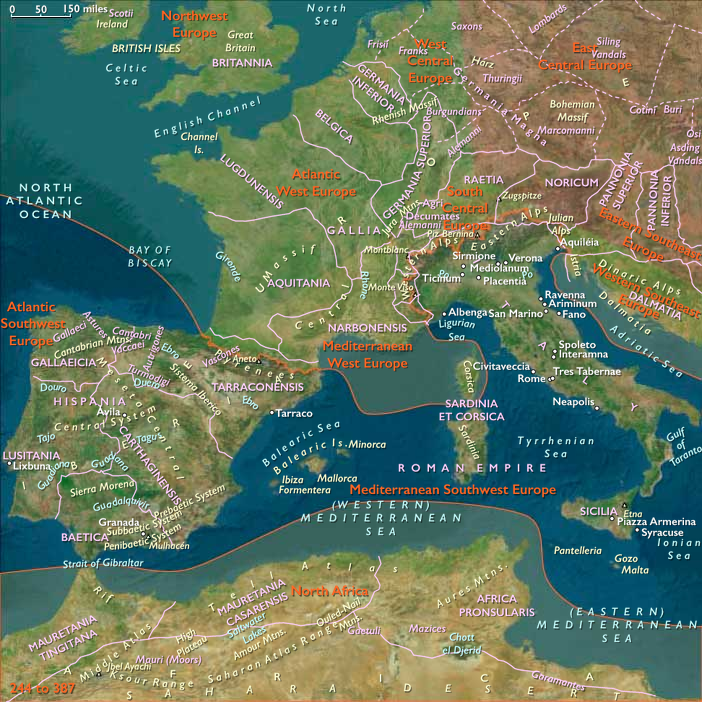
Constantine then orders the Council of Arles (Arelate), the first representative meeting of Christian bishops in the Western Roman Empire, but Miltiades dies before the council convenes.
(The modern Roman Catholic Church considers him a martyr because of earlier sufferings under the Roman emperor Maximian.)
Locations
People
Groups
Topics
- Portraits, Classical
- Roman Age Optimum
- Late Antiquity
- Diocletianic Persecution
- Civil wars of the Tetrarchy
- Roman Civil War of 313
Commodoties
Subjects
- Commerce
- Symbols
- Architecture
- Environment
- Labor and Service
- Conflict
- Mayhem
- Faith
- Government
- Custom and Law
- Technology
- Theology
Regions
Subregions
Related Events
Showing 10 events out of 59967 total
Years: 313 - 313
Locations
People
Groups
Topics
- Portraits, Classical
- Roman Age Optimum
- Late Antiquity
- Diocletianic Persecution
- Civil wars of the Tetrarchy
- Roman Civil War of 313
Commodoties
Subjects
- Commerce
- Symbols
- Architecture
- Environment
- Labor and Service
- Conflict
- Mayhem
- Faith
- Government
- Custom and Law
- Technology
- Theology
Regions
Subregions