
Conrad, having taken ship from Constantinople, had …
Years: 1148 - 1148
May
Conrad, having taken ship from Constantinople, had eventually reached Acre in April 1148.
After Conrad’s arrival, a brilliant muster of French and German notables assembles with Queen Melisende, her nineteen-year-old son and co-ruler Baldwin III, and the barons of Jerusalem to discuss how best to proceed.
Despite the absence of the northern princes and the losses already suffered by the crusaders, it is possible to field an army of nearly fifty thousand men, the largest Crusade army so far assembled.
There are a number of choices for the target of the crusade.
In northern Syria, Edessa is firmly in the control of Nur ad-Din; its count, Joscelin II, is in captivity and there is no hope of retrieving him or the city, so the matter, so important to the original call for the crusade, is apparently not even discussed.
In Antioch, Raymond of Poitiers had tried to convince Louis to attack Aleppo, Nur ad-Din's capital and the greatest threat to that city, but Raymond and Louis have quarreled (partly over rumors of an incestual relationship between Eleanor and the prince) and Raymond is not present at the Council.
The County of Tripoli is also unrepresented, although an attack on Aleppo would benefit Tripoli as well; however, the rule of Raymond II of Tripoli is challenged by Alfonso Jordan, Count of Toulouse, his cousin, and when Alfonso is poisoned on the way to the Council, Raymond is implicated in his murder.
Conrad and Louis are, in any case, unconcerned with matters in northern Syria; for them, pilgrimage to Jerusalem is an inherent part of the crusading vow, and defense of Jerusalem is of utmost importance.
In the south, the most immediate threats to Jerusalem come from Fatimid-held Ascalon and the Burid Emirate of Damascus.
The crusade has coincidentally arrived during a political crisis in Jerusalem: King Baldwin III has ruled jointly with his mother Melisende since the death of King Fulk of Jerusalem in 1143, when Baldwin was only thirteen years old; but Baldwin is now eighteen and wishes to assert his authority.
The option of Ascalon does not suit Baldwin, since his brother Amalric, who supports their mother, is already Count of Jaffa and Ascalon would have been added to his territory.
Ascalon has also been contained by a number of castles built during the reign of Fulk and is not an immediate threat.
The capture of Damascus, on the other hand, would benefit Baldwin; despite being a sometime-ally of Jerusalem, Nur ad-Din also desires it, and capturing it would help limit the emir's power.
It would please Conrad and Louis, who are interested in capturing a city that, unlike Ascalon, is important to the history of Christianity.
After considerable debate reflecting the conflicting purposes of crusaders and Jerusalem barons, it is decided to attack Damascus.
Locations
People
- Amalric I of Jerusalem
- Baldwin III of Jerusalem
- Conrad III of Germany
- Eleanor of Aquitaine
- Joscelin II of Edessa
- Louis VII of France
- Melisende
- Mu'in ad-Din Unur
- Nur ad-Din Zengi
- Raymond of Poitiers
Groups
- Berber people (also called Amazigh people or Imazighen, "free men", singular Amazigh)
- Egypt in the Middle Ages
- Muslims, Sunni
- Muslims, Shi'a
- Ismailism
- Fatimid Caliphate
- Christians, Roman Catholic
- Christians, Eastern Orthodox
- Aleppo, Seljuq Emirate of
- Jerusalem, Latin Kingdom of
- Palestine, Frankish (Outremer)
- Damascus, Burid Emirate of
- Burid dynasty
- Zengid dynasty of Syria
Topics
Commodoties
Subjects
Regions
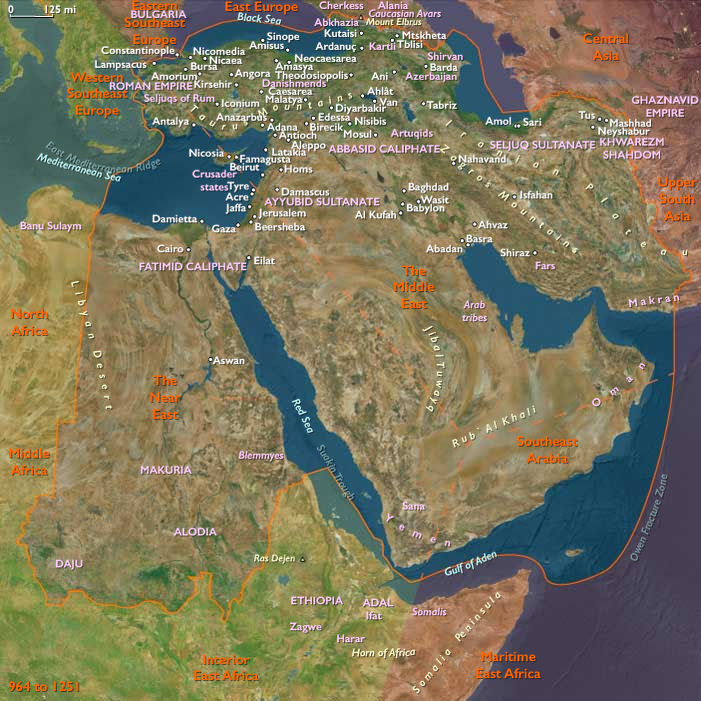
Subregions
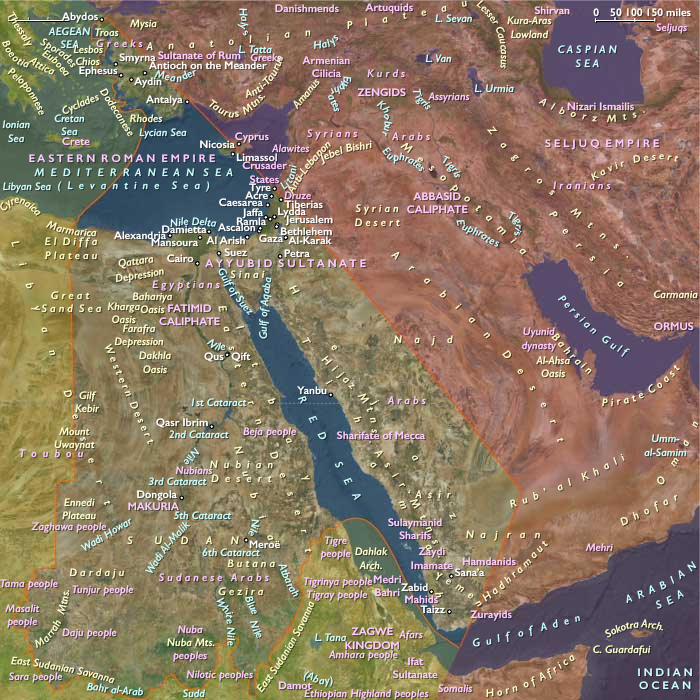
Years: 1148 - 1148
May
Locations
People
- Amalric I of Jerusalem
- Baldwin III of Jerusalem
- Conrad III of Germany
- Eleanor of Aquitaine
- Joscelin II of Edessa
- Louis VII of France
- Melisende
- Mu'in ad-Din Unur
- Nur ad-Din Zengi
- Raymond of Poitiers
Groups
- Berber people (also called Amazigh people or Imazighen, "free men", singular Amazigh)
- Egypt in the Middle Ages
- Muslims, Sunni
- Muslims, Shi'a
- Ismailism
- Fatimid Caliphate
- Christians, Roman Catholic
- Christians, Eastern Orthodox
- Aleppo, Seljuq Emirate of
- Jerusalem, Latin Kingdom of
- Palestine, Frankish (Outremer)
- Damascus, Burid Emirate of
- Burid dynasty
- Zengid dynasty of Syria
Topics
Commodoties
Subjects
Regions
Subregions