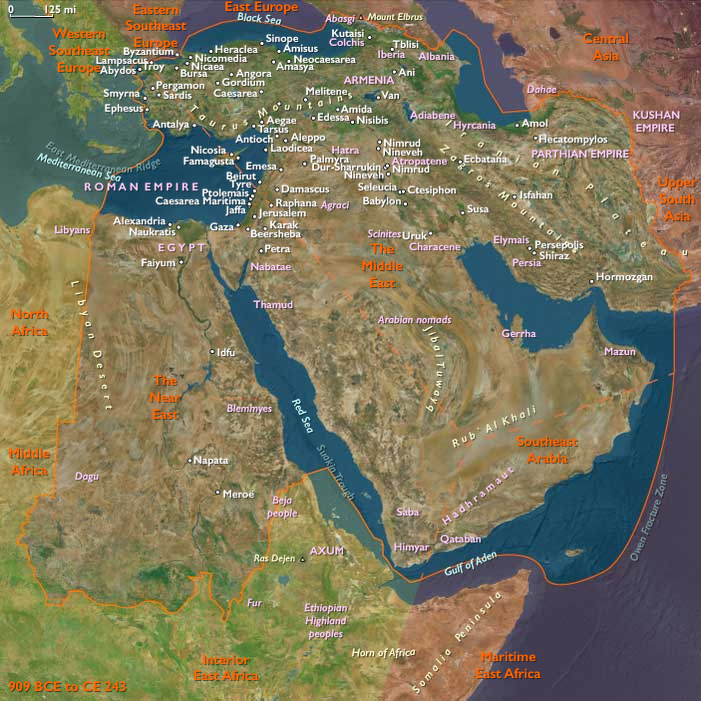
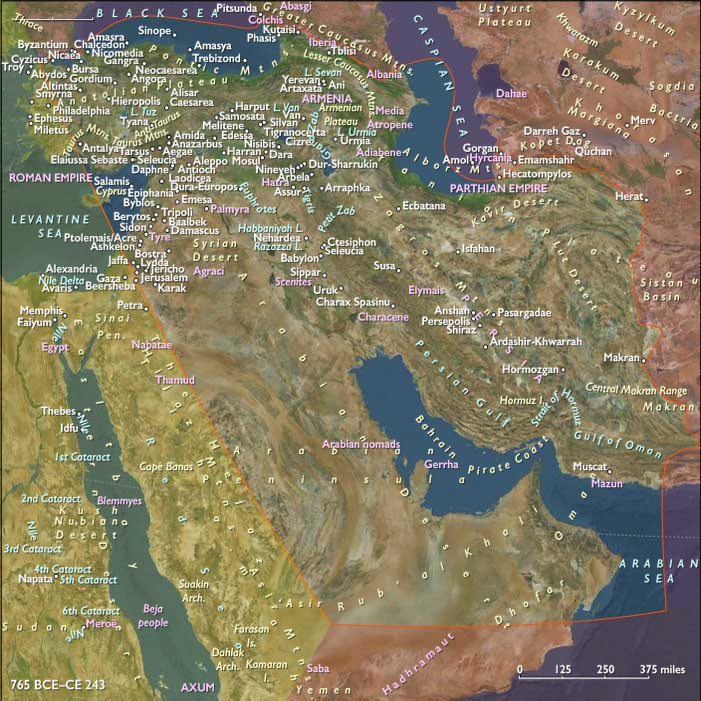
…conquers Characene, overstriking coins of Hyspaosines and …
Years: 121BCE - 121BCE
…conquers Characene, overstriking coins of Hyspaosines and driving him from his capital in 122 or 121.
Locations
People
Groups
Topics
Commodoties
Subjects
Regions
Subregions
Related Events
Filter results
Showing 10 events out of 62981 total
Grypus (hook-nose) has become less controllable as he has grown up.
In 121 BCE, Cleopatra Thea decides to eliminate him.
As he returns from a hunt one day, she offers him a cup of wine.
Since this is not common behavior for her, Grypus is suspicious and forces her to drink the wine, which kills her.
(The story may have been inspired by the fact that Grypus was interested in toxicology; some poems about poisonous herbs believed to have been written by him are quoted by the famous physician Galen).
Hyspaosines' troops had moved north and occupied Babylon and Seleucia probably sometime in 127, when the Parthians were fighting nomadic invaders in the eastern part of their territory.
His rule there must have been short, however, for the Parthian governor of Babylon and the north, Himerus, was back in Seleucia and Babylon by 126.
Himerus cannot have been a rebel, since he strikes coins in the name of the Parthian rulers Phraates II and Artabanus II, both of whom had been killed in fighting in eastern Iran.
Himerus abuses his power and is said to have oppressed the cities of Mesopotamia, plundering them and killing their inhabitants.
Cuneiform documents from Babylon stop after this date, indicating that the city does not survive the depredations of Himerus.
He vanishes, however, and Parthian sovereignty is restored by the ninth Arsacid king, Mithridates II, who comes to the throne about 124; he is the son of Artabanus II, who had been slain fighting the Sakas.
Mithridates recovers all Mesopotamia and …
Rome, to protect its ally Massilia and ensure communications with Spain, annexes a strip of territory between the Cevennes and the Alps in 121, establishing the first Roman province in France, Gallia Transalpina ("Gaul across the Alps"), an area roughly equivalent to the modern Provence and Languedoc, and later known as Gallia Narbonensis ("Narbonese Gaul").
The Provençal city of Nimes, located about 65 miles (105 kilometers) northwest of Massilia, comes under Roman control but its continued importance is assured by its location on the Via Domitia, the main Roman road between northern Italy and Spain.
The Roman proconsul Domitius Ahenobarbus undertakes a war in 121 BCE against the Allobroges, who have allied with the Arverni under Bituitus.
These Gallic tribes are defeated near the town of Vindalium, the current French town of Bédarrides.
After this defeat, the Allobroges and Arverni make preparations to renter battle with the Romans.
Bituitus again takes the field with an large army.
Where the Isar meets the river Rhone in the south of France, the consul Fabius Maximus, the grandson of Paullus, meets them in battle in the autumn of 121 BCE.
The Romans are greatly outnumbered yet manage to gain a complete victory.
It is estimated that 120,000 of Bituitus' army fell in the battle.
Following his defeat, Bituitus is taken prisoner and sent to Rome.
The Arverni had once been the most powerful tribal hegemony in Gaul during the third and second centuries BCE under their king, Luernios, but with the defeat of his son (or grandson) Bituitus, their ascendancy passes to the Aedui and Sequani.
Unlike the Allobroges, who have been brought under direct Roman rule as a result of the Celtic wars of the 120s, the Arverni negotiate a treaty that preserves their independence, though their territory is diminished.
No further Arvernian kings are mentioned in the historical record, and they may have adopted a constitutional oligarchy at this time.
Opponents of Gaius’s reforms appeal to disparate interests among the Roman factions to deny Gaius their support, but he narrowly wins election to a second term as tribune.
The patrician Marcus Livius Drusus, set up as tribune by the Senate in 121 BCE to undermine Gaius Gracchus' land reform bills, leads a conservative faction that works to disgrace the reformer.
To do this, he proposes creating twelve colonies with three thousand settlers each from the poorer classes, and relieving rent on property distributed since 133 BCE.
He also says the Latin allies should not be mistreated by Roman generals, which is the counteroffer to Gaius' offer of full citizenship.
These are known as the Leges Liviae, but they are never enacted, because the Senate simply wants to draw support away from Gracchus.
Their plan is successful and Drusus has enough support to veto Gaius' bill.
When Gaius fails to win election to a third tribunate, he assembles armed followers to oppose the repeal of his legislation.
A murder results, and the Senate for the first time passes the senatus consultum ultimum (extreme decree of the senate), declaring a state of emergency.
Gaius is killed during the subsequent mob violence, in which 3000 of his plebeian followers also die.
Both Gaius and his brother Tiberius had intended their reforms to deal with urgent problems, but they also designed them to strengthen themselves in their rivalry with other senators.
Their deaths open Rome to anarchy and civil war.
The Gracchi’s attempts at reform also herald the beginning of two political groupings in the Senate: the “Optimates,” the conservative "good men," and the “Populares,” who agitate for reforms, are not political parties but rather representative of trends, or tendencies.

Quintus Fabius Maximus Allobrogicus, successful in his conquest of Gallia Transalpina, is awarded the honor of a triumph and given the agnomen Allobrogicus.
The triumph he holds becomes famous for its spectacle, including the captive Arvernian king Bituitus in his silver ceremonial armor.
From the plunder of the Auvergne, Fabius erects the Fornix Fabianus (121 BCE; since destroyed) crossing the Via Sacra at the Forum Romanum and and adorns it with a statue of himself; it is the earliest such construction in the Roman Forum.
Bituitus is sentenced by the senate to exile in Alba Fucens, one of three foreign kings known to have been held there (the others are Syphax of Numidia and Perseus of Macedonia).
Bituitus' son, Congonnetiacus, had also been captured, and is possibly held with him at Alba.
It is to be the last time a foreign king is detained at Alba, and throughout the rest of the Late Republican period, kings are known to have been detained at Rome, often in the homes of high-ranking officials, and to have agitated actively in political affairs.
The northeastern Anatolian kingdom of Pontus has become a friend and ally of Rome by the time Mithridates V is assassinated in about 120 BCE in Sinope, poisoned by persons unknown at a lavish banquet that he holds.
In his will, he leaves the Kingdom to the joint rule of Laodice VI, Mithridates and his younger brother, Mithridates Chrestus.
Mithridates and his younger brother are both underage to rule and their mother retains all power as regent.
(Mithridates, a common surname among Anatolian rulers of the age, means gift of [the god] Mithra.”)
Rome establishes a colony at Beziers, occupied since Neolithic times, before the influx of Celts, in southeastern France twelve miles (twenty kilometers) from the Mediterranean coast, situated on a hill overlooking the Orb River at its junction with the Canal du Midi.
Family conflicts had begun to cripple Egypt’s Hellenistic Ptolemaic dynasty when Ptolemy VIII Euergetes II, or Physcon, fought his brother Ptolemy VI Philometor and briefly seized the throne.
The struggle has been continued by his sister and niece (who have both become his wives).
Physcon quarrels constantly with his sister and first queen, Cleopatra II, the widow of his brother Ptolemy VI Philometor, with whom he rules Egypt, together with her daughter Cleopatra III, except for a brief period during 131-130, when Cleopatra II was in revolt and Physcon was exiled, together with Cleopatra III, his niece and second wife.
They finally issue an Amnesty Decree in 118 BCE, but the long war has shattered Egypt’s internal stability.
Physcon’s reign has been marked by generous benefactions to the Egyptian temples, but the Greeks detest him as a tyrant, and the historical accounts of the reign emphasize his stormy relations with the Alexandrian populace.
Having caused civil war and economic collapse in Egypt, he institutes extensive reforms in 118 to restore the country.
He maintains control over Cyrenaica and …