
Conflicts among the Muslim leaders had hindered …
Years: 682 - 682
Conflicts among the Muslim leaders had hindered Muslim territorial expansion, especially after the assassination of the third caliph, 'Uthman ibn 'Affan, in 656.
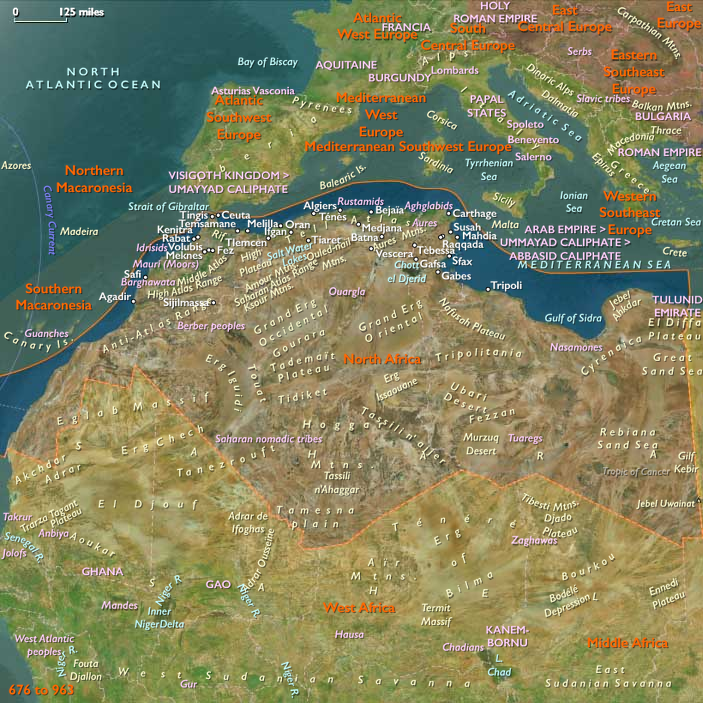
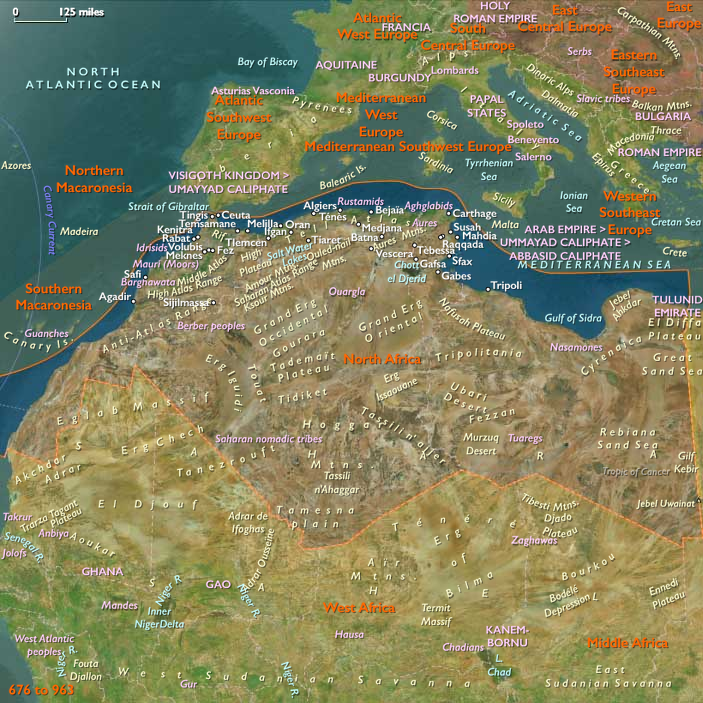
Only after the Umayyads had consolidated their authority as a caliphal dynasty in the 660s, and had come to view the conquest of the Maghreb in the context of their confrontation with the Empire, had they systematically undertaken this conquest.
Uqba ibn Nafi, a member of the Banu Quraysh, had commanded the Arab army that occupied Tunisia in 670 and, before his recall in 674, had founded the town of Kairouan as the first center of Arab administration in the Maghreb.
Abu al-Muhajir Dinar was originally a slave of Maslama ibn Mukhallad, a member of the Ansar, who had given him his freedom.
Maslama, one of the Prophet Muhammad's companions, had been appointed by the first Umayyad caliph, Muawiyah I, to the position of governor of Egypt and Ifriqiya.
The inclusion of Ifriqiya was nominal, as until then the Arabs had made only temporary raids in that direction without attempting permanent control.
Maslama had in 675 appointed Abu al-Muhajir to the position of amir or general of the Umayyad forces in Ifriqiya, a post already held by Uqba.
Maslama had advised Abu al-Muhajir to relieve Uqba of his position with due deference, but it seems that this did not happen.
Uqba was shackled and thrown into prison, from which he was only released when the Caliph requested to see him.
As Uqba left Ifriqiya for Damascus, he had vowed to treat Abu al-Muhajir as he had been treated.
What Abu al-Muhajir accomplished in the nine or so years of his command are not agreed upon by two different versions of history.
Histories written in the ninth century credit him with advancing no further west than Mila, Algeria, while those written from the eleventh century on have him capturing Tlemcen.
Muawiyah's successor as Caliph, Yazid I, is responsible for restoring Uqba in 681 to his previous position.
Uqba arrives in Ifriqiya in 682, and immediately fulfills his vow: Abu al-Muhajir is shackled and forced to accompany Uqba whenever he goes on expeditions.
Abu al-Muhajir having initiated the conquest of the Maghreb west of Tunisia, the Arabs have had to fight semi-settled Berber communities that have developed some tradition of centralized political authority.
In the course of his campaign, Abu al-Muhajir had prevailed on the Berber “king” Kusaila to become Muslim.
From his base in Tlemcen, Kusaila dominates a confederation of the Awraba tribes living between the western Aurès Mountains and the area of present-day Fès.
Since Kusaila’s profession of Islam implies his recognition of caliphal authority, it has served as a basis for coexistence between him and the Arabs.
However, after Uqba had been reinstated as commander of the Arab army in the Maghreb, he had insisted on imposing direct Arab rule over the whole region.
He leads his troops in 682 across Algeria and …
Locations
People
Groups
- Arab people
- Berber people (also called Amazigh people or Imazighen, "free men", singular Amazigh)
- Moors
- Quraysh (Arabic tribe)
- Visigothic Kingdom of Spain
- Africa, or Carthage, Exarchate of
- Roman Empire, Eastern: Heraclian dynasty
- Islam
- Egypt in the Middle Ages
- Muslims, Sunni
- Umayyad Caliphate (Damascus)
- Ifriqiya, Ummayad
Topics
- Migration Period
- Migration Period Pessimum
- Arab-Byzantine Wars
- Muslim conquest of the Maghreb
- Fitna, Second, or Second Islamic Civil War
- Biskra, Battle of
Commodoties
Subjects
Regions
Subregions
Related Events
Showing 10 events out of 56015 total
Years: 682 - 682
Locations
People
Groups
- Arab people
- Berber people (also called Amazigh people or Imazighen, "free men", singular Amazigh)
- Moors
- Quraysh (Arabic tribe)
- Visigothic Kingdom of Spain
- Africa, or Carthage, Exarchate of
- Roman Empire, Eastern: Heraclian dynasty
- Islam
- Egypt in the Middle Ages
- Muslims, Sunni
- Umayyad Caliphate (Damascus)
- Ifriqiya, Ummayad
Topics
- Migration Period
- Migration Period Pessimum
- Arab-Byzantine Wars
- Muslim conquest of the Maghreb
- Fitna, Second, or Second Islamic Civil War
- Biskra, Battle of
Commodoties
Subjects
Regions
Subregions