
Conflicting accounts shroud the details of the …
Years: 224 - 224
Conflicting accounts shroud the details of the fall of the Parthian Empire and subsequent rise of the Sassanid Empire in mystery.
One Babak, a descendant of a line of the priests of the goddess Anahita, was originally the ruler of a region called Kheir.
However, by the year 200, he had managed to overthrow Gocihr, and appoint himself as the new ruler of the Bazrangids.
His mother, Rodhagh, was the daughter of the provincial governor of Persis.
Babak and his eldest son Shapur managed to expand their power over all of Persis.
The subsequent events are unclear, due to the sketchy nature of the sources.
It is certain, however, that following the death of Babak, Ardashir, who at the time was the governor of Darabgird, got involved in a power struggle of his own with his elder brother Shapur.
Sources reveal that Shapur, leaving for a meeting with his brother, was killed when the roof of a building collapsed on him.
By the year 208, over the protests of his other brothers who were put to death, Ardashir had declared himself ruler of Persis.
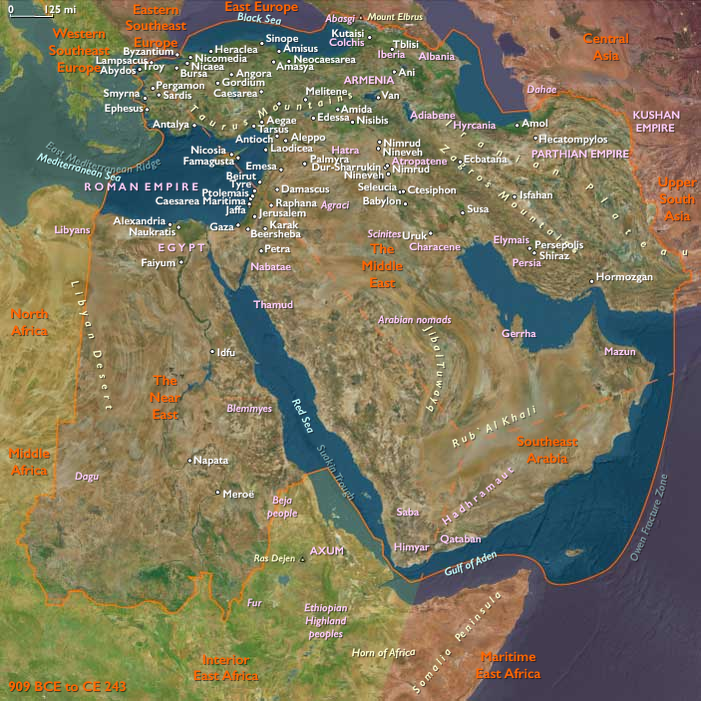
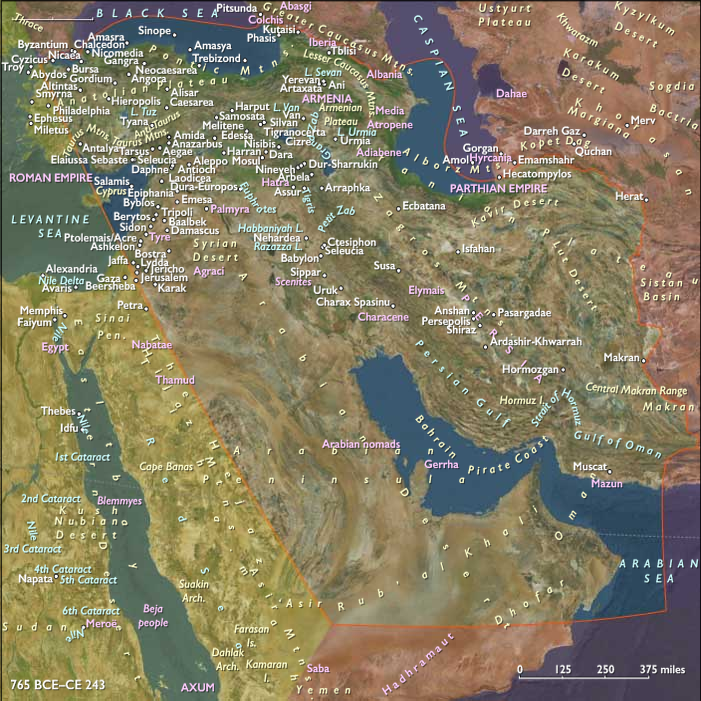
Once Ardashir was appointed Shahenshah, he had moved his capital further to the south of Persis and founded Ardashir-Khwarrah (formerly Gur, modern day Firuzabad), constructing several great palaces and carving rock reliefs.
The city, well supported by high mountains and easily defendable through narrow passes, has become the center of Ardashir's efforts to gain more power.
The city is surrounded by a high, circular wall, probably copied from that of Darabgird, and on the north-side includes a large palace, remains of which still survive today.
After establishing his rule over Persis, Ardashir I has rapidly extended his territory, demanding fealty from the local princes of Fars, and gaining control over the neighboring provinces of Kerman, Isfahan, Susiana and Mesene.
This expansion quickly comes to the attention of Artabanus IV, the Parthian king, who initially orders the governor of Khuzestan to wage war against Ardashir in 224, but the battles are victories for Ardashir.
Locations
People
Groups
Topics
Commodoties
Subjects
Regions
Subregions
Years: 224 - 224
Locations
People
Groups
Topics
Commodoties
Subjects
Regions
Subregions