
Conflict had resumed between Rome and Persia …
Years: 232 - 243
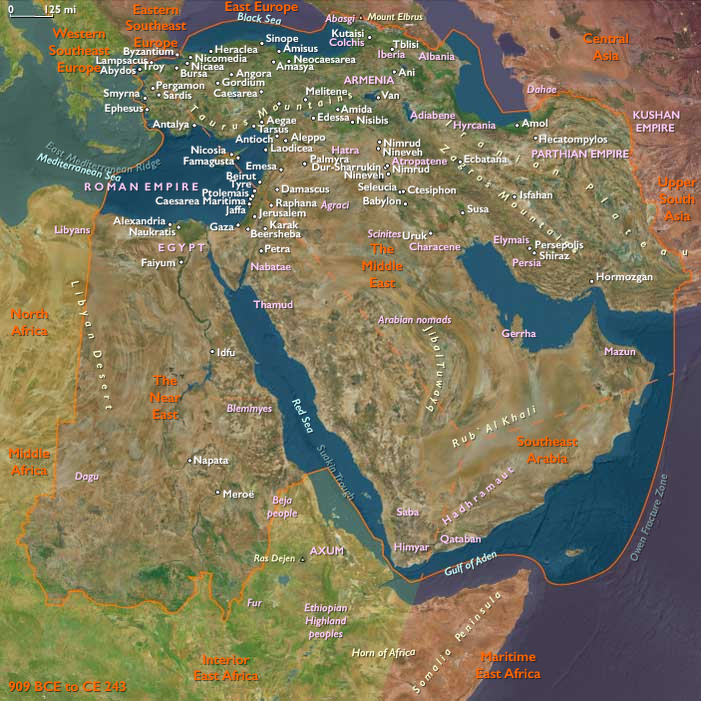
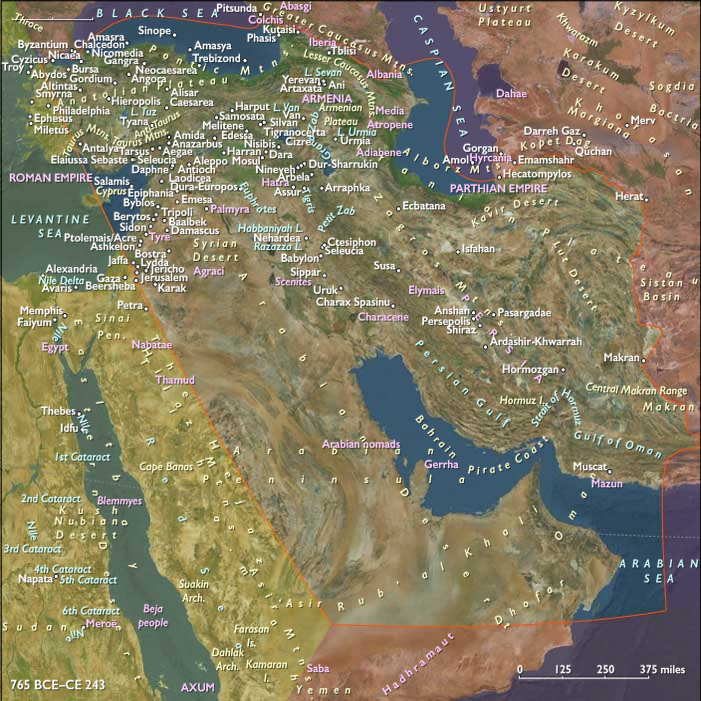
Conflict had resumed between Rome and Persia shortly after the overthrow of Parthian rule and the foundation of the Sassanid Empire by Ardashir I.
Ardashir in 230 had raided Mesopotamia and Syriaa nd demanded the cession of all the former territories of the Achaemenid Empire.
Alexander Severus, after fruitless negotiations, sets out in 232 against Ardashir and finally repulses him.
Ardashir towards the end of his reign attacks again in 238–240, taking several cities in Syria and Mesopotamia, including Carrhae and Nisibis.
The struggle resumes and intensifies under Ardashir's successor Shapur I, who invades Mesopotamia.
His forces are defeated in 243 at a battle near Resaena and the Romans regains Carrhae and Nisibis.
People
Groups
- Persian people
- Syria Palæstina, Roman province of (Judea, Samaria, and Idumea)
- Roman Empire (Rome): Severan dynasty
- Mesopotamia (Roman province)
- Persian Empire, Sassanid, or Sasanid
- Roman Empire (Rome): Non-dynastic
Topics
- Classical antiquity
- Roman Age Optimum
- Roman-Persian War of 230-33
- Crisis of the Third Century (Roman Civil “War” of 235-84)
- Year of the Six Emperors, or Roman Civil War of 238
- Roman-Persian War of 241-44
Commodoties
Subjects
Regions
Subregions
Related Events
Filter results
Showing 10 events out of 60585 total
All five expeditions led by Shu's chancellor-regent Zhuge Liang prove unsuccessful and indecisive, but the expeditions have become some of the most well-known conflicts of the Three Kingdoms period.
They overlap in popular history with the "six campaigns from Mount Qi," which is inaccurate, since Zhuge Liang only launched his campaigns from Mount Qi twice.
The culture of the Yayoi people from about 300 BCE to CE 250 shows a marked change in orientation and is more recognizably Japanese in character.
Wet-rice cultivation and bronze technology appear to have been introduced from Korea by way of Kyushu.
As opposed to the robust vigor of Jomon wares, Yayoi ceramics are made with finer clay, are turned on a wheel, and are generally more utilitarian in character, having more casual and at times elegant decoration.
The large settlements of the Yayoi people, centered in southwestern and central Japan, apparently became increasingly stratified under religious leaders.
Bronze weapons, mirrors, and bells, originally close to their Asian prototypes, are evidently used in rituals that have led to the exaggeration of their forms; the bells, especially, suggest the growth in authority of powerful clans that may have governed large areas.
The Crisis of the Third Century (235–284 CE): Rome’s Near Collapse
The Crisis of the Third Century, also called the "Military Anarchy" or "Imperial Crisis," was a period of severe instability in the Roman Empire, lasting from 235 to 284 CE. Marked by external invasions, internal civil war, and economic collapse, this crisis nearly led to the empire’s disintegration and permanently altered Roman institutions, society, and governance.
The Three Simultaneous Crises
-
External Invasions:
- The Goths, Vandals, and Alemanni launched devastating raids across Gaul, the Balkans, and Italy.
- The Sassanid Persian Empire aggressively pushed into Mesopotamia, even capturing Emperor Valerian in 260 CE.
- The Danube and Rhine frontiers collapsed, forcing Rome into constant defensive wars.
-
Internal Civil War:
- More than 25 emperors ruled in just 50 years, most meeting violent ends at the hands of rival factions or mutinous troops.
- Legions declared their own generals as emperors, leading to endless power struggles.
- The empire briefly split into three competing states:
- The Gallic Empire (Gaul, Britain, and Spain).
- The Palmyrene Empire (Syria and Egypt).
- The central Roman Empire, ruled by whoever controlled Italy.
-
Economic Collapse:
- Rome’s currency was devalued, leading to hyperinflation and a breakdown of trade.
- The tax system crumbled, forcing local provinces into a barter economy.
- Cities shrank, and large landowners gained power, beginning a shift toward a feudal-like system.
The Crisis as a Watershed Moment
Historians increasingly view the Crisis of the Third Century as the key transition between the classical Roman world and late antiquity:
-
Political Structure Changes:
- The empire became more militarized and autocratic, reducing senatorial influence.
- The rise of soldier-emperors meant that military power determined leadership, not Roman traditions.
-
Social and Economic Shifts:
- The weakened economy led to localization, with provinces relying on self-sufficient estates rather than long-distance trade.
- Cities declined in importance, while wealthy landowners gained more power, foreshadowing medieval feudal structures.
-
Religious Transformations:
- Traditional Roman polytheism weakened, while new religions, including Christianity and Eastern mystery cults, gained followers.
- The persecution of Christians intensified, as emperors sought to reinforce unity through traditional Roman gods.
The Road to Recovery: Diocletian and the Tetrarchy (284 CE)
- In 284 CE, Emperor Diocletian seized power and ended the crisis, implementing sweeping military, economic, and political reforms.
- He created the Tetrarchy, dividing the empire into Eastern and Western halves, stabilizing governance.
- His policies restored temporary order, but the empire had already fundamentally changed.
Conclusion: A Turning Point for Rome
The Crisis of the Third Century was a watershed moment in Roman history, marking the transition from the Principate (27 BCE–284 CE) to the Dominate (284–476 CE).
While Rome survived, it emerged transformed, setting the stage for:
- The eventual division of the empire into East and West.
- The rise of feudal land structures.
- The growing dominance of Christianity.
This tumultuous period reshaped Rome, leading to a new political and social order that would define Late Antiquity and the Middle Ages.
East Central Europe (232–243 CE): Frontier Tensions and Growing Regional Instability
Between 232 and 243 CE, East Central Europe—encompassing Poland, Czechia, Slovakia, Hungary, and those portions of Germany and Austria lying east of 10°E and north of a line stretching from roughly 48.2°N at 10°E southeastward to the Austro-Slovenian border near 46.7°N, 15.4°E—faced heightened instability due to mounting internal Roman challenges and intensified external pressure from neighboring tribal confederations. During this period, the Roman frontier provinces (Pannonia Superior, Pannonia Inferior, and Noricum) increasingly struggled to manage rising threats posed by Germanic and Sarmatian tribes, signaling a transition toward regional unrest.
Political and Military Developments
Internal Roman Instability
-
The Roman Empire, under the final Severan emperor, Severus Alexander (222–235 CE), and subsequently during the chaotic period following his assassination (235 CE, marking the start of the Crisis of the Third Century), experienced significant political turmoil.
-
Frontier provinces began to suffer administrative neglect, resource limitations, and diminished military effectiveness due to internal power struggles within the empire.
Increasing Frontier Challenges
-
Tribal groups—particularly the Marcomanni, Quadi, and Iazyges—recognized Roman vulnerabilities and increased pressures along the Danube, testing defenses, and initiating more frequent small-scale incursions.
-
Other tribes, including the Vandals, Carpi, and groups within northern and eastern boundaries, became more assertive, further straining Roman frontier management.
Economic and Technological Developments
Economic Disruptions Intensify
-
Economic prosperity diminished due to increased military and political uncertainties, affecting trade routes and interactions between Roman frontier provinces and tribal communities. Cross-border trade became riskier and more expensive to manage.
Slowing Infrastructure Development
-
Infrastructure projects—roads, bridges, fortifications—slowed significantly, as Roman attention and resources were redirected toward immediate military and defensive needs.
Cultural and Artistic Developments
Shift toward Defensive and Military Themes
-
Artistic and material culture increasingly reflected defensive priorities, producing fortified goods, military equipment, and artifacts emphasizing protection and security.
Reduced but Continued Cultural Integration
-
Cultural interactions persisted despite difficulties, though exchanges were more cautious and influenced by military concerns and the broader uncertainty of the period.
Settlement and Urban Development
Increased Defensive Measures
-
Roman frontier towns (Carnuntum, Vindobona, Aquincum) further intensified defensive structures, reinforcing walls, towers, and garrisons to meet growing external threats.
Tribal Adaptation to Instability
-
Germanic and Sarmatian settlements increasingly adopted defensive and mobile strategies, adjusting settlement locations and fortifications to respond effectively to instability.
Social and Religious Developments
Military Elites Dominating Tribal Leadership
-
Warrior elites and chieftains increasingly dominated tribal hierarchies, emphasizing military strength, strategic alliances, and preparedness for possible conflict as regional stability deteriorated.
Religious Intensification amid Instability
-
Traditional religious rituals among tribes intensified, particularly those emphasizing communal solidarity, protection, and warrior identity in response to increased regional uncertainty and threats.
Long-Term Consequences and Historical Significance
The era 232–243 CE was a crucial turning point in East Central Europe, marking the beginning of significant regional instability driven by internal Roman weaknesses and external tribal assertiveness. These developments anticipated the broader regional transformations and disruptions associated with the subsequent Crisis of the Third Century (235–284 CE), setting conditions for profound historical changes, migrations, and shifting power structures in the ensuing decades.
The Middle East: 232–243 CE
Roman–Sassanid Conflicts and Jewish Legal Developments
The era from 232 to 243 CE marks an intensified phase of conflict between the Roman Empire and the recently established Sassanid Persian Empire under Ardashir I and later his successor, Shapur I. Initially, in 230 CE, Ardashir launches raids into Roman-held Mesopotamia and Syria, boldly demanding Rome’s cession of all territories that once belonged to the Achaemenid Empire.
Roman Emperor Alexander Severus, after unsuccessful diplomatic attempts, responds militarily in 232, eventually repelling the Persian advances. Ardashir, determined and strategic, renews his assaults between 238 and 240, successfully capturing critical cities including Carrhae and Nisibis in Syria and Mesopotamia.
The conflict escalates further under Ardashir's ambitious heir, Shapur I, who initiates a large-scale invasion of Roman Mesopotamia. Shapur's forces, however, suffer a significant defeat in 243 CE near Resaena, allowing the Romans to reclaim Carrhae and Nisibis and temporarily stabilizing their eastern frontier.
Simultaneously, this era witnesses important developments among Babylonian Jews, who recognize Samuel bar Abba (Rav Samuel) as their principal temporal and judicial authority, especially in monetary and civil law. Rav Samuel’s influential rulings—known as responsa—guide dispersed Jewish communities, encouraging adherence to local laws while upholding Jewish traditions. His progressive ordinances notably include prohibitions on marriages without proper courtship and forbid fathers from betrothing daughters without their consent. These rulings significantly shape Jewish social and legal practices, equipping Babylonian Jews with flexible strategies for adapting to life within foreign environments.
Babylonian Jews accept as binding the rulings of Samuel bar Abba, the acknowledged temporal leader of the Jewish community in Babylonia, in monetary and civil matters.
He also instructs Jews to adopt the laws of whichever land they dwell in, thus preparing them for survival in foreign environments.
Rav Samuel is noted for improving moral and intellectual positions through his responsa (ordinances), including a ban on marriage without courtship and forbidding fathers to betroth a daughter without her consent.
These responsa, posed in the form of questions, become a popular way of maintaining contact with dispersed communities of Jews.
The Kushan empire, acknowledged by contemporaries as one of the four great Eurasian powers of its time (the others being China, Rome, and Parthia), declines after the rise of the Sassanian dynasty in Iran and of local powers in northern India.
Although the empire fragments into petty principalities, Kushan princes long continue their rule in various provinces.
Under the second Sassanian ruler, Shapur I, the Persians establish control over parts of Afghanistan, including Bagram, in 241.
Variations on the word “Afghan”may date from as early as a third-century Sassanian reference to “Abgan”.
Near East (232–243 CE): The Crisis Begins
The Near East enters a turbulent period beginning in 235 CE, marking the start of the Crisis of the Third Century, characterized by internal instability, external pressures, and economic disruption throughout the Roman Empire. Following the assassination of Emperor Severus Alexander in 235, Rome plunges into a prolonged period of military anarchy, civil wars, and economic decline. The empire experiences rapid succession of emperors, undermining centralized control and leaving provinces vulnerable.
Roman Administration and Decline
The administrative structure of the Roman Near East, previously a stabilizing force, begins to weaken significantly during this era. Economic exploitation, heavy taxation, and the demands of continuous warfare strain the region, exacerbating the social and economic divisions particularly noticeable in provinces like Egypt and Syria Palestina. The urbanized and Hellenized populations continue to hold advantages over rural, native communities, but even urban centers start to feel the pressures of instability.
Jewish Communities and Continued Scholarship
Despite these pressures, Jewish intellectual activity remains resilient, particularly in Galilee. The scholarly work that had flourished earlier continues, centered around the compilation and analysis of the Mishnah under the guidance of leaders such as Judah ha-Nasi. This resilient intellectual tradition ensures that Jewish identity and scholarship survive despite external turmoil and ongoing Roman persecution.
Christianity Amidst Instability
Christian communities across the Near East face fluctuating periods of persecution and tolerance as Roman authorities struggle to maintain control. The Christian presence remains particularly strong in Egypt, despite earlier edicts like those of Septimius Severus, which had banned new conversions. By the mid-third century, the Coptic Church continues to solidify its cultural and religious identity despite official hostility and administrative neglect from Rome.
Roman Influence in Jordan and Arabia
In the Roman province of Arabia, former Nabataean territories, including key cities like Petra, continue to integrate into the empire’s extensive network, although prosperity diminishes with the wider instability of the Roman state. Nevertheless, the established infrastructure and Hellenized culture ensure some continuity, even as Roman authority wavers.
Rome’s Southern Strategy and Meroë
The kingdom of Kush, particularly around Meroë, remains strategically significant to Rome as a buffer against southern incursions. Rome’s support for the Nobatae, a militarized local group, continues despite its internal problems, underscoring the continued Roman reliance on regional proxies to maintain frontier stability.
Technological and Cultural Legacies
Technological advancements like cast glass windows, first developed in Alexandria, symbolize continued innovation despite broader imperial disruptions. Likewise, the transition from Greek to Latin administration accelerates following the 212 CE grant of Roman citizenship to Egyptians, further illustrating shifting cultural dynamics amid imperial crisis.
Legacy of the Era
This era initiates a period of significant instability for the Near East, characterized by weakening Roman governance, economic strain, and intensified cultural resilience among Jewish and Christian communities. Despite these challenges, intellectual scholarship and regional adaptations ensure cultural continuity, leaving a lasting legacy that influences subsequent historical developments.
Mediterranean Southwest Europe (232–243 CE): Late Severan Stability and Emerging Challenges
The era 232–243 CE in Mediterranean Southwest Europe continues under the relatively stable rule of Alexander Severus, gradually shifting towards increasing military and political challenges. This period witnesses ongoing administrative reforms, heightened frontier pressures, and sustained cultural vitality, marking the twilight of the Severan dynasty.
Continuing Administration of Alexander Severus
Alexander Severus maintains his efforts to improve governance, uphold judicial fairness, and enhance provincial administration. Relying significantly on influential advisors, notably jurists such as Ulpian, he further refines Roman law, bolstering the empire’s legal and administrative foundations.
Growing Military Pressures and Frontier Conflicts
During the 230s, Alexander Severus increasingly confronts military pressures along the empire's frontiers, notably from the Sassanian Empire in the east and Germanic tribes along the Rhine and Danube rivers. His attempts to balance diplomacy and military strength lead to mixed results, creating tension within Rome’s military leadership.
In 235 CE, amid these ongoing challenges, Alexander Severus undertakes a military campaign against Germanic incursions along the Rhine. The limited success of this campaign, combined with dissatisfaction among military ranks, contributes to growing discontent and instability.
Economic and Infrastructure Development
Despite external threats and internal pressures, Alexander Severus’s administration continues significant infrastructure investments. Improvements in roads, urban facilities, and economic policies support sustained regional prosperity and commercial growth across Mediterranean Southwest Europe.
Cultural and Intellectual Continuity
Cultural activities remain vibrant, marked by ongoing artistic, architectural, and intellectual achievements. Elaborate sculptures, intricately carved sarcophagi, and public monuments continue to thrive, reflecting the period's artistic richness. Intellectual life, especially philosophical discourse and theological discussions within early Christian communities, remains robust and influential.
Christian Community Developments
Christianity continues its expansion and doctrinal refinement during this period. The sustained intellectual engagement among Christian theologians helps solidify and articulate the emerging Christian identity, reinforcing the religion's significance within Roman society.
End of Alexander Severus and Emerging Instability
Alexander Severus’s reign ends abruptly with his assassination in 235 CE by disaffected soldiers, precipitating the "Crisis of the Third Century." This event signals a significant turning point, characterized by prolonged instability, internal conflict, and frequent changes in leadership.
Legacy of the Era
The era 232–243 CE represents the last phase of relative stability under the Severan dynasty, increasingly overshadowed by military pressures and internal dissent. Alexander Severus's administrative efforts and economic policies leave enduring impacts, although his assassination starkly underscores the empire’s vulnerability, setting the stage for subsequent decades of political turmoil and uncertainty.
Mediterranean Southwest Europe (232–243 CE): Late Severan Stability and Emerging Challenges
The era 232–243 CE in Mediterranean Southwest Europe continues under the relatively stable rule of Alexander Severus, gradually shifting towards increasing military and political challenges. This period witnesses ongoing administrative reforms, heightened frontier pressures, and sustained cultural vitality, marking the twilight of the Severan dynasty.
Continuing Administration of Alexander Severus
Alexander Severus maintains his efforts to improve governance, uphold judicial fairness, and enhance provincial administration. Relying significantly on influential advisors, notably jurists such as Ulpian, he further refines Roman law, bolstering the empire’s legal and administrative foundations.
Growing Military Pressures and Frontier Conflicts
During the 230s, Alexander Severus increasingly confronts military pressures along the empire's frontiers, notably from the Sassanian Empire in the east and Germanic tribes along the Rhine and Danube rivers. His attempts to balance diplomacy and military strength lead to mixed results, creating tension within Rome’s military leadership.
In 235 CE, amid these ongoing challenges, Alexander Severus undertakes a military campaign against Germanic incursions along the Rhine. The limited success of this campaign, combined with dissatisfaction among military ranks, contributes to growing discontent and instability.
Economic and Infrastructure Development
Despite external threats and internal pressures, Alexander Severus’s administration continues significant infrastructure investments. Improvements in roads, urban facilities, and economic policies support sustained regional prosperity and commercial growth across Mediterranean Southwest Europe.
Cultural and Intellectual Continuity
Cultural activities remain vibrant, marked by ongoing artistic, architectural, and intellectual achievements. Elaborate sculptures, intricately carved sarcophagi, and public monuments continue to thrive, reflecting the period's artistic richness. Intellectual life, especially philosophical discourse and theological discussions within early Christian communities, remains robust and influential.
Christian Community Developments
Christianity continues its expansion and doctrinal refinement during this period. The sustained intellectual engagement among Christian theologians helps solidify and articulate the emerging Christian identity, reinforcing the religion's significance within Roman society.
End of Alexander Severus and Emerging Instability
Alexander Severus’s reign ends abruptly with his assassination in 235 CE by disaffected soldiers, precipitating the "Crisis of the Third Century." This event signals a significant turning point, characterized by prolonged instability, internal conflict, and frequent changes in leadership.
Legacy of the Era
The era 232–243 CE represents the last phase of relative stability under the Severan dynasty, increasingly overshadowed by military pressures and internal dissent. Alexander Severus's administrative efforts and economic policies leave enduring impacts, although his assassination starkly underscores the empire’s vulnerability, setting the stage for subsequent decades of political turmoil and uncertainty.
Years: 232 - 243
People
Groups
- Persian people
- Syria Palæstina, Roman province of (Judea, Samaria, and Idumea)
- Roman Empire (Rome): Severan dynasty
- Mesopotamia (Roman province)
- Persian Empire, Sassanid, or Sasanid
- Roman Empire (Rome): Non-dynastic
Topics
- Classical antiquity
- Roman Age Optimum
- Roman-Persian War of 230-33
- Crisis of the Third Century (Roman Civil “War” of 235-84)
- Year of the Six Emperors, or Roman Civil War of 238
- Roman-Persian War of 241-44
