Conall mac Comgaill becomes king of Dál …
Years: 560 - 560
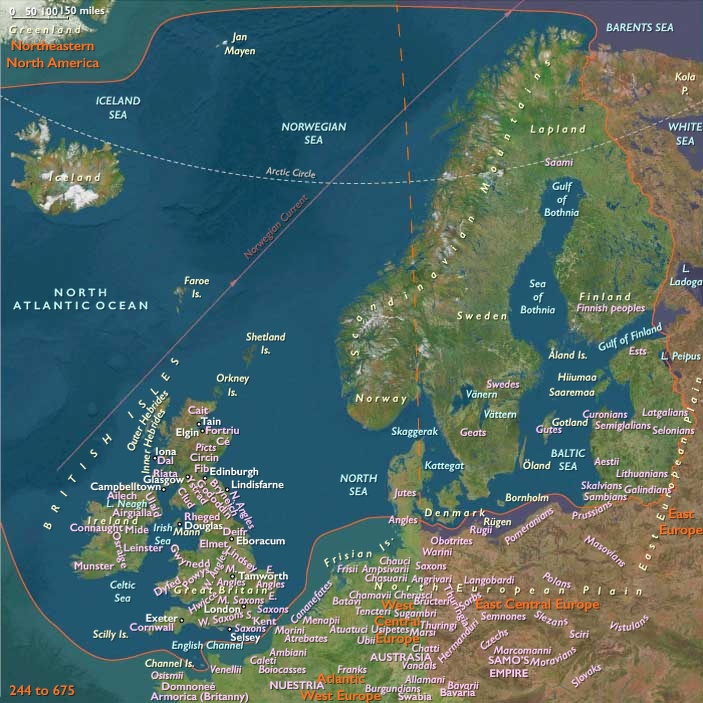
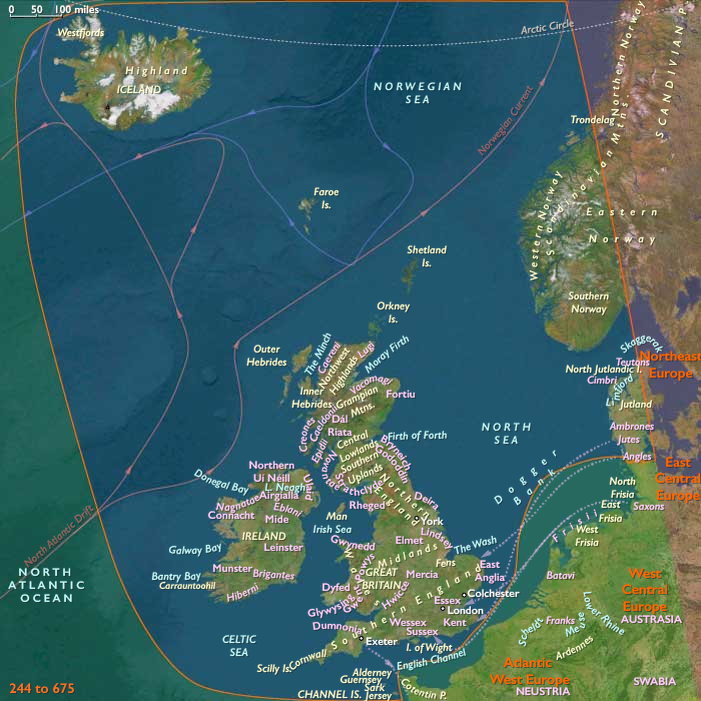
Conall mac Comgaill becomes king of Dál Riata, a Gaelic overkingdom on the western coast of Scotland.
Locations
Groups
Topics
Subjects
Regions
Subregions
Related Events
Filter results
Showing 10 events out of 57523 total
The Avars have moved westward from south Russia, subjugating Utigurs, Kutrigurs, and Slavic peoples to the profit of the empire.
By 560, the Avars, who enslave Slavs (hence the name), have apparently conquered all the territory occupied by Eastern Slavs, or Antes.
The Avars destroy one Bulgar tribe, but the rest save themselves by submitting to another horde of Turkic newcomers.
The Avars are familiar with the stirrup, and they may have introduced it into Europe.
(Some of the earliest unequivocal evidence of the use of the stirrup comes from Avar graves.)
The First Council of Braga, convened in 561 CE, formally condemns Priscillianism, a heretical movement that had persisted in Hispania since the fourth century. This council, held in the Suebi Kingdom of Galicia, reinforces the region’s alignment with Chalcedonian Christianity, further distancing it from Arian and Priscillianist influences.
Cealwin becomes King of Wessex in 560 upon the death of his father Cynric.
Glappa succeeds his father Ida in 559 as king of Bernicia.
Anglian settlers during his rule will expand their territory in what is now southeastern Scotland.
Emperor Xiaozhao of Northern Qi dies from injuries suffered while hunting; his brother succeeds him as Emperor Wucheng.
Chlothar I: Sole Ruler of the Franks and the End of His Reign (558–561 CE)
In 558 CE, following the death of his brother Childebert I, Chlothar I becomes the sole King of the Franks, unifying all of the territories originally ruled by Clovis I. His rule extends over most of Gaul and large parts of Germania, and he leads expeditions into Saxony, further consolidating Frankish influence over the eastern frontier.
1. Chlothar’s Sole Rule Over the Frankish Kingdom (558 CE)
- With Childebert’s death, Chlothar reunites the Merovingian kingdom, becoming the undisputed King of the Franks.
- His rule spans Gaul and Germania, making him one of the most powerful monarchs in post-Roman Western Europe.
- He leads campaigns into Saxony, continuing the Frankish expansion eastward.
2. Internal Struggles: The Revolt of Chram
- The end of Chlothar’s reign is marked by internal dissension, particularly the rebellion of his son Chram.
- Chram revolts multiple times, seeking to seize power from his father.
- After one failed rebellion, Chram flees to Brittany, where he gathers support.
3. Chram’s Defeat and Brutal Execution
- Chlothar pursues Chram into Brittany, determined to eliminate his rebellious son.
- Upon capturing him, Chlothar shuts Chram, along with his wife and children, in a cottage, which he then sets on fire, burning them alive.
- This act of filicide deeply disturbs Chlothar, who is soon overwhelmed with remorse.
4. Chlothar’s Death and His Final Act of Penance
- Wracked with guilt, Chlothar travels to Tours, where he seeks forgiveness at the tomb of St. Martin, one of the most revered saints in the Frankish kingdom.
- Shortly afterward, in late 561 CE, Chlothar dies at the royal palace at Compiègne, bringing his reign to an end.
5. The Re-Division of the Frankish Kingdom (561 CE)
Following Frankish tradition, Chlothar’s unified kingdom is once again divided among his surviving sons:
- Charibert I – Receives Aquitaine, ruling from Paris.
- Sigebert I – Inherits Austrasia, with Metz as his capital.
- Guntram – Rules Burgundy, centered in Orléans.
- Chilperic I – Takes control of Neustria, governing from Soissons.
This division reignites rivalries between the Frankish kings, leading to decades of internal conflicts, assassinations, and power struggles, particularly between Chilperic and Sigebert.
Conclusion: Chlothar’s Legacy
- Chlothar I reunifies the Frankish kingdom for a brief period but fails to establish lasting unity, as his sons immediately divide the realm upon his death.
- His military campaigns expand Frankish power, securing dominance over Gaul and parts of Germania.
- His brutal treatment of Chram highlights the ruthlessness of Merovingian succession struggles, which will continue to shape Frankish politics for generations.
- His pilgrimage to St. Martin’s tomb reflects the growing role of the Catholic Church in Frankish royal life, reinforcing the idea that monarchs sought divine legitimacy and absolution for their actions.
Despite his momentary reunification of the Frankish kingdom, Chlothar’s death marks the return of fragmentation, setting the stage for future conflicts among his heirs that will define the next phase of Merovingian rule.
Taiyuan, the secondary capital of Northern Qi, is rebuilt in 562; it will become a center of Buddhism.
The kingdom of Silla, in 562, expels from the Korean peninsula the Japanese, who had established a foothold on the coast in the fourth century.
The Avars, still in the pay of Constantinople, push west until, in 562, they meet the enlarged Frankish kingdom at the Elbe.
King Sigebert I repels an attack on Austrasia by the Avars at Regensburg.
A fifty years' truce between Persia and Rome is finally negotiated, probably at the end of 561; Constantinople agrees to pay an annual tribute of thirty thousand solidi (gold coins); in return, the Persians renounce all claim to Lazica, an important bulwark against northern invaders, and undertake not to persecute their Christian subjects.
Justinian has thus maintained his eastern provinces virtually intact in spite of the vigorous offensives of the Persian king, so his policy on this front can hardly be described as a failure.
The treaty also regulates trade between Rome and Persia, since rivalry between the two great powers has always had its economic aspects, focused primarily upon the silk trade.
Raw silk reaches Constantinople through Persian intermediaries, either by a land route leading from China through Persia or by the agency of Persian merchants in the Indian Ocean.
The need to break this Persian monopoly had led Justinian to search for new routes and new peoples to serve as intermediaries: in the south, the Ethiopian merchants of the kingdom of Axum; in the north, the peoples around the Crimea and in the Caucasian kingdom of Lazica, as well as the Turks of the steppes beyond the Black Sea.
Other valuable commodities are exchanged in the Black Sea region, including textiles, jewelry, and wine from East Rome for the furs, leather, and slaves offered by the barbarians; yet, silk remains the commodity of prime interest.
It is fortunate, then, that before 561, East Roman agents had smuggled silkworms from China into Constantinople, establishing a silk industry that will liberate the empire from dependence on Persia and become one of the medieval Greek empire's most important economic operations.