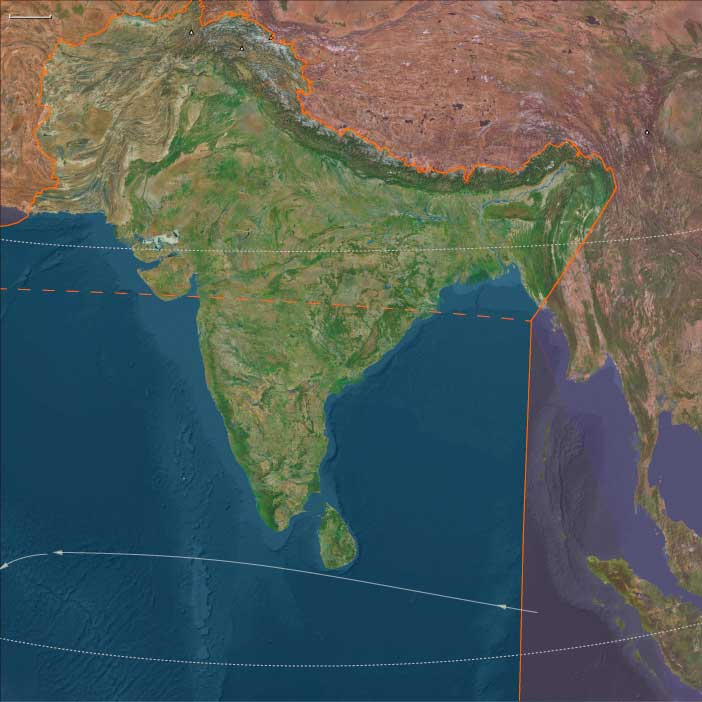
Japan halts the British drive into Burma in early 1944, then stage a counteroffensive against the British in India, besieging the British at Imphal.
Construction of the Ledo Road continues.
Stilwell, in early 1944, begins moving toward the strategic town of Myitkyina, the road’s northernmost terminus.
Japanese forces in China gain control of the remaining railroad running south from Hangzhou to Guangzhou during the first half of 1944; during the same time, they seize the airfields in the southeast used by American volunteer fliers to attack the Japanese.
The RAF-supplied Britons at Imphal break the Japanese siege in July 1944.
Thailand’s Pibul Songgram government resigns in July of 1944.
By July 1944, MacArthur’s forces have captures almost all of New Guinea.
Stilwell, with superior air support, rolls back a northward offensive by the Japanese and takes Myitkyina in August 1944.
Nimitz’s fleet arrives from the Central Pacific in late August and moves to take the Palau Islands off the southern Philippines.
In September, MacArthur’s forces sieze Morotai in the Moluccas.
The Japanese fleet attempts, unsuccessfully, to destroy transports landing US troops on the island of Leyte in the October 23—25 1944 Battle of Leyte Gulf.
For the first time, Japan employs the young volunteer pilots of its Kamikaze (“divine wind”) Corps, whose members purposely crash their bomb-laden planes into Allied vessels.
In less than a week, the Americans drive the Japanese forces from southern and northeastern Leyte, but for the next two months, the opposing armies struggle mightily in bloody jungle clashes.
In November 1944, US fliers based in the Marianas initiate the strategic bombing of Kapanese airfields, industrial targets and naval installlations.
Increasing disagreement between Generalissimo Jiang Jeishei and General Stilwell, including Stilwell’s public criticism of Kiang, results in deficiencies in China’s defenses and Stilwell’s recall in the latter part of 1944.
Japanese domination of the land route from Korea to Malaya cuts China in half by December 1944.
General William Joseph Slim leads the British 14th Army from into Burma in December 1944.
One corps moves north to sieze Kalewa on the Chidwin River, another presses southwards through western Burma.
Organized Japanese resistance on Leyte ends by late December.
Troop transports move the US Sixth Army through Surigao Strait into the Sulu and Mindanao seas in early January 1945.
The British and Chinese complete the 470 mile (750 kilometer) Ledo Road on January 7, 1945.
The British 14th Army in Burma joins up with the US-led Chinese forces to open the road to supply traffic.
Following three days of naval and air bombardment, US forces under General Douglas MacArthur invade Lingayen, Luzon on January 9, 1945, forcing the Japanese to fall back to the mountainous north and east.
Additional US troops land in western and southern Luzon, then combine with all invasion forces to converge on Manila.
Simultaneously, US paratroopers capture the fortress of Corregidor.
MacArthur’s troops enter Manila on February 4.