
Commodus, perhaps seeing the fire’s destruction as …
Years: 192 - 192
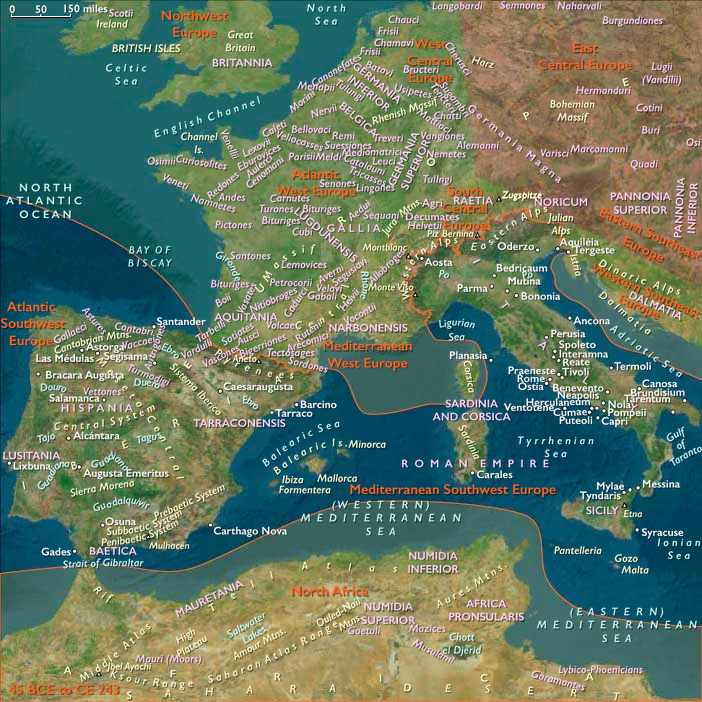
Commodus, perhaps seeing the fire’s destruction as an opportunity, declaring himself the new Romulus early in 192, ritually re-founds Rome, renaming the city Colonia Lucia Annia Commodiana.
All the months of the year are renamed to correspond exactly with his (now twelve) names: Lucius, Aelius, Aurelius, Commodus, Augustus, Herculeus, Romanus, Exsuperatorius, Amazonius, Invictus, Felix, Pius.
The legions are renamed Commodianae, the fleet which imports grain from Africa is termed Alexandria Commodiana Togata, the Senate is entitled the Commodian Fortunate Senate, his palace and the Roman people themselves are all given the name Commodianus, and the day on which these reforms are decreed is to be called Dies Commodianus.
Thus he presents himself as the fountainhead of the Empire and Roman life and religion.
He also has the head of the Colossus of Nero adjacent to the Colosseum replaced with his own portrait, gives it a club and places a bronze lion at its feet to make it look like Hercules, and adds an inscription boasting of being "the only left-handed fighter to conquer twelve times one thousand men".
In 191-92, a now-forgotten Roman sculptor executes a beautifully detailed polished marble bust of the bearded Emperor, represented as his patron god, Hercules, replete with lionskin and bearing a club in his right hand and the apples of the Hesperides in his left.
An inscribed altar from Dura-Europos on the Euphrates shows that Commodus's titles and the renaming of the months were disseminated to the furthest reaches of the Empire; moreover, that even auxiliary military units received the title Commodiana, and that Commodus claimed two additional titles: Pacator Orbis (pacifier of the world) and Dominus Noster (Our Lord).
The latter eventually will be used as a conventional title by Roman Emperors, starting about a century later, but Commodus seems to have been the first to assume it.
In November 192, Commodus holds Plebian Games, in which he shoots hundreds of animals with arrows and javelins every morning, and fights as a gladiator every afternoon, naturally winning all the bouts.
In December, he announces his intention to inaugurate the year 193 as both consul and gladiator on January 1.
At this point, the Praetorian prefect Quintus Aemilius Laetus forms a conspiracy with Commodus’ chamberlain Eclectus to supplant Commodus with Pertinax, taking the emperor’s mistress into their confidence.
On December 31, Marcia poisons his food but he vomits up the poison; so the conspirators send his wrestling partner Narcissus to strangle him in his bath.
Commodus's death marks the end of the Nervan-Antonian dynasty.
Locations
People
Groups
Topics
Commodoties
Subjects
- Commerce
- Watercraft
- Sculpture
- Environment
- Labor and Service
- Conflict
- Mayhem
- Games and Sports
- Faith
- Government
- Technology
Regions
Subregions
Years: 192 - 192
Locations
People
Groups
Topics
Commodoties
Subjects
- Commerce
- Watercraft
- Sculpture
- Environment
- Labor and Service
- Conflict
- Mayhem
- Games and Sports
- Faith
- Government
- Technology
Regions
Subregions