
Columbus, anchored off the Canary Isles near …
Years: 1493 - 1493
February
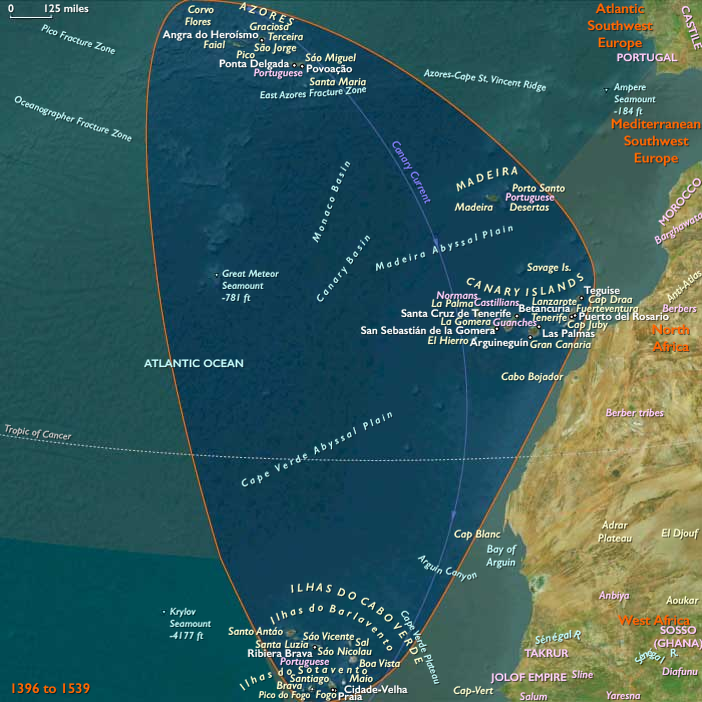
Columbus, anchored off the Canary Isles near the end of his return voyage from the New World, composes a long letter to Luis de Santangel, Treasurer of Aragon, who had given him substantial help in fitting out his expedition.
Columbus evidently intends his announcement of his discovery of the West Indies for the eyes of the king and queen of Spain.
Concerning Hispaniola, he writes of "many spices and vast mines of gold and other metals" and "innumerable people.” The inhabitants, although "well-made men of commanding stature," appear to be "extraordinarily timid" and "so unsuspicious and so generous with what they possess, that no one who had not seen it would believe it.
They never refuse anything that is asked for.
They even offer it themselves, and show so much love that they would give their very hearts."
One sailor, writes Columbus, "was found to have got for a leathern strap, gold of the weight of two and a half castellanos, and others for even more worthless things much more; while for a new blancas they would give all they had, were it two or three castellanos of pure gold or an arroba or two of spun cotton."
Columbus states that he "had to win their love, and to induce them to become Christians, and to love and serve their Highness and the whole Castilian nation, and help to get for us things they have in abundance, which are necessary to us. vThey have no religion, nor idolatry, except that they all believe power and goodness to be in heaven. They firmly believed that I, with my ships and men, came from heaven, and with this idea I have been received everywhere, since they lost fear of me."
The "vast mines" of Hispaniola notwithstanding, the Arawaks "have no iron, nor steel, nor weapons, nor are they fit for them, because although they are well-made men of commanding stature, they appear extraordinarily timid.The only arms they have are sticks of cane, cut when in seed, with a sharpened stick at the end, and they are afraid to use these."
Columbus writes of the native peoples he encounters as being “far from ignorant. They are most ingenious men, and navigate these seas in a wonderful way, and describe everything well, but they never before saw people wearing clothes, nor vessels like ours. In these isles there are a great many canoes, something like rowing boats, of all sizes, and most of them are larger than an eighteen-oared galley. They are not so broad, as they are made of a single plank, but a galley could not keep up with them in rowing, because they go with incredible speed, and with these they row about among all these islands, which are innumerable, and carry on their commerce. I have seen some of these canoes with seventy and eighty men in them, and each had an oar.”
Aside from the gold appropriated from the native peoples, West Indies mahogany begins to be imported for use in fine European furniture.
Locations
People
Groups
- Arawak peoples (Amerind tribe)
- Christians, Roman Catholic
- Castile, Crown of
- Canary Islands (Castilian colony)
Topics
- Age of Discovery
- Canary Islands, conquest of the
- Colonization of the Americas, Spanish
- Columbian Exchange
Commodoties
Subjects
Regions
Subregions
Related Events
Showing 10 events out of 40265 total
Years: 1493 - 1493
February
Locations
People
Groups
- Arawak peoples (Amerind tribe)
- Christians, Roman Catholic
- Castile, Crown of
- Canary Islands (Castilian colony)
Topics
- Age of Discovery
- Canary Islands, conquest of the
- Colonization of the Americas, Spanish
- Columbian Exchange
Commodoties
Subjects
Regions
Subregions