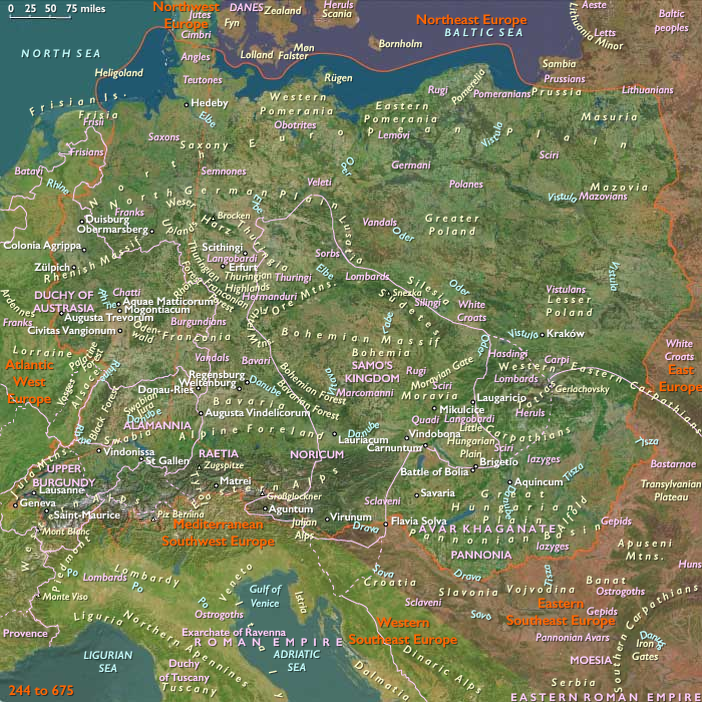
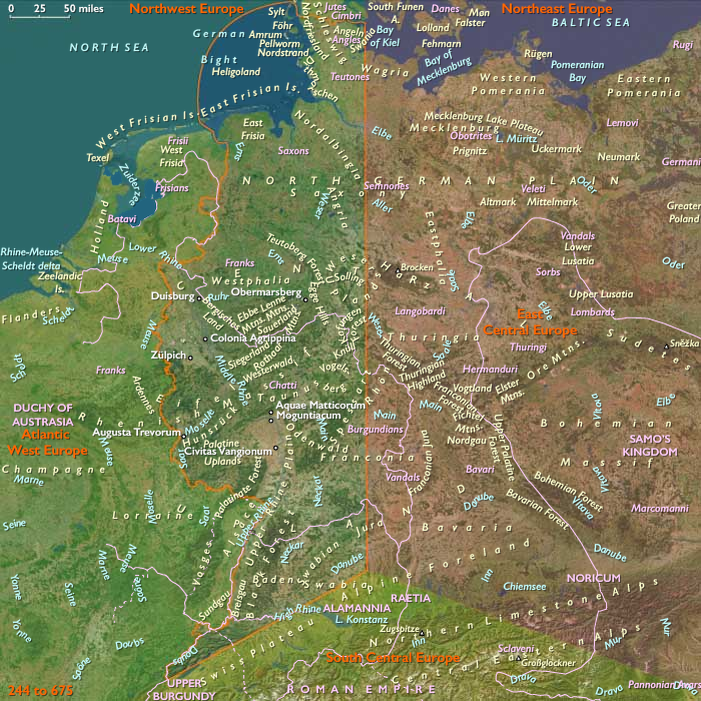
…Colonia Agrippina (Cologne, Germany).
Years: 285 - 285
November
…Colonia Agrippina (Cologne, Germany).
Locations
People
Groups
- Germania Inferior (Roman province)
- Gallia Belgica (Roman province)
- Germans
- Heruli (East Germanic tribe)
- Burgundians (East Germanic tribe)
- Alamanni (Germanic tribal alliance)
- Roman Empire (Rome): Non-dynastic
- Bagaudae (peasant insurgent groups)
Topics
Commodoties
Subjects
Regions
Subregions
Related Events
Filter results
Showing 10 events out of 60134 total
Diocletian is not the only challenger to Carinus' rule; the usurper M. Aurelius Julianus, Carinus' corrector Venetiae, had taken control of northern Italy and Pannonia after Diocletian's accession.
He mints coins from the mint at Siscia (Sisak, Croatia) declaring himself as emperor and promising freedom.
It is all good press for Diocletian, and aids in his portrayal of Carinus as a cruel and oppressive tyrant.
Julianus' forces are weak, however, and are handily dispersed when Carinus' armies move from Britain to northern Italy, defeating and killing Julianus near Verona in the spring of 285.
Diocletian, as leader of the united East, is clearly the greater threat to Carinus.
Over the winter of 284–5, Diocletian has advanced west across the Balkans.
In the spring, some time before the end of May, his armies meet those of Carinus across the river Margus (Great Morava) in Moesia.
In modern accounts, the site has been located between the Mons Aureus (Seone, west of Smederevo) and Viminacium, near modern Belgrade, Serbia.
Carinus now proceeds to attack Diocletian, who would have been the loser had not Carinus been assassinated.
One account has him assassinated by a tribune whose wife he had seduced; in another, the battle is represented as having resulted in a complete victory for Diocletian, for Carinus' army had deserted him: this second account is also confirmed by the fact that Diocletian keeps Carinus' Praetorian Guard commander in service, though it is possible that Flavius Constantius, the governor of Dalmatia and Diocletian's associate in the household guard, had already defected to Diocletian in the early spring.
When the Battle of the Margus began, Carinus' prefect Aristobulus had also defected.
(Of the two dozen-plus emperors ruling Rome in the past fifty years, the lives of all but one have ended violently.)
Following Diocletian’s victory, both the western and the eastern armies acclaim him emperor.
Diocletian exacts an oath of allegiance from the defeated army and departs for Italy.
Bagaudae (also spelled bacaudae) are groups of peasant insurgents who emerge during the "Crisis of the Third Century", and persist particularly in the less Romanized areas of Gaul and Hispania.
The name probably means "fighters".
C.E.V. Nixon assesses the bagaudae, from the official Imperial viewpoint, as "bands of brigands who roamed the countryside looting and pillaging."
J.C.S. Léon interprets the most completely assembled documentation as identifying the bagaudae as the impoverished local free peasants, reinforced by bandits and deserters from the legions, who are resisting the extension of proto-feudal privileges and control in marginal areas of the Empire.
Léon sees the invasions, usurpers and disorders of the third century crisis not as causative, but as providing a chaotic relaxation of local power, within which the bagaudae achieve some temporary and scattered successes, under the leadership of lesser members of the ruling class.
The bagaudae first come to the attention of the central authorities in 285.
The fourth-century historian Eutropius describes them as rural people under the leadership of Amandus and Aelianus, while Aurelius Victor called them bandits.
The historian David S. Potter suggests that they were more than peasants, seeking either Gallic political autonomy or reinstatement of the recently deposed Carus (a native of Gallia Narbonensis, in what would become southern France): in this case, they would be defecting imperial troops, not brigands.
Although poorly equipped, led and trained—and therefore a poor match for Roman legions—Diocletian certainly considered bagaudae a threat sufficient to merit an emperor to counter them.
E.M. Wightman, in Gallia Belgica, claims that Amandus and Aelianus were likely local Gallic landowners who became "tyrants" and fought back against the Romans.
The Panegyric of Maximian, dating to 289 and attributed to Claudius Mamertinus, relates that during the bagaudae uprising of 284–285, "inexperienced farmers sought military garb; the plowman imitated the infantryman, the shepherd the cavalryman, the rustic ravager of his own crops the barbarian enemy".
In fact, they share several similar characteristics with the Germanic Heruli.
Mamertinus also called them "two-shaped monsters" (monstrorum biformium), emphasizing that while they were technically Gallo-Roman farmers and citizens, they were also marauding rogues who had become foes of the empire.
Maximian travels to Gaul late in the summer of 285, engaging the Bagaudae.
Details of the campaign are sparse and provide no tactical detail: the historical sources dwell only on Maximian's virtues and victories.
The 289 panegyric to Maximian records that the rebels were defeated with a blend of harshness and leniency.
As the campaign was against the Empire's own citizens, and therefore distasteful, it went unrecorded in titles and official triumphs.
Indeed, Maximian's panegyrist declares: "I pass quickly over this episode, for I see in your magnanimity you would rather forget this victory than celebrate it." (Panegyrici Latini 10(2), quoted in Williams, 46; Southern, 137.)
The revolt has significantly abated by the end of the year, and Maximian moves the bulk of his forces to the Rhine frontier, heralding a period of stability.

Maximian had not put down the Bagaudae swiftly enough to avoid a Germanic reaction.
Two barbarian armies—one of Burgundians and Alamanni, the other of Chaibones and Heruli—ford the Rhine in the autumn of 285 and enter Gaul.
The first army is left to die of disease and hunger, while Maximian intercepts and defeats the second.
He then establishes a Rhine headquarters in preparation for future campaigns, either at Moguntiacum (Mainz, Germany), …
…Augusta Treverorum (Trier, Germany), or …
Diocletian is not, properly speaking, a soldier, although he comes from the army's ranks, having lived most of his life in military camps (these may have been either in Gaul, as reported in the Historia Augusta, or in Moesia), he The empire is too great for one man to administer; nearly every week, either in Africa, or somewhere on the frontier that extends from Britain to the Persian Gulf, along the Rhine, the Danube, the Pontus Euxinus (Black Sea), and the Euphrates, he has been forced to suppress a revolt or stop an invasion.
Diocletian and his lieutenants have in the past six months calmed the stirrings of revolt among Roman troops stationed on the frontiers.
He is in Nicomedia in the beginning of 286, and from this point forward, he dedicates himself to restoring civil order to the empire by removing the army from politics.
Being more attracted to administration, Diocletian requires a man who is both a soldier and a faithful companion to take responsibility for military defense.
He now makes an unexpected decision-to share the throne with a colleague of his choice.
He chooses Maximian, an Illyrian, the son of a peasant from the area around Sirmium, whom he had made Caesar in 285, and now makes him Augustus.
A little later, though still keeping Rome as the official capital, he chooses two other residences.
Diocletian establishes himself at Nicomedia, in western Anatolia and close to the Persian frontier, in order to keep watch on the East.
Maximian, who is responsible for the West, is installed at Milan in northern Italy, in order to prevent German invasions.
As an Augustus, Maximian has thus become in theory the colleague of Diocletian, but his role will always be subordinate.
Maximian’s Naval Defense Against the Franks and Saxons (Late 3rd Century CE)
By the late 3rd century CE, the Franks and Saxons had intensified their maritime raids, pillaging the coasts of Spain and Gaul. In response, Emperor Maximian (co-ruler with Diocletian) assembled a naval force to counter these threats and secure the Roman Channel and North Sea regions.
The Fleet at Gesoriacum and the Appointment of Carausius
- The Roman fleet was based at Gesoriacum (modern Boulogne, France), a key naval and commercial hub on the Channel.
- Command of this newly assembled fleet was given to Mausaeus Carausius, a skilled naval officer and former pilot, originally from Menapia (modern Belgium).
- Carausius had previously won distinction fighting the Bagaudae, a group of peasant rebels and brigands who had destabilized parts of Gaul and Hispania.
Carausius’ Mission and Rise to Power
- His primary objective was to intercept and destroy Frisian, Frankish, and Saxon raiders before they could reach the Roman coasts.
- However, he was accused of corruption, as he allegedly allowed the pirates to raid first before attacking them and seizing their loot.
- Facing execution by Maximian, Carausius declared himself Emperor of Britain and Northern Gaul in 286 CE, breaking away from Roman central authority and forming his own rebel state known as the Britannic Empire.
Impact of Maximian’s Naval Campaign
- While the Franks and Saxons were a major threat, Rome’s internal power struggles undermined its ability to effectively police the Channel.
- Carausius' seizure of power in Britain and northern Gaul forced Maximian and Diocletian to focus on civil war rather than frontier defense.
- The Franks and Saxons continued raiding, exploiting Rome’s weakening grip over its northern provinces.
Conclusion: The Prelude to Further Roman Decline in the West
Maximian’s naval efforts were a necessary response to the growing barbarian threat, but the rise of Carausius as a breakaway ruler demonstrated the empire’s internal instability. These events foreshadowed later Germanic incursions and the eventual breakdown of Roman control in the West.
The overthrow of Hormizd has made Bahram secure.
Diocletian signs a peace treaty with him, and …
…installs Tiridates III, a Roman protégé, as king of Armenia, which the Persians have been forced to relinquish.
Years: 285 - 285
November
Locations
People
Groups
- Germania Inferior (Roman province)
- Gallia Belgica (Roman province)
- Germans
- Heruli (East Germanic tribe)
- Burgundians (East Germanic tribe)
- Alamanni (Germanic tribal alliance)
- Roman Empire (Rome): Non-dynastic
- Bagaudae (peasant insurgent groups)